

Your business isn’t a true asset if it requires your permission to function; it’s just a high-pressure job you can’t quit. Most founders mistake frantic activity for genuine growth, failing to build business systems for scalability that can survive their absence. They create teams that look to them for every minor decision, resulting in a bottleneck that guarantees burnout and strategic drift. If your service delivery falters the moment you step away, you haven’t built a company. You’ve built a cage.
You recognise the exhaustion of being the sole engine of your enterprise. It’s a common trap, but it’s one that leads to stagnation rather than success. This article provides the roadmap to transition from a people-dependent operation to a system-dependent powerhouse using proven execution frameworks. You’ll learn how to instil clear accountability across your leadership team and significantly increase your company valuation. We’ll examine the shift from manual oversight to the disciplined, repeatable rhythms that drive predictable results.
Key Takeaways
- Learn how to implement robust business systems for scalability to stop your company from hitting a growth ceiling caused by owner-centric decision-making.
- Identify the “Founder’s Trap” and transition your operations from being people-dependent to being driven by repeatable, high-performance execution frameworks.
- Master the four pillars of scaling (People, Strategy, Execution, and Cash) to ensure your growth doesn’t create unmanageable complexity.
- Align your leadership team using the “One Page Strategic Plan” to eliminate strategic drift and ensure every department is focused on your core objectives.
- Pinpoint and close critical execution gaps that drain momentum and prevent your business from running predictably without your constant oversight.
The Scalability Trap: Why People-Dependent Businesses Hit a Ceiling
True Scalability isn’t about working harder; it’s about structural integrity. In a competitive market, business systems for scalability represent the framework that permits a company to expand its output without a corresponding explosion in complexity or owner fatigue. If every growth spurt requires more of your personal time, you aren’t scaling. You’re just inflating a bubble that will eventually burst under the weight of your own involvement.
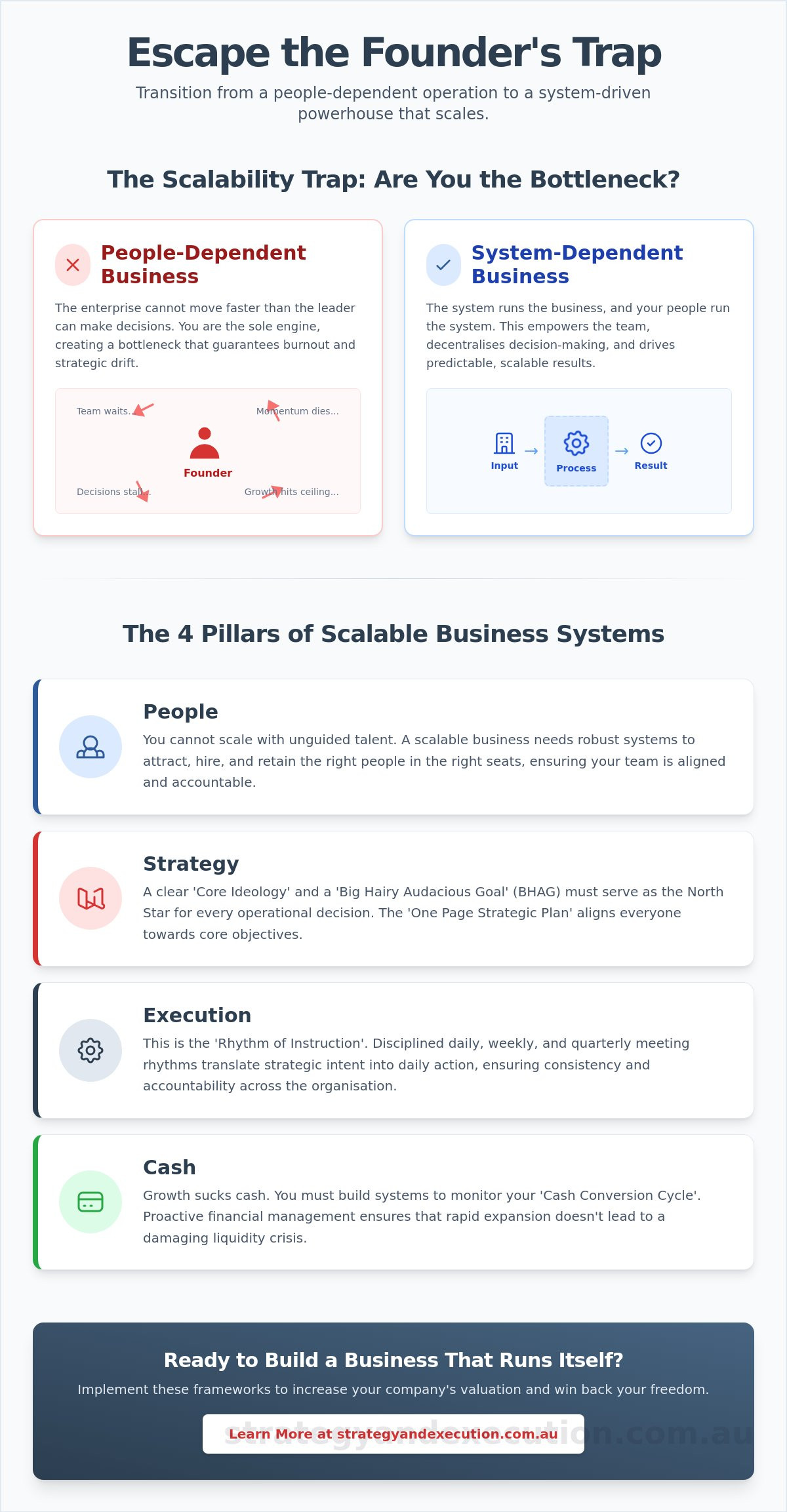
Many CEOs fall into the “Founder’s Trap.” This occurs when the enterprise cannot move faster than the leader can make decisions. It’s a recipe for stagnation. When you are the sole arbiter of quality and direction, you become the ultimate bottleneck. Your team stops thinking and starts waiting, which kills momentum and breeds a culture of dependency.
To understand how to break this cycle and build a more resilient structure, watch this brief breakdown of essential operational systems:
Australian mid-market firms often plateau at the 20 to 50 employee mark because they lack the operational excellence required to handle increased volume. They rely on “Heroic Management,” where problems are solved through sheer force of will and individual effort. Systemic Execution replaces this exhaustion with repeatable rhythms. It ensures that excellence is a product of the process, not just the person.
The E-Myth Shift: Working ON the Business, Not IN It
Transitioning to a systems-dependent model means the system runs the business while your people run the system. Implementing robust business systems for scalability is the only way to avoid the “chaos tax” that frequently erodes margins in Australian small-to-medium enterprises. The E-Myth Mastery approach focuses on building a business that can eventually thrive independently of the owner by prioritising process over personality. For Brisbane business owners still trapped in the technician’s role, working with an e-myth coach Brisbane provides the structured framework needed to make this critical transition.
Identifying Growth Constraints in Your Current Setup
Spotting “bottleneck” roles is the first step toward liberation. These are often senior positions where work goes to die because the lack of clear frameworks forces staff to seek permission for every task. Your leadership team’s primary role is to decentralise decision-making. By establishing clear execution frameworks, you empower the team to move forward without waiting for a nod from the corner office.
The 4 Pillars of Scalable Business Systems
Scaling is a discipline, not an accident. To move beyond a founder-centric model, you must implement a rigorous framework that balances four critical areas: People, Strategy, Execution, and Cash. These are the fundamental engines of your business systems for scalability. Without balance across these pillars, growth becomes lopsided and eventually unsustainable.
- People: You cannot scale with “B-players” or unguided talent. You need systems to attract, hire, and retain the right people in the right seats.
- Strategy: A scalable business requires a “Core Ideology” and a “Big Hairy Audacious Goal” (BHAG). These serve as the North Star for every operational decision.
- Execution: This is the “Rhythm of Instruction.” It ensures that your strategic intent is translated into daily action across the entire organisation.
- Cash: Growth sucks cash. You must build systems to monitor your “Cash Conversion Cycle” so that rapid expansion doesn’t lead to a liquidity crisis.
Focusing on Building Scalable Operations means moving from reactive firefighting to proactive management. It requires a commitment to structural integrity over short-term fixes.
Execution Rhythms: The Heart of Scalability
Consistency beats intensity every time. A structured Rockefeller Habits weekly meeting agenda is infinitely more powerful than a dusty 50-page SOP. These daily, weekly, and quarterly rhythms keep your team aligned and accountable. Without this pulse, your strategy is just a wish list. For those ready to institutionalise these habits, the Scaling Up Program Australia provides the definitive roadmap for high-growth execution.
Standard Operating Procedures (SOPs) That Actually Work
Ditch the “manual on the shelf” syndrome. It’s useless. Developing effective business systems for scalability requires documentation that people actually use. Apply the 80/20 rule: focus on the 20% of processes that drive 80% of your results. Use checklists, video tutorials, and visual workflows to ensure clarity and reduce the margin for error. If your current operations feel like they’re held together by sticky tape, it’s time to speak with a strategist about architecting a more durable model.
Implementing Your Scalability Framework in Brisbane and Adelaide
Theory is cheap. Execution is where most Australian businesses fail. To build business systems for scalability that actually function, you must follow a deliberate sequence of implementation. This isn’t about buying new software; it’s about installing discipline. If you attempt to systemise chaos, you simply end up with faster chaos.
The process begins with alignment. First, get your leadership team onto a single page. If your executives aren’t pulling in the same direction, your staff certainly won’t. Second, identify your execution gaps. These are the specific friction points where momentum stalls and profit leaks. Third, establish a Scaling Up implementation plan tailored to the unique economic conditions of Brisbane or Adelaide. Finally, roll out the meeting rhythms. Push accountability down the line so every employee knows exactly what success looks like each day.
Maintaining Momentum and Accountability
Discipline often fades when the initial excitement of a new strategy wears off. This is where an external strategic advisor becomes essential. They provide the objective perspective and the “tough love” needed to keep the leadership team focused on systemic growth rather than falling back into daily operations. Use “Critical Numbers” and real-time KPIs to monitor the health of your business systems for scalability. If you can’t measure the performance of a system in real-time, you aren’t managing it; you’re just guessing. For South Australian executives looking to eliminate operational waste and install repeatable processes, a structured approach to business process improvement Adelaide provides the rigorous execution framework needed to convert manual effort into autonomous, predictable growth.
Next Steps for Australian Leaders
Audit your calendar this week. Calculate how many hours you spent firefighting versus how many you spent building systems. If the ratio is skewed toward the former, your growth is capped and your valuation is stagnant. Transitioning from operator to architect requires a commitment to learning new execution frameworks. View our upcoming events for leadership alignment workshops in Brisbane and Adelaide to begin the process of building a business that thrives without your constant intervention.
Architect Your Exit from the Daily Grind
Growth without structure is simply a recipe for exhaustion. You now understand that the “Founder’s Trap” is a choice, not a necessity. By mastering the four pillars of People, Strategy, Execution, and Cash, you move from being the engine of your business to being its architect. Implementing robust business systems for scalability ensures that your company delivers consistent results regardless of your personal involvement. It’s the difference between owning a high-pressure job and owning a valuable asset.
We bring over 20 years of executive coaching experience and the expertise of Certified Scaling Up Practitioners to every engagement. Our team has delivered proven results for mid-market Australian firms looking to break through their growth ceilings and eliminate operational chaos. Don’t let strategic drift or inconsistent delivery dictate your future. Book a Strategic Review to identify your scalability gaps and start building a business that runs with clockwork precision. Your transition to a system-dependent powerhouse starts today.
Frequently Asked Questions
What is the difference between scaling and growing a business?
Growing means your expenses increase at the same pace as your revenue. Scaling is the ability to increase revenue without a proportional increase in costs. To achieve this, you must implement business systems for scalability that allow your operations to handle higher volumes through efficiency rather than just adding more staff. Growth often leads to exhaustion. Scaling leads to exponential company value.
How do I know if my business is ready for scalability systems?
You are ready the moment you become the primary bottleneck in your organisation. If every minor decision requires your approval or if service quality drops when you aren’t present, your current model has reached its limit. These are clear indicators that your enterprise is people-dependent rather than system-dependent. Strategic systems are necessary to break through the revenue plateaus common in Australian mid-market firms.
Will implementing systems make my business too rigid or bureaucratic?
Effective systems create freedom, not friction. Bureaucracy happens when you have bad processes that serve the ego rather than the outcome. Well-designed business systems for scalability remove the mental load of repetitive tasks. This allows your leadership team to focus on high-level strategy and innovation. Discipline in your execution rhythms actually provides the framework for more creative problem-solving across the entire company.
How long does it take to implement a Scaling Up framework?
True transformation is a multi-quarter commitment, not a weekend workshop. You can align your leadership team and set your first quarterly priorities within 90 days. However, fully institutionalising these habits across a firm typically takes 12 to 24 months of disciplined practice. It’s about building a new organisational muscle. Results in team accountability and clarity are usually visible within the first two meeting cycles.
Need Help Turning Strategy Into Results?
Let’s talk about your goals and how we can help you move forward with clarity and confidence.
