

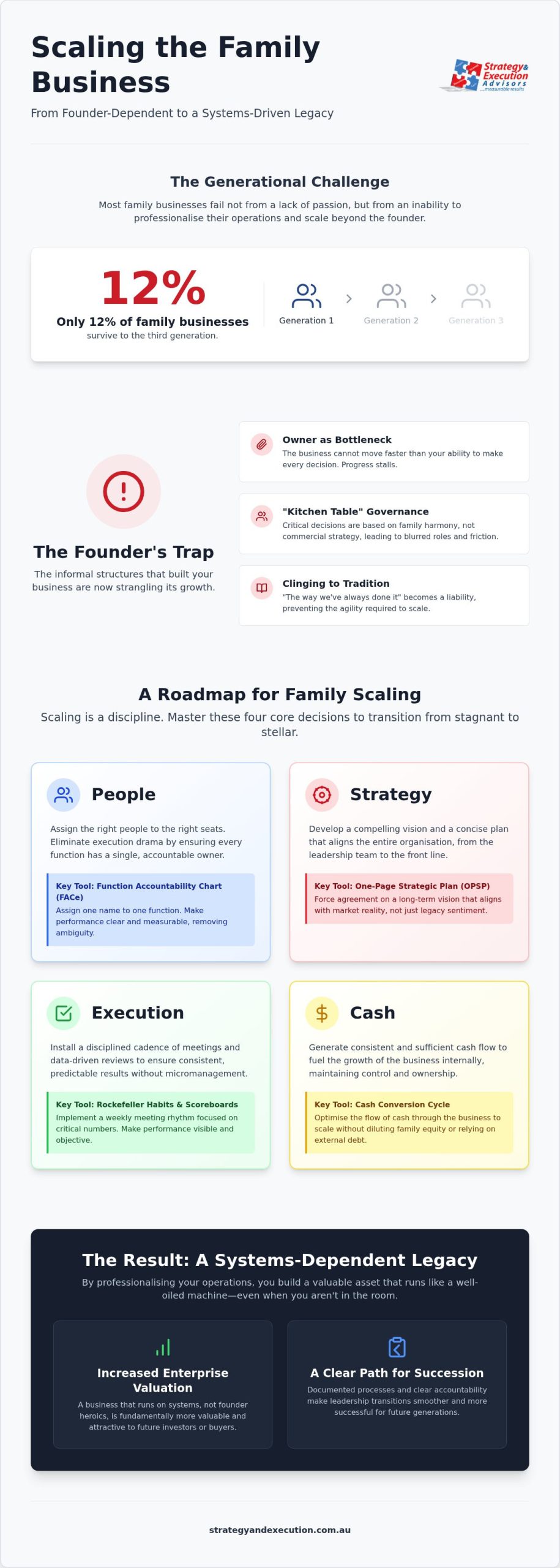
Only 12% of family businesses survive to the third generation. Most don’t fail because of a poor product or a lack of passion. They fail because they cannot bridge the gap between “kitchen table” intuition and professional execution. If you are serious about scaling up for family business success, you must recognise that what got you here won’t get you there. The informal structures that served you in the early days are now the very things strangling your progress.
You likely feel the weight of the “Founder’s Trap,” where the business cannot function without your constant intervention. It is exhausting, and it is unnecessary. You deserve a company that operates with discipline and clarity, rather than one fuelled by board meeting drama and blurred roles. This article outlines the transition from a founder-dependent shop to a high-growth “gazelle.” We will examine the proven frameworks used by over 40,000 leaders to professionalise operations, increase enterprise valuation, and ensure your business runs like a well-oiled machine, even when you aren’t in the room.
Key Takeaways
- Identify and dismantle the “Founder’s Trap” to ensure the business grows beyond the owner’s personal capacity and daily involvement.
- Transition from informal “kitchen table” management to a structured governance model that prioritises strategic growth over family harmony.
- Use the Function Accountability Chart (FACe) to assign family and non-family employees to roles based on performance rather than birthright.
- Master a One-Page Strategic Plan (OPSP) to professionalise scaling up for family business and align the entire team around a single vision.
- Build a systems-dependent organisation that increases enterprise valuation and provides a clear path for successful succession planning.
The Founder’s Trap: Why Family Businesses Struggle to Scale
Growth is a double-edged sword. While revenue might be climbing, your personal capacity remains fixed. This creates the Founder’s Trap. It occurs when the business cannot move faster than the owner’s ability to make decisions. You become the ultimate bottleneck. Every process, every sign-off, and every strategic pivot must pass through you. It’s an exhausting way to lead and a guaranteed way to stall progress.
This stagnation is often rooted in “Kitchen Table Governance.” This is where critical business decisions are made based on family harmony rather than commercial strategy. You avoid the hard conversations to keep the peace at Sunday lunch. Consequently, the business suffers. These systemic challenges in family businesses often lead to relational friction. This happens when family roles don’t match professional accountabilities. If your cousin is the Head of Sales but lacks the drive to hit targets, your business is subsidising a hobby, not building a legacy.
Tradition is another silent killer. In a rapidly evolving market, “the way we’ve always done it” is a liability. Clinging to legacy processes prevents the agility required for scaling up for family business success. You must be willing to kill your darlings to make room for systems that actually work. High-growth firms don’t rely on history; they rely on repeatable, scalable execution.
Breaking the Cycle of Reactive Management
Stop putting out fires. Reactive management is a symptom of a lack of discipline. You need a proactive rhythm of execution that demands results over excuses. This starts with “frank and fearless” feedback. In a professionalised family firm, performance is the only currency. If a family member isn’t performing, they must be held to the same standards as any other employee. No exceptions.
You must also separate the “Family” from the “Business.” Hold your family council meetings at a different time and place than your board meetings. This simple boundary reduces emotional drama and ensures that when you are in the boardroom, you are focused entirely on strategy and scale. It’s time to stop managing by consensus and start leading with intent. Professionalising your growth means putting the health of the organisation before the comfort of the individual.
The 4 Decisions Framework: A Roadmap for Family Scaling
Scaling is not a mystery; it is a discipline. To master scaling up for family business, you must get four core decisions right: People, Strategy, Execution, and Cash. These aren’t just theoretical concepts. They are the practical levers that move a business from stagnant to stellar. Most family firms fail because they focus on one while ignoring the others. This imbalance is where the soul of the business gets lost in the grind.
Start with People. Use the Function Accountability Chart (FACe) to bring order to the chaos. Many family firms have three people doing one job or one person doing three. This ambiguity creates “execution drama.” FACe assigns one name to one function. Accountability becomes clear, and performance becomes measurable. Next, align your Strategy with a One-Page Strategic Plan (OPSP). This document forces the family to agree on a long-term vision that aligns with market reality, not just legacy sentiment.
Execution is the third pillar. It requires a rigorous meeting rhythm that ensures accountability without the need for micro-management. Finally, focus on Cash. Optimise your Cash-to-Cash Conversion Cycle to fuel growth internally. This allows you to scale without diluting family equity or becoming beholden to external lenders. If you are ready to move past the kitchen table, speak with a growth strategist to begin your transition.
Professionalising the Leadership Team
Your next critical hire likely isn’t a relative. To reach the next level, you often need a non-family executive who brings objective expertise and a fresh perspective. Use a Scaling Up Implementation Plan to align this new leadership team with your core values. This shift demands new behaviours. You must prioritise the health of the enterprise over individual family egos. Professionalism isn’t about being cold; it’s about being clear.
Establishing a Cadence of Accountability
Subjective family opinions are the enemy of scale. You need objective data. Implement a Rockefeller Habits Weekly Meeting Agenda to keep everyone focused on your “Critical Numbers.” A visible Scoreboard provides the objective truth of your performance. It removes the emotion from the room and replaces it with facts. When the numbers are red, the family must address the system, not the person. This cadence builds the momentum required for sustainable growth.
Building a Systems-Dependent Legacy for Future Generations
A business that relies on the founder’s daily presence isn’t an asset; it’s a high-pressure job. To achieve true scaling up for family business, you must shift from a “family-run” operation to a “family-owned” professional organisation. This transition requires a relentless focus on systems. When your processes are documented and repeatable, the business gains a life of its own. It ceases to be a collection of individual efforts and starts to be a scalable machine that functions independently of any one person.
This is where the expertise of an E-Myth Coach Brisbane becomes invaluable. By documenting core processes, you remove the “magic” from the founder and place it into the system. This doesn’t just reduce daily friction; it radically increases your enterprise valuation. Future buyers and successors don’t pay for your personal sweat equity. They pay for a predictable engine that produces results without you. Systems-dependency is the only way to ensure a successful succession planning advisor adelaide outcome, turning the firm into a transferable legacy rather than an owner-dependent burden.
Succession as a Growth Strategy, Not an Exit
Stop viewing succession as the end of the road. It is the ultimate test of your business’s structural integrity. If you can hand over the keys and the company continues to grow, you’ve built something of real value. Preparing the next generation requires more than just “on-the-job” osmosis. It demands structured leadership development and clear accountabilities. We help facilitate this through intensive, hands-on workshops. Check Our Events for upcoming sessions on professionalising family leadership and mastering the mechanics of scale.
Securing the Family’s Financial Future
Legacy is built on financial strength. Use “The Power of One” financial levers to identify the small changes in pricing, volume, and costs that maximise cash flow for the family’s wealth. This ensures the business remains a “Gazelle”—a high-impact, high-growth firm—even during generational shifts. By applying the Scaling Up framework, you ensure the business remains a source of prosperity for decades, rather than a relic that fades once the founder steps away.
Secure Your Legacy Through Strategic Execution
Professionalisation is not a threat to your family values; it is the only way to protect them. You cannot scale while remaining the ultimate bottleneck. Transitioning from “kitchen table” management to a structured execution framework is the difference between a business that survives and one that dominates. By mastering the 4 Decisions and documenting core processes, you move beyond the “Founder’s Trap” and build a firm that functions independently of your daily presence. This shift doesn’t just reduce execution drama; it significantly increases your enterprise valuation for the next generation.
Successful scaling up for family business requires a battle-tested approach. Ted Bonel is a Certified Scaling Up Practitioner with over 20 years of “systems thinking” experience specifically tailored for Australian mid-market firms. He specialises in helping leaders move from theory to deed, ensuring the business becomes a high-growth “gazelle” rather than an owner-dependent burden. Stop managing by crisis and start leading by design. Book a strategy call with Ted Bonel today to discuss your family business scale-up plan and secure your organisation’s future. The path to a professionalised, high-value legacy starts with a single decision to act.
Frequently Asked Questions
How do I tell a family member they aren’t the right fit for a leadership role as we scale?
Base the conversation on objective data using the Function Accountability Chart (FACe). It is not a personal attack; it is a structural necessity. If the individual cannot meet the defined KPIs for that seat, they must move to a role where they can add value or step out of the operational side entirely. Protecting a family member’s ego at the expense of the company’s health is a fast track to failure.
What is the biggest mistake family businesses make when trying to implement Scaling Up?
The most common error is a lack of discipline and making “family exceptions” to the rules. Successful scaling up for family business requires a total commitment to the framework. If you allow family members to skip weekly meetings or ignore their Scoreboard targets, you undermine the entire system. Consistency is the only way to build a culture of accountability that survives generational shifts.
Can we scale our family business without bringing in external investors or debt?
You can absolutely scale internally by focusing on the Cash pillar of the framework. By optimising your Cash-to-Cash Conversion Cycle and identifying the “Power of One” financial levers, you can generate the capital needed to fund growth without diluting your equity. This approach keeps control within the family while providing the fuel necessary to transform into a high-growth gazelle without external interference.
How long does it typically take to see results from a Scaling Up implementation in a family firm?
Expect to see a shift in clarity and alignment within the first 90 days of scaling up for family business. However, fully professionalising the organisation and embedding the meeting rhythms usually takes between 12 and 24 months. Disciplined execution is a marathon, not a sprint. The goal is to build a systems-dependent legacy that outlasts the current leadership, which requires time to cement new habits.
Need Help Turning Strategy Into Results?
Let’s talk about your goals and how we can help you move forward with clarity and confidence.
