

A 50-page business plan isn’t a strategy; it’s a paperweight that breeds confusion and kills momentum. Most executive teams in Australia start the year with grand ambitions only to watch them dissolve into “execution drama” by the end of the first quarter. You’ve likely felt the frustration of a leadership team that’s busy but fundamentally misaligned. Learning how to create a one page strategic plan is the only way to stop the drift and restore high-impact focus.
This guide provides the disciplined framework to condense your entire business strategy into a single, actionable page. You’ll learn to replace complexity with a clear, visual roadmap for the next three to five years. We’ll introduce the Strategy & Execution Advisors framework to ensure complete alignment between the CEO and the executive team while establishing a rhythmic process for tracking progress. Prepare to move beyond theory and into relentless execution.
Key Takeaways
- Stop burying your strategy in 50-page binders that your team ignores. Align the Four Critical Decisions of People, Strategy, Execution, and Cash on a single, visible document.
- Discover how to create a one page strategic plan that distils your long-term vision into immediate, actionable Quarterly Rocks.
- Eliminate execution drama by implementing a disciplined meeting rhythm, including daily huddles and weekly tactical sessions.
- Ensure every element of your plan earns its place by focusing strictly on measurable outcomes rather than abstract theory.
Beyond the Dusty Binder: Why Your Business Needs a One Page Strategic Plan
Traditional business plans are bloated liabilities. They sit in dusty binders, unread and ignored, while your team drifts through the quarter without direction. A 50-page document isn’t a strategy; it’s a distraction that breeds “execution drama.” In the competitive Australian mid-market of 2026, clarity is your ultimate competitive advantage. You don’t need more pages; you need more focus.
Learning how to create a one page strategic plan (OPSP) allows you to align the Four Critical Decisions: People, Strategy, Execution, and Cash. This framework isn’t just a summary of your goals. It’s a disciplined tool that forces you to make hard choices. If a priority doesn’t fit on the page, it doesn’t belong in your business. Mastering how to create a one page strategic plan is the first step toward building a systems-dependent business that thrives without constant CEO intervention.
The Rockefeller Habits Philosophy: Simplicity at Scale
The OPSP acts as the nervous system for a Scaling Up organisation. It provides a single source of truth that every employee, from the executive suite to the warehouse, can actually understand. Without this simplicity, scale inevitably leads to chaos. By condensing your entire strategy onto one page, you eliminate the noise that hides poor performance. It moves your team from abstract theory into a rhythmic system of accountability. It’s about ensuring everyone is rowing in the same direction, with the same map, at the same time.
The 7-Column Blueprint: How to Populate Your One Page Strategic Plan
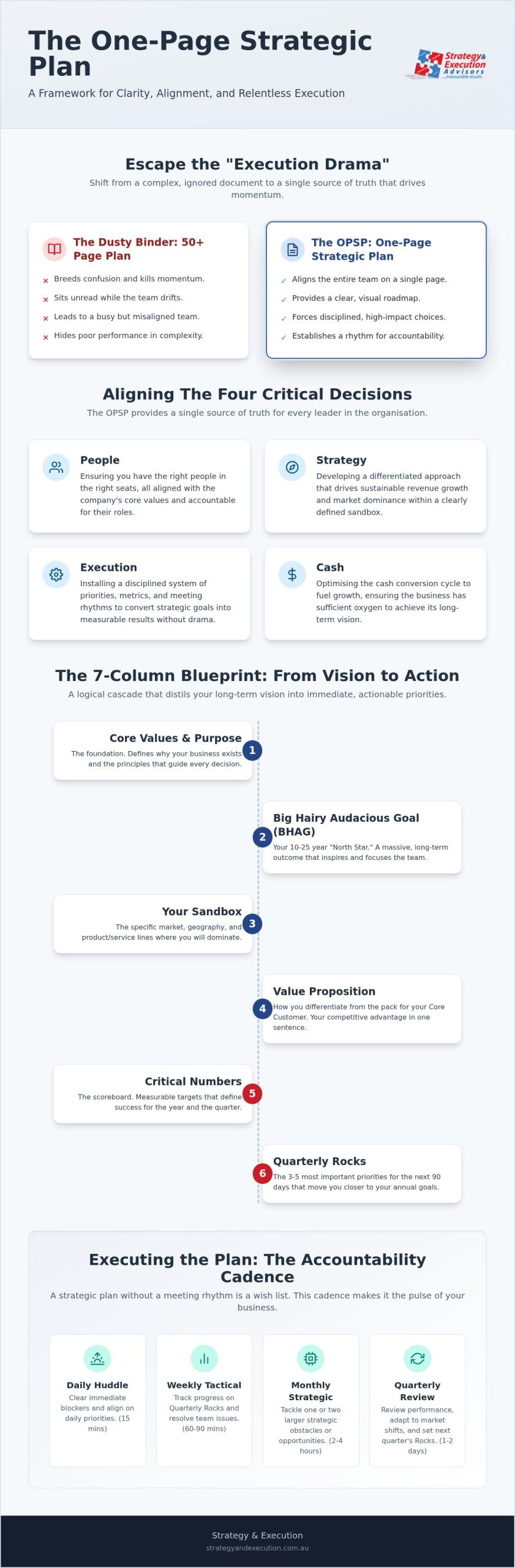
Building an OPSP isn’t a creative writing exercise; it’s a structural engineering project for your business. When you sit down to learn how to create a one page strategic plan, you must adopt a ruthless mindset. Every word on that page must earn its place. If a phrase doesn’t drive action or clarify a decision, delete it. Complexity is often just a mask for a lack of conviction. You aren’t writing a manifesto; you’re building a tool for relentless execution.
The entire plan is anchored by your Big Hairy Audacious Goal (BHAG). This is your 10-to-25-year North Star. Without a clear BHAG, your quarterly efforts are just random acts of management. It provides the necessary tension between your current state and your ultimate destination. It ensures that every short-term “Rock” is a deliberate step toward a massive, long-term outcome. If your BHAG doesn’t make your team both excited and slightly nervous, it isn’t big enough.
From Core Values to Quarterly Rocks: The Strategic Cascade
The blueprint moves through a logical cascade. It starts with your Core Values and Purpose, defining why your business deserves to exist. From there, you must define your “Sandbox”, which is the specific market, geography, and product line where you will dominate. Don’t try to be everything to everyone. Identify your Core Customer and build a Value Proposition that actually differentiates you from the pack. If you can’t describe your competitive advantage in a single sentence, you don’t have one.
Strategy is useless without measurement. You must set Critical Numbers that define success for both the year and the upcoming quarter. These numbers act as the scoreboard for your executive team. They transform abstract desires into binary outcomes: you either hit the target or you didn’t. This transparency can be uncomfortable, but it’s essential for scaling. If your team struggles with this level of accountability, it might be time to speak with a Scaling Up advisor to bridge the execution gap.
Executing the Plan: Turning Your OPSP into Measurable Results
A strategic plan without a meeting rhythm is merely a wish list. Most leaders fail because they treat the OPSP as a static document. It’s not. It’s the pulse of your business. To succeed, you must implement a rigorous cadence: the Daily Huddle for immediate blockers, the Weekly Tactical to track progress on Rocks, and the Monthly Strategic to tackle larger obstacles. This rhythm ensures the plan lives in the minds of your team rather than dying in a drawer. Knowing how to create a one page strategic plan is only half the battle; the rest is the discipline to review it constantly.
Accountability requires names, not just departments. Use the Function Accountability Chart (FACe) to link every strategic pillar on your OPSP to a specific leader. If two people are responsible, no one is. This tool exposes gaps in your leadership structure and ensures every Critical Number has an owner. It transforms the OPSP from a collective dream into a set of individual mandates that drive performance across the entire organisation.
Establishing an Accountability Cadence for Your Team
Use the “Theme” section of your OPSP to drive high-intensity focus for the quarter. A well-chosen theme aligns the team around a single measurable win and provides a reason to celebrate. However, market conditions shift. You must conduct a Quarterly Review to pivot your plan based on real-world feedback. Mastering how to create a one page strategic plan requires more than just filling out a template; it demands a cultural shift toward transparency. To ensure your plan is built on solid ground, contact Ted Bonel for a facilitated OPSP workshop and move from theory to a battle-tested system.
Master Your Strategy for 2026
Complexity is the enemy of execution. You now have the framework to strip away the noise and align your executive team behind a single, visual roadmap. Understanding how to create a one page strategic plan is the first step toward eliminating the execution drama that plagues most mid-market firms. Strategy is only as strong as the discipline behind it. Implement meeting rhythms and clear accountability so your strategy doesn’t become another forgotten binder.
Stop letting strategic drift stall your growth. As Strategy & Execution Advisors, we provide certified Scaling Up coaching and custom OPSP facilitation for leadership teams in Brisbane, Queensland, and across Australia. Our proven Rockefeller Habits systems turn abstract goals into tangible results. Book a Strategic Planning Consultation to Build Your OPSP today and take control of your organisation’s future. It’s time to transition from thought to deed.
Frequently Asked Questions
How often should we update our One Page Strategic Plan?
Update your plan every quarter to maintain momentum. While your long-term vision remains stable, the 90-day execution cycle requires fresh targets based on performance data. Annual sessions reset the one-year objectives; however, the quarterly review is where you pivot. If your plan sits untouched for six months, it’s already obsolete. Discipline requires constant calibration.
Can a complex, multi-national business really fit its strategy on one page?
Absolutely. Complexity is a reason for the OPSP, not an excuse to avoid it. Multi-national organisations use a cascading approach where each region or division develops its own plan. Learning how to create a one page strategic plan for each business unit ensures global alignment while allowing for local execution. It strips away the noise that usually hides corporate inefficiency.
Who in the company should have access to the OPSP?
Total transparency is the standard. Every employee must understand the company’s direction, values, and quarterly priorities to make effective daily decisions. While granular financial sensitivities might remain confidential, the strategic roadmap should be visible in every office. If your team doesn’t know what the “win” looks like for the quarter, they’re just trading time for money.
What is the difference between a Goal and a Rock on the OPSP?
A Goal is an annual outcome; a Rock is a 90-day priority. Rocks are the essential building blocks that drive your yearly targets toward completion. When determining how to create a one page strategic plan, you must limit your team to three to five Rocks per quarter. Overloading the plan with too many priorities guarantees that nothing of substance gets finished.
Need Help Turning Strategy Into Results?
Let’s talk about your goals and how we can help you move forward with clarity and confidence.
