

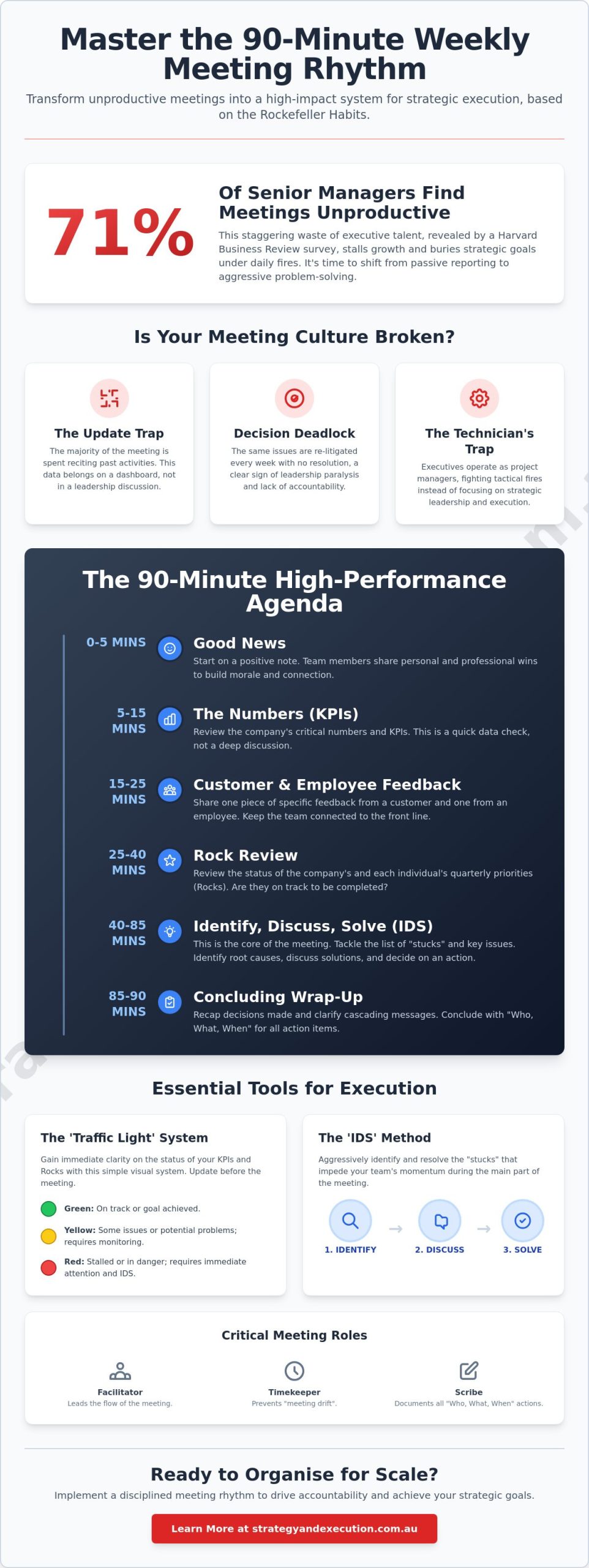
A Harvard Business Review survey revealed that 71% of senior managers find their meetings to be unproductive and inefficient. This is a staggering waste of executive talent that many firms simply accept as a cost of doing business. If your leadership team is currently drifting through the quarter with no clear alignment on your top priority, you don’t need more discussion. You need a disciplined rockefeller habits weekly meeting agenda. High-growth firms don’t leave execution to chance; they use a rigorous 90-minute rhythm to identify roadblocks and maintain momentum.
You’ve likely felt the frustration of meetings that run overtime without producing a single actionable outcome. It is a common pitfall where “stucks” remain hidden and strategic goals are buried under daily fires. I’ll show you how to master the exact weekly meeting structure used by the world’s fastest-growing companies to ensure your team stays focused and accountable. We will explore the specific segments of the Rockefeller Habits rhythm, from sharing good news to reviewing key metrics and clearing the path for your quarterly “Rocks.”
Key Takeaways
- Stop wasting time on passive reporting and pivot to a high-impact, problem-solving rhythm.
- Implement the 90-minute rockefeller habits weekly meeting agenda to maintain absolute alignment on your quarterly priorities.
- Utilise the ‘Traffic Light’ system to gain immediate clarity on the status of your KPIs and strategic Rocks.
- Adopt the ‘IDS’ method to aggressively identify and resolve the “stucks” that impede your team’s momentum.
- Recognise when to engage an external facilitator to break through legacy dysfunction and organise for rapid scale.
Mastering the Rhythm: Why Your Current Leadership Meetings are Failing
Australian mid-market businesses are bleeding capital through “meeting drift.” You see it every week. Highly paid executives sit in a boardroom for two hours, yet they leave with no clear direction and no resolved issues. This isn’t just an inconvenience; it is a strategic failure that stalls growth. Most firms use their time to report on the past. High-growth teams use it to dictate the future. You must transition from passive reporting to aggressive problem-solving to protect your margins.
The rockefeller habits weekly meeting agenda is built on the foundation of Rockefeller Habit #3: a consistent communication rhythm. This habit creates organisational momentum that competitors cannot match. While your rivals are reacting to market shifts, you are executing with precision. The principles established by John D. Rockefeller during the rise of Standard Oil were never about luck. They were about the rigorous application of systems. A strategic weekly deep-dive is the heartbeat of this system, providing a 90-minute window to align the team and clear the path for your quarterly priorities.
The Symptoms of a Broken Meeting Culture
Identify the “Circular Debate” in your firm. This occurs when the same roadblocks are discussed for months without a final decision. It is a sign of leadership paralysis. Look for these specific red flags:
- The Update Trap: Spending the majority of the session reciting past activities.
- Decision Deadlock: Re-litigating the same issues every week with no outcome.
- The Technician’s Trap: Executives operating as glorified project managers instead of strategic leaders.
Updates are the enemy of effective leadership time. If your team spends 45 minutes reciting what they did last week, you’ve already lost. That data belongs on a dashboard, not in a meeting. Many leaders fall into the technician’s trap because they focus on tactical fires instead of strategic execution. This lack of discipline ensures you stay small while your overheads grow.
Routine Sets You Free: The Rockefeller Philosophy
Discipline is often mistaken for rigidity. In reality, a standardised rockefeller habits weekly meeting agenda reduces cognitive load for your leadership team. When the structure is fixed, your brain power is reserved for solving complex business problems. Establish a “same time, same place” rule and stick to it. This consistency is non-negotiable. A reliable rhythm prevents the need for disruptive ad-hoc “emergency” meetings that break your team’s focus. When everyone knows that “stucks” will be addressed every Tuesday morning, the urge to interrupt the flow of work vanishes. This is how you organise for scale and ensure your strategy actually turns into results.
The Rockefeller Habits Weekly Meeting Agenda: A 90-Minute Framework
Execution is a discipline. Discipline requires time. Many leadership teams fail because they attempt to cram strategic alignment into a sixty-minute window. This is a mistake. The “Golden 90” is the non-negotiable standard for high-growth firms. Sixty minutes allows for little more than a status update, which belongs on a dashboard, not in the boardroom. The full 90-minute rockefeller habits weekly meeting agenda provides the space required to move beyond surface-level reporting and into deep, strategic problem-solving. Designing an effective meeting agenda is the first step toward reclaiming your executive team’s productivity and ensuring your quarterly goals remain on track.
Preparation is the prerequisite for performance. Before the meeting starts, every leader must complete a “Pulse” check. This involves updating their KPIs and Rock status in your tracking system. Do not waste time during the meeting on data entry. Assign three critical roles to maintain order: the Facilitator to lead the flow, the Timekeeper to prevent “meeting drift,” and the Scribe to document every “Who, What, When” action item. If your team continues to struggle with moving from talk to action, you may need to speak with a certified advisor to reset your execution framework.
The Agenda Breakdown: Minute by Minute
Structure creates freedom. Follow this strict timing to ensure every minute delivers a return on investment:
- 0-5 mins: Good News. Share one personal and one professional win. This builds trust and shifts the team’s mindset from “defence” to “offence.”
- 5-15 mins: The Numbers. Review the scoreboard. If a KPI is “Red,” do not solve it yet. Simply identify it.
- 15-25 mins: Feedback. What are your customers and employees saying? This provides the “ground truth” often missing at the executive level.
- 25-85 mins: The Deep Dive. This is the engine room of the rockefeller habits weekly meeting agenda. Use this hour to solve one or two major strategic “stucks” that are preventing progress.
Closing with Clarity: The One-Word Close
The final five minutes are as important as the first. Spend minutes 85 to 90 summarising the “Who, What, When” actions. Every attendee must leave the room with absolute clarity on their number one priority for the coming week. Ambiguity is the primary cause of strategic drift. Finish with the “One-Word Close.” Each person shares a single word that describes their current emotional state or their takeaway from the session. This provides the Facilitator with an immediate gauge of team alignment. If the words are “focused” or “clear,” you have succeeded. If they are “confused” or “overwhelmed,” you have identified a problem that must be addressed immediately.
Tracking the Scoreboard: KPIs and Quarterly Rocks
Strategy without execution is merely a hallucination. To ensure your long-term vision becomes a reality, you must align every rockefeller habits weekly meeting agenda with your One-Page Strategic Plan (OPSP). The weekly rhythm is where the high-level strategy meets the operational pavement. If your OPSP defines where you are going, your weekly scoreboard tells you if you are actually moving the needle. High-growth firms don’t guess; they measure. This alignment prevents the strategic drift that often plagues mid-market companies as they attempt to scale. A rigorous scaling up implementation plan ensures your weekly rhythm connects directly to your long-term growth targets and prevents the execution crisis that derails so many ambitious Australian firms.
Data is the only antidote to corporate delusion. Utilise a “Traffic Light” system for absolute clarity: Green means you are on track, Amber suggests a risk, and Red signals a critical failure. There is no room for “sort of” or “mostly” in a high-performance culture. You must also prioritise leading indicators over lagging financial data. Revenue is a ghost of decisions made months ago. Leading indicators, such as sales activity or production efficiency, are the levers you can pull today to change tomorrow’s results. This relentless focus ensures the leadership team never loses sight of the “Big Rock,” which is the primary quarterly priority that determines your success.
Visualising Progress for the Leadership Team
Your scoreboard must be visible and visceral. Whether you use digital dashboards or a physical board in the boardroom, the data must be updated before the meeting starts. Wasting ten minutes of executive time watching someone log into a portal is a failure of discipline. This real-time visibility allows you to link weekly activities directly to your Scaling Up program Australia goals. When the team can see the direct correlation between their daily output and the firm’s strategic milestones, accountability becomes self-sustaining and transparent.
Employee and Customer Pulse
The boardroom can easily become an echo chamber. To prevent this, you must integrate the “Voice of the Customer” into your tactical discussions. Share specific feedback from the front lines every week. This isn’t about anecdotal stories; it is about identifying patterns. If three customers mention the same friction point, it’s a systemic issue, not a one-off complaint. Similarly, tracking employee pulse allows you to spot morale dips before they transform into turnover crises. This qualitative data provides the necessary context for the Deep Dive section of your agenda, ensuring you are solving the right problems rather than just chasing symptoms. If you find your team is constantly “Red” on these pulses, it may be time to reassess your organisational design and accountability systems.
The Stucks and Accountability: Dealing with the ‘Red’ Status
A “Stuck” is any roadblock preventing a KPI or strategic Rock from being “Green.” In a high-performance culture, “Red” status is not a mark of shame; it is a signal for the team to mobilise. Hiding a roadblock is a fireable offence because it compromises the entire firm’s momentum. The rockefeller habits weekly meeting agenda provides the structure to bring these issues to light before they become terminal. You must foster a “no-blame” environment that simultaneously demands absolute individual accountability. If a leader is “Red,” they must own it and present a plan to resolve it with direct honesty. To further support this shift in leadership culture, you can discover Alfredo Bala (The Motivation Guy) and his strategic insights for team development.
The “IDS” method, Identify, Discuss, and Solve, is your primary tool for clearing the path. Most leadership teams spend 80% of their time discussing symptoms and only 20% on the actual problem. Flip this ratio. Spend the majority of your time identifying the root cause. If your team is consistently failing to clear “Red” statuses, your execution systems are likely broken. You may need to engage a strategy execution advisor to help your team master the discipline of closing the accountability loop and maintaining strategic focus.
Effective Problem Solving in the Deep Dive
Facilitators must be ruthless with the clock. If a discussion wanders into a tangent, kill it immediately. The Deep Dive is for solving strategic “stucks,” not for general updates or venting. Ensure the loudest voice in the room does not dominate the session; silence the extroverts to hear from the quietest strategist. The 5 Whys technique involves asking “why” five times in succession to strip away superficial symptoms and reveal the fundamental systemic root cause of a roadblock.
The Accountability Loop
Precision is the hallmark of elite execution. Every decision made during the rockefeller habits weekly meeting agenda must be recorded as a “WWW”: Who, What, and When. If an action item does not have a specific owner and a hard deadline, it does not exist. Review the previous week’s WWW list at the start of every meeting. If items are left incomplete without a valid “stuck” being raised, you are facing a performance issue. Recurring stucks often signal a systemic business failure that requires a structural redesign. Stop accepting excuses and start demanding results.
Scaling Up in Australia: Implementing the Rhythm for 2026
High-growth firms in Brisbane and Adelaide are already adapting these habits to navigate shifting local market conditions. You cannot rely on outdated management styles in a 2026 economy. The rockefeller habits weekly meeting agenda is the global standard, but its application must be tailored to your specific operational environment. A manufacturing firm in Adelaide requires different KPI focuses than a professional services firm in Brisbane. However, the underlying discipline of the 90-minute rhythm remains the same. Audit your current meeting culture now. If you aren’t resolving at least two major strategic “stucks” every week, your rhythm is failing you.
Breaking old, dysfunctional meeting habits is difficult for any internal team. Most leadership groups are too close to their own internal politics to self-correct effectively. This is where an external facilitator becomes essential. They provide the authoritative perspective required to stop the circular debates and enforce the 90-minute limit. Once your leadership team masters this discipline, you must cascade the rhythm. Transition from a single leadership meeting to departmental weekly meetings across the entire organisation. This ensures every employee, from the front line to the back office, is aligned with the firm’s strategic “Rocks.”
Local Expertise for Queensland and South Australian Leaders
Leverage the expertise at Strategy & Execution to coach your team through the critical first 90 days of implementation. We help you customise the Rockefeller framework to suit your specific industry dynamics, whether you are managing complex supply chains or high-value consultancy teams. Don’t wait for the start of a new financial year to fix your execution. Organise your first “Habit-Aligned” weekly meeting this month to identify the roadblocks that are currently eroding your margins.
The Path to Execution Excellence
The weekly rhythm is not an island. It is the fuel for your Monthly and Quarterly planning sessions. When your team meets every seven days with absolute discipline, they begin to self-correct. They no longer wait for permission to solve problems because the rockefeller habits weekly meeting agenda demands immediate resolution and clear accountability. This is how you build a business that is systems-dependent rather than owner-dependent. Take the next step toward organisational mastery. Book a Scaling Up workshop in Brisbane to master your execution and secure your firm’s growth for 2026 and beyond.
Reclaiming Your Strategic Momentum
Success is not a product of luck; it is the result of relentless execution. By implementing a disciplined rockefeller habits weekly meeting agenda, you move your leadership team from passive reporting to active problem-solving. This shift ensures your primary quarterly priorities remain the focus, rather than being buried under daily fires. You’ve seen how the “Golden 90” framework and the “IDS” method clear the path for rapid scale. Now, the choice is yours: continue with the drift of unproductive meetings or commit to a proven system of accountability.
Ted Bonel is a Certified Scaling Up Practitioner with over 20 years of strategic execution experience. He has a proven track record of helping mid-market firms in Brisbane and Adelaide achieve measurable growth through structural integrity and operational excellence. Don’t leave your 2026 results to chance. Scale your business with the Rockefeller Habits—contact Ted Bonel today. It’s time to stop talking about growth and start executing the systems that make it inevitable. Your team is ready for the clarity that only a rigorous rhythm can provide.
Frequently Asked Questions
How long should a Rockefeller Habits weekly meeting actually last?
A standard rockefeller habits weekly meeting agenda requires exactly 90 minutes to be effective. Sixty minutes is insufficient for anything beyond basic reporting; it leaves no room for the strategic deep dive required to solve complex organisational issues. High-growth firms protect this “Golden 90” to ensure the leadership team moves beyond symptoms and addresses root causes. If you find yourself finishing early, you aren’t digging deep enough into your strategic “stucks.”
Who should facilitate the weekly leadership team meeting?
What is the difference between a daily huddle and a weekly meeting?
The daily huddle is a 15-minute tactical pulse check focused on the next 24 hours, whereas the weekly meeting is a 90-minute strategic alignment session. Huddles are about “what is happening,” while the weekly meeting is about “why we are stuck” and “how we solve it.” Mixing these rhythms is a common mistake that leads to strategic drift. Keep your daily sessions brief and save the deep, analytical discussions for your weekly 90-minute slot.
How do we handle team members who don’t update their KPIs on time?
Updating KPIs before the meeting is a non-negotiable requirement for participation. If a leader arrives with an un-updated scoreboard, they are disrespecting the team’s time and stalling the firm’s momentum. Address this immediately as a performance and accountability issue rather than a technical one. A “Red” status is acceptable; an “Unknown” status due to missing data is a failure of leadership discipline that must be corrected with direct honesty.
Can we run a Rockefeller weekly meeting with a remote or hybrid team?
Yes, provided you utilise a centralised digital scoreboard and insist on a “cameras-on” policy to maintain engagement. Remote teams must be even more disciplined with the rockefeller habits weekly meeting agenda to compensate for the lack of physical presence. Use breakout rooms for the Deep Dive if your team is large, but ensure everyone returns to the main room for the One-Word Close. Physical distance is no excuse for a lack of strategic alignment.
What if we have more than two ‘Deep Dive’ topics to discuss?
Prioritise the two issues that have the greatest impact on your quarterly “Rocks” and move the others to the next week. Attempting to solve five problems in one session ensures you solve none of them effectively. If an issue is truly urgent and cannot wait seven days, schedule a separate “Council Meeting” specifically for that topic. The weekly rhythm must remain focused on the most critical roadblocks to prevent the team from becoming overwhelmed by tactical noise.
How often should we review the meeting agenda itself for effectiveness?
Review your meeting effectiveness at the end of every quarter during your strategic planning session. Ask the team if the current rhythm is identifying “stucks” early enough and if the Deep Dive sessions are actually resulting in resolved issues. If the meetings feel like a chore rather than a tactical strike, you likely need to reset your facilitation or tighten your data requirements. Constant refinement is necessary to maintain a high-performance execution culture.
Should we invite guest speakers or other staff to the leadership weekly?
Rarely, if ever. The leadership weekly is a high-trust environment designed for candid, sometimes difficult, strategic discussions. Inviting guests or junior staff can stifle this candour and turn a productive session into a performance. If you need specific data from a departmental head, have them submit it beforehand or join for a specific 10-minute feedback segment only. Protect the integrity of the leadership room to ensure absolute honesty in every Deep Dive.
Need Help Turning Strategy Into Results?
Let’s talk about your goals and how we can help you move forward with clarity and confidence.
