

If your business requires your daily presence to survive, you don’t own an asset; you own a high-stress job that has officially hit its limit. You’re likely clocking 60-plus hours a week, battling relentless decision fatigue, and harbouring a quiet fear that the entire operation would collapse if you took a month off. Building owner-independent business isn’t about “stepping back” or “letting go” in a vague, emotional sense. It’s about the rigorous installation of execution frameworks that replace your intuition with team-led discipline.
We recognise that growth often plateaus because the founder is maxed out. This guide provides the exact strategic architecture required to transition from a founder-reliant operation to a self-sustaining enterprise. You’ll learn how to leverage 2026’s hyperautomation trends and agentic AI workflows to buy back your time and increase your business valuation for an eventual exit. We’ll detail the shift from being the primary problem-solver to becoming the architect of a high-performing team that takes initiative without your prompting.
Key Takeaways
- Identify the “Gilded Cage” where profit depends on your 60-hour week and learn how to decouple EBIT from your personal input.
- Building owner-independent business requires the Scaling Up framework to ensure you have the right people in the right seats.
- Apply E-Myth Mastery principles to treat your business as the product, focusing on the “Critical Few” processes that drive 80% of results.
- Establish a communication rhythm, including a 15-minute Daily Huddle, to eliminate ad-hoc interruptions and align your team on a Critical Number.
- Transition from a founder-reliant operation to a scalable enterprise by installing rigorous execution discipline over abstract theory.
The Founder’s Trap: Why Your Indispensability is a Strategic Risk
Stop lying to yourself about the strength of your company. If your daily presence is the only thing keeping the gears turning, you haven’t built a business; you’ve built a gilded cage. Many profitable Australian enterprises fall into this trap, where the founder works a 60-hour week just to maintain the status quo. This is the definition of owner-dependency, and it is a terminal risk to your long-term growth. Building owner-independent business requires a fundamental shift in perspective. You must define success as an entity where EBIT and growth are entirely decoupled from your personal daily input.
The test for this is brutal but necessary. If you cannot take a 30-day holiday without checking your email or answering “quick questions,” you own a job, not an asset. In the Australian mid-market, this lack of autonomy slashes your business valuation. Sophisticated buyers don’t pay for your intuition or your personal relationships; they pay for predictable, repeatable systems that function regardless of who is in the CEO chair. Your indispensability is not a badge of honour. It is a strategic liability that prevents you from scaling.
The Psychology of the Bottleneck
Most founders suffer from a “Hero Complex.” It feels good to be the primary problem solver. It’s rewarding to have the team come to you for every major decision. However, this “Command and Control” leadership style fails the moment you scale past 10 employees. You become the bottleneck through which every piece of progress must pass. To scale, you must abandon the role of the hero. The evolution of a leader requires a permanent shift from being the Chief Problem Solver to becoming the Chief Architect of the system.
For consumer-facing brands, this transition is particularly vital; Founder Freedom offers a dedicated coaching path for B2C founders ready to step out of the daily grind and into a strategic leadership role.
Valuation and the Exit Reality
Australian acquirers are currently aggressive, but they are also disciplined. They heavily discount businesses where “Tribal Knowledge” resides solely in the founder’s head. When knowledge isn’t documented, it doesn’t exist to a buyer. This is where rigorous business process management (BPM) becomes essential. By documenting and improving your workflows, you transform “the way we do things” into a tangible asset.
In the Scaling Up framework, this transition directly impacts your “Cash” decision. An owner-independent business generates better cash flow because decisions are made faster and closer to the customer. For Brisbane SMEs, preparing for a lucrative exit starts years before the sale. It begins the moment you decide that building owner-independent business is your primary strategic objective. You aren’t just selling a service; you are selling a machine that produces results without you.
The Four Decisions Framework: Building the Pillars of Autonomy
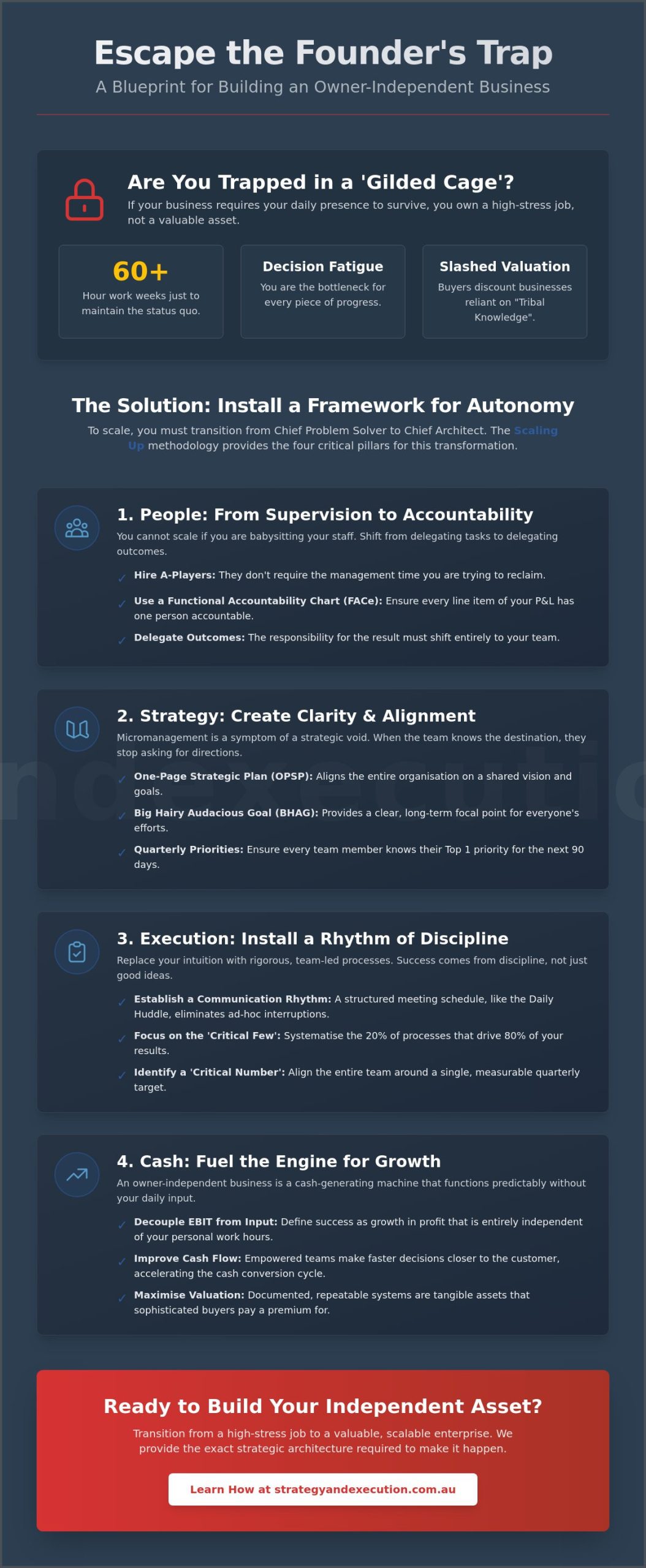
Scaling Up is not merely a growth tool; it is a rigorous framework for liberation. To move beyond the Founder’s Trap, you must install a structural backbone that survives your absence. This methodology centres on four critical pillars: People, Strategy, Execution, and Cash. Building owner-independent business requires you to stop “working hard” and start architecting these systems with surgical precision. If your business lacks this clarity, growth will always be capped by your personal bandwidth.
People: Moving from Supervision to Accountability
You cannot scale if you are babysitting your staff. There is a fundamental difference between delegating tasks and delegating outcomes. When you delegate a task, you remain the owner of the result. When you delegate an outcome, the responsibility shifts entirely. We use the Functional Accountability Chart (FACe) to remove ambiguity. Every line item in your P&L must have one person, and only one person, accountable for its success. Hiring A-Players is non-negotiable for owner-independence because B-Players require the very management time you are trying to reclaim. If you find yourself constantly correcting work, you have a talent problem, not just a process problem.
This talent gap often includes professional communication; for businesses with a global outlook, you can discover English Explorer to equip your staff with the Business English proficiency needed for high-level accountability.
Strategy: The Power of the One-Page Strategic Plan
Micromanagement is usually a symptom of a hidden strategic void. If your team doesn’t know where the company is going, they will default to asking you for direction every hour. The One-Page Strategic Plan (OPSP) aligns the entire organisation around a shared vision and a Big Hairy Audacious Goal (BHAG). This document ensures every staff member knows their Top 1 priority for the quarter. When everyone understands the strategies for scaling operational processes, they can make autonomous decisions that align with the long-term objective. This clarity allows you to step out of the daily “what now?” conversations and focus on high-level architecture.
Execution and Cash provide the final layers of security. Implementing the Rockefeller Habits ensures that accountability is a rhythm, not a random event. Meanwhile, a focus on Cash ensures the business has the liquidity to scale without your personal guarantee. Building owner-independent business is a matter of discipline, not luck. If you are ready to stop being the centre of every decision, exploring Scaling Up programs can provide the execution discipline your Brisbane enterprise needs to thrive independently.
Systematising Operations: Replacing Tribal Knowledge with Process
Your business is not the service you deliver to the market. It is the engine that produces that service. If that engine requires your constant manual adjustment to function, it is poorly designed. Building owner-independent business demands that you apply E-Myth Mastery principles: the business is the product, not the service itself. You are an architect, not a mechanic. You must identify the “Critical Few” processes that drive 80% of your results and turn them into repeatable systems.
Founder intuition is a scaling killer. It is invisible, unteachable, and non-transferable. When “the way we do things” only exists in your head, you are the ultimate bottleneck. Documenting Standard Operating Procedures (SOPs) is not about creating a dusty manual. It is about capturing the high-performance DNA of your company so that a team of A-Players can execute without your intervention. This is how you move from a founder-reliant operation to a scalable enterprise.
The E-Myth Shift: Working ON the Business
Most founders are stuck in “Technical” work, performing the tasks they are best at rather than building the systems to handle them. You must distinguish between Technical, Managerial, and Entrepreneurial roles. Systematising does not require a bureaucratic nightmare of paperwork. Use digital tools and rapid video capture to document workflows in real-time. This allows for immediate process capture without slowing down your momentum. Focus your energy on working ON the business, creating the blueprints that others will follow.
Exponential Systems for Modern Scaling
In 2026, manual monitoring is obsolete. We leverage ExO (Exponential Organisation) attributes like Dashboards and Algorithms to maintain oversight without physical presence. These systems provide real-time data that replaces the owner’s “gut feel” with objective truth. By implementing these technological layers, you can 10x your output without 10x-ing your personal stress levels. A data-driven business is a manageable business. Building owner-independent business means trusting the data and the systems you have built to monitor it, allowing you to lead from a strategic distance rather than the trenches.
Establishing the Execution Rhythm: 5 Steps to Team Autonomy
Independence is not a state of being; it is a result of structural discipline. You cannot expect a team to act autonomously if they are constantly waiting for your input or reacting to your ad-hoc interruptions. Building owner-independent business requires a communication rhythm that replaces chaos with predictability. This rhythm ensures that information flows without you acting as the central switchboard. By installing these five specific steps, you move from managing people to managing the system.
- Step 1: The Daily Huddle. A 15-minute standing meeting to clear bottlenecks and align on the day’s Critical Number.
- Step 2: The Weekly Meeting. A 60 to 90 minute session to review KPIs and solve one “stuck” strategic issue.
- Step 3: Monthly Management Review. A deep dive into the P&L and progress against the One-Page Strategic Plan.
- Step 4: Quarterly Planning. Resetting priorities and defining “Rocks” for the next 90 days.
- Step 5: Annual Strategy. Reframing the long-term roadmap and refining the BHAG.
The Daily Huddle: Eliminating the “Quick Question”
The “quick question” is a productivity killer. It forces you back into the trenches and prevents your team from thinking for themselves. A 15-minute daily huddle solves this by providing a dedicated forum for alignment. Every team member, whether in a Brisbane office or working remotely, must answer three questions: What’s up? Where am I stuck? What is my number one priority for today? This creates immediate visibility. It allows the team to resolve issues amongst themselves before they ever reach your desk. If you want to install this level of discipline, consider our Rockefeller Habits coaching to get started.
KPIs and Dashboards: Trust but Verify
You cannot lead what you do not measure. Autonomy requires transparency, which is why leading indicators are essential. These are the metrics that predict success before the month ends, rather than lagging indicators that merely report on the past. We utilise a Red/Yellow/Green reporting system for instant status updates. Green means on track. Yellow indicates a warning. Red signifies a failure that requires intervention. As the owner, your rule is simple: only intervene when a metric is Red. This discipline protects your time and forces the team to own the “Green” results without your constant oversight. Building owner-independent business is only possible when the data, not the founder, provides the primary source of truth.
Strategy & Execution: Your Partner in Building an Independent Asset
Strategy & Execution serves as a catalyst for founders who are ready to stop being the bottleneck. We don’t offer generic advice or “quick fixes.” We install the Scaling Up framework with a direct, results-oriented approach that demands discipline. Building owner-independent business is a rigorous process that requires moving beyond the “Hero Complex” to become a true leader. We provide the “tough love” and strategic reassurance needed to move your organisation from thought to deed.
Our E-Myth Mastery and Leadership Development programs facilitate your transformation from a “Doer” to a “Leader.” We challenge you to build a business that functions as a product, not just a service. This means installing systems that allow for high performance without your direct intervention. In the 2026 landscape, this involves moving your enterprise into the “Exponential” category by leveraging ExO principles to increase your impact without increasing your stress. We focus on structural integrity and tangible outcomes to ensure your business is a sellable asset.
Why a Local Brisbane Scaling Up Coach Matters
The Australian mid-market presents unique regulatory and competitive pressures that require local expertise. A Brisbane-based coach understands the nuances of our market, from navigating the latest tax reform credits to managing regional talent dynamics. We offer on-site workshops and hands-on implementation support that generic, remote consultants cannot match. Our history includes battle-tested case studies of Australian businesses that achieved owner-independence through the Rockefeller Habits. These companies didn’t just survive; they thrived by adopting a culture of accountability and measurable progress that persists even when the founder is absent.
Next Steps: The Scalability Audit
The first step to freedom is a blunt, honest assessment of your current state. You must diagnose where your “Four Decisions”-People, Strategy, Execution, and Cash-are failing to support your growth. Most founders find that their business has plateaued because they haven’t yet built the systems to survive their own absence. If you are ready to stop being the centre of every problem and start building owner-independent business, it is time for a diagnostic. Book a Strategic Review with Ted Bonel today to start your transition toward a self-sustaining, scalable enterprise.
Architect Your Exit and Reclaim Your Time
Your indispensability is the greatest threat to your company’s future value. We’ve established that building owner-independent business requires more than just delegation; it demands the installation of a rigorous execution rhythm and the Four Decisions framework. You must transition from the Chief Problem Solver to the Architect of a self-sustaining system. It’s not a theoretical exercise. It’s a strategic necessity for any Australian mid-market leader who wants to scale without burning out or sacrificing their eventual exit valuation.
The roadmap for 2026 is clear. Replace tribal knowledge with documented processes and swap ad-hoc interruptions for a disciplined meeting rhythm. As a Certified Scaling Up Practitioner with 20-plus years of executive execution experience, I specialise in driving this exact transition for Australian enterprises. We provide the “tough love” and structural expertise required to turn your business into a high-performing asset that thrives in your absence. Don’t let your growth plateau because you’re maxed out.
Scale your business and reclaim your freedom-Work with a Scaling Up Coach
The path to freedom starts with a single decision to stop being the bottleneck. Take the lead today.
Frequently Asked Questions
What is the first step to making a business owner-independent?
The first step is acknowledging that you are the primary bottleneck in your organisation. You must conduct a rigorous audit of your daily tasks to identify where “Founder Intuition” is stalling progress. Building owner-independent business begins by documenting these intuitive decisions and turning them into repeatable processes. Without this initial shift in your own behaviour, no amount of external framework will stick.
How long does it take to build an owner-independent business?
Expect a timeframe of 12 to 24 months for a complete transition. While you will see immediate relief after installing a Daily Huddle, true independence requires multiple cycles of quarterly planning to embed new habits. This is a journey of cultural transformation and structural reinforcement. It takes time to move from a founder-reliant model to a self-sustaining enterprise that functions without your manual oversight.
Can a service-based business really run without the founder?
Absolutely. Service-based businesses often struggle because the founder is perceived as the “product.” You must apply E-Myth Mastery principles to systematise your service delivery so it becomes a repeatable machine. By documenting the “Critical Few” processes, you ensure that your team can deliver high-quality results without you. Your expertise must be codified into the system rather than remaining locked in your head.
What are the Rockefeller Habits and how do they help with independence?
The Rockefeller Habits are ten essential execution disciplines that create a predictable rhythm in your organisation. They focus on alignment, data, and communication. By installing these habits, you replace ad-hoc interruptions with structured meetings like the Daily Huddle. This rhythm provides the team with the clarity they need to make decisions autonomously, which is a cornerstone of building owner-independent business.
Do I need to hire an expensive management team to achieve this?
No. Achieving independence is about the quality of your people and the clarity of their roles, not the size of their salaries. You need A-Players who are accountable for specific outcomes rather than just performing tasks. Use a Functional Accountability Chart (FACe) to ensure the right people are in the right seats. Clarity of accountability often eliminates the need for redundant, expensive middle management.
How does owner-independence affect the sale price of my business?
Owner-independence is the single biggest driver of your business valuation multiple. Australian acquirers discount businesses that cannot function without the founder because the risk of collapse after the sale is too high. A business that runs on systems and a disciplined team is a transferable asset. By removing yourself from daily operations, you transform a high-stress job into a lucrative investment that commands a premium price.
Is Scaling Up better than EOS for building an independent company?
Scaling Up provides a more robust framework for mid-market companies aiming for exponential growth. While EOS is effective for smaller teams, Scaling Up goes deeper into Strategy and Cash. It offers a more comprehensive toolkit for leaders who need to manage complex operations and international scaling. For businesses that have outgrown basic management systems, the Scaling Up methodology provides the necessary rigour to achieve true autonomy.
Need Help Turning Strategy Into Results?
Let’s talk about your goals and how we can help you move forward with clarity and confidence.
