

Your business isn’t a scalable asset if it requires your constant presence just to survive. If every minor decision still lands on your desk, you’ve built a bottleneck, not a company. Most Australian leaders mistake frantic activity for progress, but real growth begins with creating standard operating procedures (sops) that liberate the founder from the daily grind.
You’re likely tired of watching quality fluctuate across different team members or spending your weekends re-explaining tasks that should have been mastered months ago. It’s a common frustration, but it’s one that ends with disciplined documentation. This guide will show you how to pivot from a person-dependent model to a systems-dependent powerhouse that scales predictably. We’ll break down the professional framework needed to organise high-value, exit-ready operations that run with clinical precision. It’s time to stop fighting fires and start building an organisation that functions without you.
Key Takeaways
- Define the “best known way” to perform every business function and eliminate the owner-dependency that stunts your growth.
- Master the 5-step framework for creating standard operating procedures (sops) by prioritising the “Critical Few” processes that drive your results.
- Learn to map workflows visually before writing a single word of text to ensure your systems are clear, actionable, and adopted.
- Move beyond “one-and-done” manuals by integrating your SOPs into a weekly execution rhythm for constant operational improvement.
- Build a high-value, exit-ready company that functions with clinical precision regardless of who is in the office.
Beyond the Manual: Why Creating Standard Operating Procedures is Critical for Scale
A Standard Operating Procedure (SOP) is not a dusty manual sitting on a shelf. It is the documented, “best known way” to perform a specific business function. Without it, you aren’t leading; you’re babysitting. In Queensland, we often suffer from a “tall poppy” mentality that shies away from rigid structure, fearing it kills creativity or culture. The opposite is true. Lack of structure kills growth. If you want to scale, you must move beyond the amateur stage of “winging it” and commit to creating standard operating procedures (sops) that ensure consistency across your entire team.
“If your business stops when you go on holiday, you don’t have a business; you have a job.” This blunt reality check is the catalyst for moving toward a systems-dependent business. It is about building an engine that runs without your constant, direct input. True leadership is about designing the machine, not being a cog within it.
To better understand how to build these systems effectively, watch this breakdown of the process:
The Link Between SOPs and Business Valuation
Documented processes are a massive de-risking tool for potential buyers or successors. A business that relies on the owner’s “secret sauce” or individual intuition is inherently risky and often worthless to an outsider. By codifying your operations, you create a transferable asset that retains its value regardless of who is at the helm. This is a critical pillar of succession planning in Brisbane. If you can’t hand over a clear manual of operations, you aren’t selling a business; you’re selling a headache.
SOPs as the Foundation of Execution Discipline
Execution drama is the friction caused by team members guessing how to do their jobs. It leads to errors, expensive rework, and leadership frustration. Within the Scaling Up framework, SOPs support the “Execution” decision by providing the structural integrity needed to achieve quarterly goals. When everyone follows the same proven playbook—integrating the sales training and coaching from Just Go Sell to drive consistency—you eliminate the variance that destroys profit. Discipline is the bridge between a bold strategy and a tangible result. It requires the courage to document what works and the accountability to ensure it is followed every single time.
The 5-Step Framework for Writing Effective SOPs That Actually Get Used
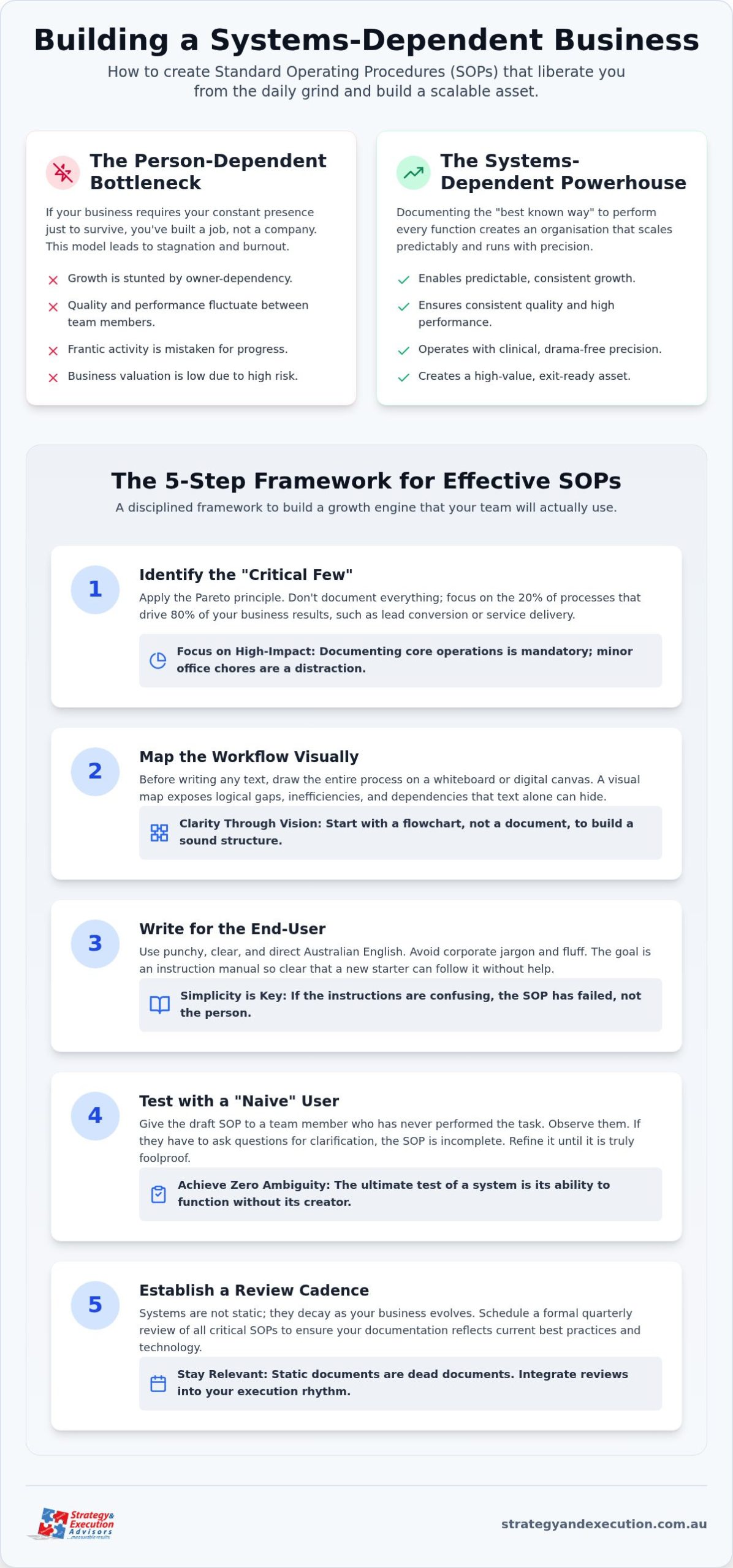
Most leaders fail at creating standard operating procedures (sops) because they attempt to document every minor task at once. This results in a bloated, unusable library that your team will eventually ignore. Discipline requires you to prioritise utility over volume. If a system isn’t easy to follow, it isn’t a system; it’s a hurdle. Follow this rigorous 5-step framework to build a growth engine that actually functions.
- Step 1: Identify the “Critical Few”: Apply the Pareto principle. Focus on the 20% of processes that drive 80% of your results. Documenting your lead conversion or service delivery is mandatory; documenting minor office chores is a distraction.
- Step 2: Map the Workflow Visually: Do not start with text. Draw the process on a whiteboard or digital canvas first. Visual mapping reveals logical gaps that words often hide. Consult a professional guide to writing SOPs to ensure your foundational structure is sound.
- Step 3: Write for the End-User: Use punchy, declarative Australian English. Avoid corporate fluff. If a new starter can’t understand the instruction, the instruction is the failure, not the person.
- Step 4: Test with a “Naive” User: Hand the draft to someone who has never performed the task. If they need to ask you for clarification, your SOP is incomplete. Refine it until it’s foolproof.
- Step 5: Establish a Review Cadence: Systems decay as your business evolves. Schedule a quarterly review to ensure your documentation reflects current best practices. Static documents are dead documents.
Using the PACe Tool to Organise Your Systems
In the Scaling Up methodology, we utilise the Process Accountability Chart (PACe). This tool is essential for clear execution because it defines exactly who “owns” the process versus who “executes” the individual steps. Accountability cannot be shared. When one person is responsible for the integrity and updating of the SOP, the system stays alive. If you find your team is still struggling with accountability, reach out to our strategic advisors for a practical alignment session.
Visual vs. Text-Based SOPs: What Works Best?
For fast-moving Brisbane teams, brevity is king. Video screencasts, flowcharts, and concise checklists often outperform long-form manuals. A three-minute video demonstrating a complex software task is far more effective than a ten-page document. Keep your documentation accessible and visual. An SOP that is too long to read is an SOP that will never be opened.
Systemising for Success: Integrating SOPs into Your Scaling Up Rhythm
Stop treating creating standard operating procedures (sops) as a one-and-done project. It’s a continuous commitment to structural integrity. Your documentation must be woven into your business systems for scalability. If a system is static, it’s already decaying. True scalability requires a living library of processes that evolve as your company grows.
The role of a leader must shift from “Chief Firefighter” to “Chief System Architect.” If you’re still the one answering every technical query, you haven’t built a business; you’ve built a cage. Use your Weekly Meeting Rhythm to audit your operations. When a KPI is missed, don’t immediately blame the person. Ask if the system failed. Queensland leaders need to “call it as it is.” If the team isn’t following the procedure, the procedure is likely the problem. Use a standardized workflow for writing an SOP to ensure your internal logic is sound before you demand total compliance.
Overcoming Team Resistance to Systemisation
Teams often resist documentation because they fear micromanagement. Reframe this immediately. SOPs provide “freedom through discipline.” When the “best known way” is documented, you don’t need to hover. The team gains autonomy because the expectations are clear and measurable. Involve your staff in the creation process. Those who do the work should help write the rules. This drives buy-in and ensures the steps are practical, not just theoretical fluff designed in a vacuum.
Next Steps: From Documentation to Operational Excellence
Start small, but start now. Identify the first three SOPs your Brisbane firm needs this week: lead intake, client onboarding, and your weekly meeting agenda. Once these are codified, you’ll feel an immediate reduction in operational friction. If your executive team is struggling to align on these priorities, explore our professional coaching for executive team alignment. Scaling is a team sport. It requires a shared commitment to the systems that drive your growth engine regardless of who is in the office.
From Chaos to Clinical Precision: Secure Your Scalable Future
Chaos is a choice. If you continue to tolerate a business that relies on your personal heroics, you’ve chosen a ceiling for your growth. Transitioning to a systems-dependent model isn’t a luxury; it’s a requirement for any leader who wants to exit the daily firefighting cycle. By creating standard operating procedures (sops) that focus on the “Critical Few” results-driving activities discussed earlier, you build a transferable asset that holds real market value. Discipline in documentation creates the structural integrity needed to scale without compromise.
To further solidify this foundation and achieve a globally recognised standard of excellence, check out Align Quality for their specialist consulting in quality management systems.
Strategy & Execution Advisors brings over 20 years of experience to mid-market Australian firms. As certified Scaling Up and E-Myth Mastery coaches, we don’t deal in abstract theory. We deliver a no-nonsense, results-oriented approach that enforces accountability and drives measurable momentum. Our frameworks have been battle-tested in the real world to ensure your operations run with clinical precision.
Stop guessing and start systemising. Ready to systemise your business for scale? Book a strategy session with Strategy & Execution Advisors today.
The discipline you apply today determines the freedom you enjoy tomorrow. It’s time to build the machine that finally allows you to lead.
Frequently Asked Questions
How long should a standard operating procedure be?
An SOP should be as concise as possible while remaining functional. Length is the enemy of adoption. If a procedure exceeds two pages of text, it is likely too complex or attempting to cover multiple business functions. Focus on delivering the “best known way” through checklists, diagrams, and short videos. Brevity ensures that your team actually uses the document instead of relying on guesswork.
Who is responsible for creating SOPs in a growing company?
Accountability for creating standard operating procedures (sops) lies with the Process Owner identified in your PACe chart. While the leader acts as the architect, the individuals executing the tasks should draft the initial steps. This ensures the documentation reflects reality rather than abstract theory. The leader’s role is to verify that the system aligns with the broader scaling strategy and maintains structural integrity.
What is the difference between an SOP and a policy?
A policy is a high-level rule that dictates “what” must happen, whereas an SOP is the technical instruction for “how” to perform the task. Policies provide the boundaries for your organisation; SOPs provide the workflow. For example, a policy might state that all client enquiries must be answered within four hours. The SOP details the exact software clicks and communication scripts required to meet that standard.
How often should we review and update our SOPs?
You must review your systems at least quarterly or immediately when a process is flagged as “broken” during your weekly meeting rhythm. Static documents lead to operational decay. As your business scales, your “best known way” will inevitably change. Regular audits ensure that creating standard operating procedures (sops) remains a dynamic growth engine rather than a historical record of how you used to work.
Need Help Turning Strategy Into Results?
Let’s talk about your goals and how we can help you move forward with clarity and confidence.
