

If your business grinds to a halt the moment you step away, you don’t own a scalable asset. You own a high-pressure job masquerading as a company. Most Australian founders fall into the “Heroic Owner” trap, becoming the ultimate bottleneck while profit leaks through inconsistent delivery. This is why business process improvement for scalability is no longer optional. With the RBA cash rate sitting at 4.35 per cent, the cost of operational waste is now too high to ignore. Stop trying to work faster; start building systems.
This guide outlines how to dismantle owner-dependency and install a disciplined execution engine using the Scaling Up 2.0 framework. You’ll learn how to transition from a person-dependent struggle to a system-driven asset that increases company valuation and operates without your constant intervention. We’ll examine the four key decisions of People, Strategy, Execution, and Cash to ensure your business scales with precision rather than drama.
Key Takeaways
- Discover how to break through the “invisible ceiling” that stalls Australian firms by transitioning from owner-led activity to system-dependent execution.
- Master the 4-Decision framework to ensure business process improvement for scalability is integrated into your People, Strategy, Execution, and Cash pillars.
- Learn to pinpoint and organise the core processes that generate the most operational drama and transform them into repeatable, high-value systems.
- Understand how to build a drama-free workplace that operates autonomously, significantly increasing your company valuation for a future exit or succession.
Beyond Efficiency: Why Process Improvement is the Key to Australian Scalability
Efficiency is a baseline. Scalability is a strategic choice. In the Australian SME landscape, founders frequently confuse frantic activity with meaningful progress. True business process improvement for scalability isn’t just about doing things faster. It represents a fundamental shift from owner-led chaos to system-dependent execution. Without this transition, your growth will eventually stall.
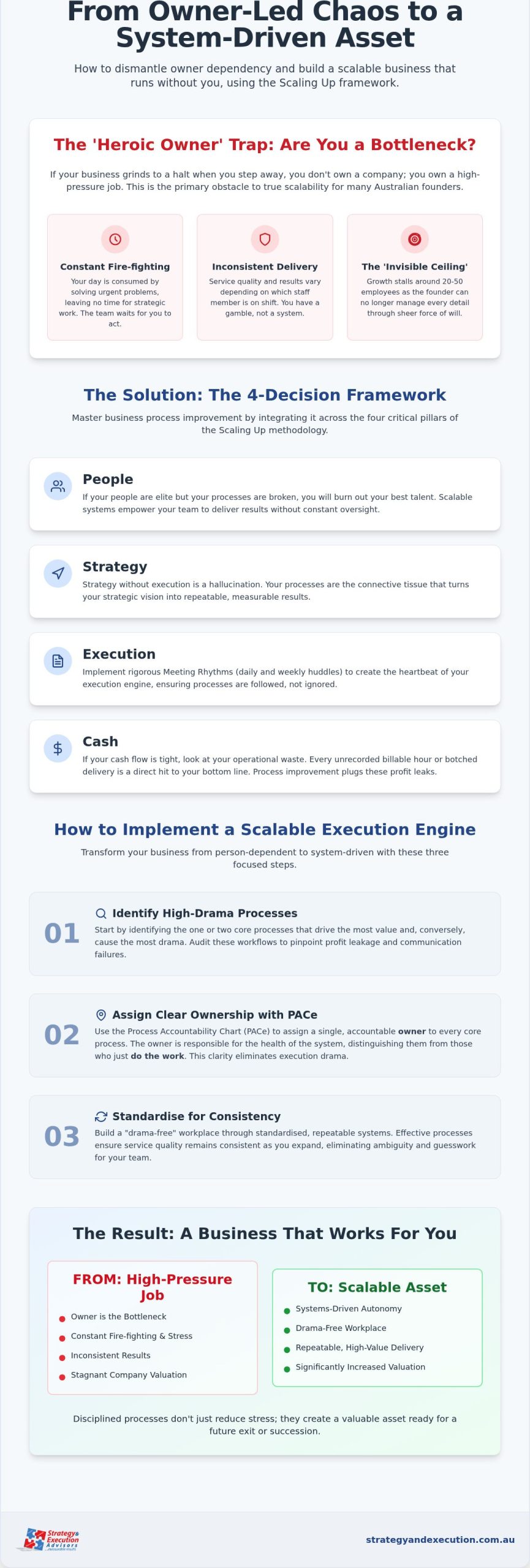
Most firms hit an “Invisible Ceiling” when they reach 20 to 50 employees. At this size, the founder can no longer manage every detail through sheer force of will. Communication breaks down. Service delivery becomes inconsistent. Profit leaks through operational waste. You aren’t scaling; you’re simply inflating a structure that lacks the integrity to hold its own weight. The Scaling Up philosophy dictates that processes must align with People, Strategy, and Cash to create a sustainable engine. This alignment ensures that every workflow directly supports your strategic execution and bottom-line results.
Dismantling the Heroic Owner Trap
If your business requires your daily intervention to function, you own a high-pressure job, not a scalable asset. The symptoms are clear: constant fire-fighting and a team that waits for your permission before acting. It’s time for some tough love. The bottleneck is always at the top of the bottle. You are the primary obstacle to your firm’s expansion. To build a business that operates autonomously, you must replace your personal “heroics” with standardised, repeatable systems that empower your team to deliver results without your oversight.
The 4-Decision Framework for Mastering Process Excellence
Strategy without execution is a hallucination. In the Scaling Up framework, business process improvement for scalability underpins the four critical decisions: People, Strategy, Execution, and Cash. If your people are elite but your processes are broken, you’ll burn out your best talent. If your cash flow is tight, look at your operational waste. Processes shouldn’t be complex manuals; they should be the connective tissue that turns strategy into repeatable results.
Start by identifying the “one or two” core processes that drive the most value and, conversely, the most drama in your firm. These are usually high-stakes handoffs where communication fails. Audit these workflows to pinpoint profit leakage. Every unrecorded billable hour or botched delivery is a direct hit to your bottom line. To maintain integrity across Queensland teams, from Brisbane to the Gold Coast, implement rigorous Meeting Rhythms. These daily and weekly huddles ensure processes are followed, not ignored. They provide the heartbeat of your execution engine. If you’re struggling to find the leak, speak with a strategist to gain an objective perspective.
PACe: The Process Accountability Chart for Results
Accountability dies when ownership is vague. Use the PACe tool to assign a single, accountable owner to every core business process. There’s a sharp distinction between “doing the work” and “owning the process.” The owner is responsible for the health and performance of the system itself, not just individual tasks. This clarity is a vital component of a Scaling Up implementation plan. When everyone knows who owns the result, execution drama vanishes and scalability becomes a reality.
Implementing a Scalable Execution Engine in Queensland
Queensland’s high-growth corridors demand more than just ambition; they require operational rigour. In a fast-paced market, growth often masks underlying operational rot until it’s too late. Building a “drama-free” workplace isn’t achieved through culture retreats. It is the result of standardised, repeatable systems that eliminate ambiguity. Effective business process improvement for scalability ensures that as you expand across Brisbane or into regional hubs, your service quality remains consistent. If your results vary based on which staff member is on shift, you don’t have a system; you have a gamble.
Internal teams rarely possess the objectivity to dismantle their own inefficient habits. This is where an external process consultant becomes essential. They provide the “tough love” and strategic clarity internal stakeholders often avoid. By integrating E-Myth Mastery principles, you transform your company into a business that runs without your constant presence. This shift is critical for long-term security. Disciplined processes don’t just reduce stress; they significantly increase company valuation. Whether you’re preparing for a future exit or a family succession, a systems-dependent engine is the only asset worth buying.
Taking the First Step: From Strategy to Execution
A Vision Statement is a starting point, not a solution. You must translate high-level goals into a populated One-Page Strategic Plan (OPSP) to drive daily accountability. This document forces alignment and ensures every team member understands their role in the broader machine. For Queensland leaders, working with an E-Myth coach in Brisbane provides the tactical roadmap needed to build a systems-dependent business that scales. Stop tolerating execution drama. Take the 4-Decisions Assessment now to pinpoint your primary bottleneck and start the transition from founder-dependent chaos to a professional, scalable engine.
Command Your Growth Through Systems
Scalability isn’t a byproduct of effort; it’s the result of architectural discipline. You’ve now seen how owner-dependency creates an invisible ceiling that limits your firm’s potential. By mastering business process improvement for scalability, you replace daily fire-fighting with a repeatable execution engine. This requires rigorous adherence to the 4-Decision framework and clear accountability for every core workflow. Stop tolerating the profit leakage and execution drama that plague unmanaged growth.
Strategy & Execution Advisors provides the catalyst you need to transition from a high-pressure job to a scalable asset. Led by Ted Bonel, a certified Scaling Up practitioner with over 20 years of hands-on experience, we help you install the systems that improve cash flow and company valuation. Don’t let your business stall as it expands. Book a strategic consultation with Strategy & Execution Advisors today to dismantle your bottlenecks and build a business that operates autonomously. Your future exit starts with today’s discipline.
Frequently Asked Questions
How long does it take to see results from business process improvement?
Results in accountability are often immediate once you assign a single owner to a core process. Tangible operational gains typically manifest within the first 90-day execution cycle. This timeframe allows your team to adopt new meeting rhythms and iron out friction in high-drama workflows. Lasting business process improvement for scalability is a continuous discipline, not a one-off project with a fixed end date.
Do I need expensive automation software to start scaling my business?
No, automation is the final step. Automating a broken or inefficient process only accelerates your failure. You must first stabilise your manual workflows to ensure they actually work. Once you have a disciplined, repeatable system that produces consistent results, you can then look at software to enhance speed. Start with the PACe tool to define ownership before investing in complex digital tools.
What is the difference between a general business coach and an execution specialist?
General coaches often focus on motivation or broad advice. An execution specialist is an architect who installs proven frameworks like Scaling Up to drive measurable outcomes. We don’t just talk about goals; we implement the accountability systems and meeting rhythms required to reach them. Our focus is on structural integrity and dismantling the bottlenecks that prevent your firm from operating autonomously.
Can process improvement help with my company’s cash flow problems?
Yes, because profit leakage is usually a process failure. Business process improvement for scalability identifies where time and resources are wasted, directly impacting your bottom line. By streamlining sales-to-delivery handoffs and tightening billing cycles, you reduce the drama that ties up capital. Efficient systems ensure you collect cash faster and spend less on correcting avoidable mistakes made by an uncoordinated team.
Need Help Turning Strategy Into Results?
Let’s talk about your goals and how we can help you move forward with clarity and confidence.
