

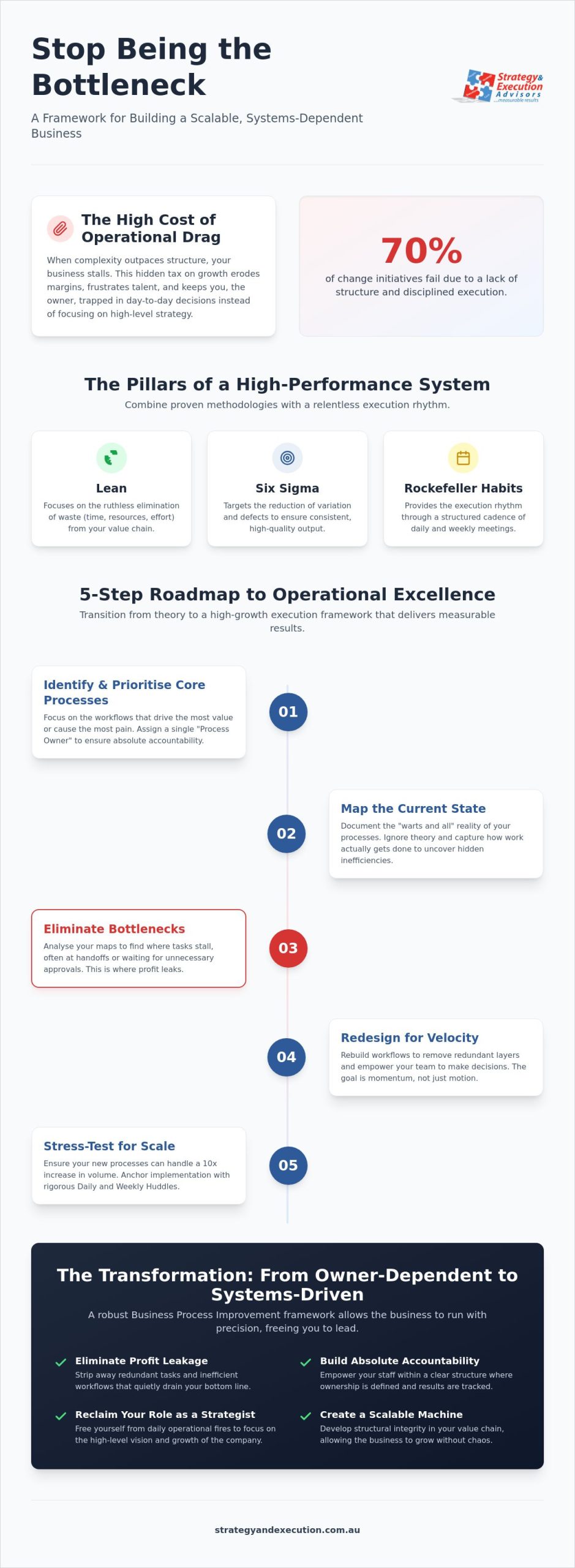
Your business isn’t failing because you lack talent; it’s stalling because you’ve become the very bottleneck you’re trying to outrun. When every minor decision must pass through your desk, you aren’t a leader; you’re a glorified traffic warden. This operational drag isn’t just frustrating; it’s expensive. With nearly 70% of change initiatives failing due to a lack of structure, you cannot afford to wing it. You need a rigorous business process improvement framework that prioritises execution over theory and eliminates the redundant tasks draining your bottom line.
We understand the pressure of watching profit leak through inefficient systems while your team remains stuck in “the way we’ve always done it.” You want an organisation that runs like a Swiss watch, where accountability is absolute and you’re finally free to focus on high-level strategy. This guide will show you how to master the frameworks that transform your business into a scalable, high-performance machine. We’ll break down the essential execution rhythms and digital-first strategies required to strip away waste, empower your staff, and build a truly systems-dependent company.
Key Takeaways
- Shift your perspective from static flowcharts to a dynamic discipline that actively identifies and eliminates operational drag.
- Implement a proven business process improvement framework to transition your firm from an owner-dependent bottleneck to a scalable, systems-dependent machine.
- Identify your high-value core processes and map their current state with absolute candour to uncover hidden profit leakage and redundant tasks.
- Anchor your framework in a rigorous execution rhythm, using Daily Huddles and Weekly Meetings to ensure accountability and momentum.
- Reclaim your role as a strategist by building structural integrity into your value chain, allowing the business to run with precision without your constant intervention.
Understanding the Business Process Improvement Framework: Beyond the Flowchart
Business process improvement is not a one-off HR project or a series of colourful flowcharts. It is a rigorous, systematic discipline used to identify, analyse, and refine workflows to drive peak performance. To truly master this, leaders must view it through the lens of Business Process Management (BPM), treating every task as a link in a value chain that either creates momentum or breeds friction. Stop fixing symptoms. Start building systems.
To better understand this concept, watch this helpful video:
Australian mid-market firms often hit a growth ceiling because they attempt to scale chaos. When you grow without a business process improvement framework, you inevitably encounter operational drag. Operational drag is the hidden tax on growth that occurs when complexity outpaces your structural integrity. Ad-hoc fixes might provide temporary relief, but they fail to deliver long-term value. You must transition to a systems-dependent business where the owner is no longer the primary bottleneck for every minor decision.
The Strategic Cost of Inefficiency in Australian Firms
Broken processes do more than just slow you down; they erode your margins and frustrate your high-performing talent. In the Scaling Up framework, these gaps directly impact your Cash and People decisions. Inefficient workflows bleed capital through redundant labour and missed opportunities. High-performing staff will leave if they are constantly battling “the way we’ve always done it.” Operational drag is the silent killer of enterprise value.
Core Methodologies: Lean, Six Sigma, and Rockefeller Habits
Lean focuses on the ruthless elimination of waste. Six Sigma targets the reduction of variation to ensure consistent quality. While these methodologies provide the tools, the Rockefeller Habits provide the execution rhythm. Without a structured cadence of daily and weekly meetings, even the best process improvements will eventually wither. Discipline is the bridge between a theoretical framework and high-growth execution.
Designing Your Framework: The 5-Step Roadmap to Operational Excellence
Designing a Business Process Improvement (BPI) initiative requires more than just a software subscription. It demands a rigorous business process improvement framework that aligns with your specific growth trajectory. This is not an academic exercise. It is a strategic overhaul designed to strip away the friction that slows your team down. You must move from theory to a roadmap that delivers measurable operational velocity.
Identifying and Mapping Your Value Chain
Start by identifying your “Core Processes.” These are the workflows that drive the most value or cause the most pain. Distinguish these from support processes like internal administration. Most leaders fail because they try to fix everything at once. Focus on the value chain first. Assign a single “Process Owner” for every workflow to ensure absolute accountability. Accountability dies when responsibility is shared. Use visual tools to centre the team on the workflow; seeing the mess is the first step toward cleaning it up.
Eliminating Bottlenecks and Stress-Testing for Scale
Map your current state with brutal honesty. Ignore how you think things should work and document the “warts and all” reality. You will likely find that tasks stall at specific handoffs or wait for unnecessary executive approvals. Redesign these steps for velocity by removing redundant layers and empowering your team to make decisions. A process is only as good as its weakest link.
Stress-test your new workflows against your strategic goals to ensure they can handle a 10x increase in volume. This alignment is a central component of our Scaling Up Program Australia, where we link operational improvements to your quarterly priorities. If your current systems are still acting as a bottleneck, consult with an advisory expert to refine your operational design and reclaim your strategic focus.
Implementing Improvement: Transitioning from Theory to High-Growth Execution
The most sophisticated business process improvement framework is worthless if it sits in a digital drawer. Execution is where theory meets reality. Many leaders fail here because they lack the discipline to maintain the new standards they’ve designed. You must establish a “Meeting Rhythm” to review performance and address deviations immediately. Without this heartbeat, your team will inevitably slide back into old, inefficient habits.
Your role as a leader is to be the guardian of these systems. Resist the urge to “work around” the process when things get busy. Every time you bypass a system to put out a fire, you signal to your team that the system doesn’t matter. If you want a business that scales, you must be the first to follow the rules you’ve set. This is the foundation of learning how to make your business run without you.
Establishing an Execution Rhythm in Brisbane and Adelaide
Success in the mid-market requires a relentless focus on the “Execution” pillar. Use the Rockefeller Habits Weekly Meeting Agenda to track your process KPIs with surgical precision. The Daily Huddle and Weekly Meeting aren’t just chats; they are the pulse of your operational excellence. Discipline equals freedom. When your systems are predictable, your time becomes your own again.
Scaling Your Systems: The E-Myth and ExO Perspective
Shifting from “doing” the work to “designing” the business is a psychological hurdle many founders struggle to clear. Working with an E-Myth Coach in Brisbane provides the external perspective needed to build a systems-dependent business. Once your core processes are stable, you can apply ExO (Exponential Organisations) principles. This involves leveraging external assets and algorithms to scale your workflows at a rate that traditional models cannot match. Stop being the engine; start being the architect.
Reclaim Your Strategic Focus Through Operational Velocity
Identify the friction. Fix the flow. Scale the result. High-growth execution isn’t a matter of luck; it’s a matter of design. Ad-hoc fixes only lead to more fires. By implementing a rigorous business process improvement framework, you strip away the operational drag that turns leaders into bottlenecks. You shift from being the engine of the business to its architect.
Establish your meeting rhythms and hold your team to the standards you’ve set. Discipline in the small things creates the freedom to tackle the big things. With over 20 years of industry experience across Australia, our certified Scaling Up and E-Myth Mastery experts have helped mid-market firms in Brisbane and Adelaide achieve this transition. We don’t offer quick fixes. We offer proven systems that deliver measurable results.
Stop letting profit leak through broken workflows. Book a Strategic Consultation to Fix Your Operational Gaps and start building the scalable, high-performance machine your leadership deserves. Your business is ready to grow. Make sure your processes are ready to support it.
Frequently Asked Questions
What is a business process improvement framework?
A business process improvement framework is a structured discipline used to identify, analyse, and refine workflows to drive peak performance. It replaces ad-hoc “quick fixes” with a systematic roadmap for operational excellence. Rather than just mapping tasks, a robust framework aligns your team’s daily actions with your strategic growth targets. It ensures every step in your value chain is necessary, efficient, and produces a measurable outcome.
How do I choose the right process improvement methodology for my mid-market business?
Select a methodology based on your specific operational bottleneck. If your problem is waste and inefficiency, Lean is your primary tool. If you suffer from inconsistent quality or high error rates, Six Sigma provides the necessary variation reduction. For Australian mid-market firms, we recommend anchoring these tools within the Rockefeller Habits. This provides the execution rhythm required to make technical improvements stick in a high-growth environment.
Why do most process improvement initiatives fail in growing companies?
Most initiatives fail due to a lack of leadership discipline and a missing execution rhythm. Research suggests that up to 70% of change efforts collapse because they are treated as one-off projects rather than cultural shifts. When leaders “work around” the new system during busy periods, they signal that the framework is optional. Accountability dies without a structured cadence of daily and weekly meetings to monitor progress.
How often should we review and update our business processes?
You should monitor process KPIs weekly and conduct a comprehensive review every quarter. High-velocity businesses don’t wait for an annual audit to fix profit leakage. Use your weekly meetings to identify where tasks are stalling and adjust immediately. This continuous refinement ensures your business process improvement framework evolves alongside your scale, preventing your systems from becoming obsolete as your organisation grows.
Need Help Turning Strategy Into Results?
Let’s talk about your goals and how we can help you move forward with clarity and confidence.
