

Stop being the bottleneck. If your business plateaus the moment you take a holiday, you don’t own a scalable asset. You own a high-pressure job that depends entirely on your personal stamina. Most Australian founders are currently trapped in a cycle of founder fatigue, acting as the primary technician rather than the strategic architect. Learning how to make your business run without you is not a luxury; it is the only path to a high-performance enterprise and a successful future exit.
You likely feel the weight of inconsistent execution and a team that refuses to take ownership. It is exhausting to watch momentum stall whenever you aren’t there to push it. This guide delivers the exact framework to transition from the workshop floor to the boardroom. We will examine the execution rhythms and leadership systems required to build a self-sustaining business that scales while you are off-grid.
Key Takeaways
- Identify the structural flaws in a systems-dependent business that force you to remain the primary operator.
- Deploy the “7 Strata” strategy to ensure your team executes high-level plans without your constant supervision.
- Discover how to make your business run without you by replacing personal stamina with the “Scaling Up” execution framework.
- Establish rigorous meeting rhythms to drive radical accountability and maintain operational momentum without your daily presence.
- Use the “Power of One” to monitor organisational health through precise data rather than subjective observation.
Understanding the Owner Trap: Why Most Australian Businesses Stall
Most Australian businesses don’t stall because of the economy. They stall because the founder is the only engine. This is the “Owner Trap”. It occurs when an operation relies on your personal stamina instead of a robust organisational framework. Without true business scalability, your firm is a liability rather than an asset. You have created a high-paying job for yourself, but you haven’t built a company.
Transitioning your mindset is the first step in learning how to make your business run without you. You must stop acting as the “Technician” who performs the work and start acting as the “Architect” who designs the system. If you spend your day “working in” the business, you have zero capacity to “work on” its strategic expansion. You are effectively an expensive employee blocking your own growth.
To understand the mechanics of this transition, watch this breakdown on structural independence:
Australian leaders often suffer from the “no one can do it as well as me” delusion. This mindset is a cage. It prevents delegation and ensures your team remains mediocre. True leadership involves building systems that allow others to exceed your own performance. If you are the smartest person in the room, you are in the wrong room.
The E-Myth Mastery: Moving Beyond the Technician
Working with an E-Myth coach Brisbane helps you shift from people-dependency to systems-dependency. People are unpredictable and inconsistent. Systems are repeatable and scalable. If your business relies on finding “superstars” to function, it will eventually break. If it relies on documented, rigorous systems, it becomes a predictable profit machine that thrives in your absence.
The High Cost of Being Essential
Being essential is a financial disaster. When it’s time for a valuation or exit, a business that requires the owner to function is worth significantly less. Buyers don’t want to buy your daily stress; they want to buy your cash flow. Founder fatigue is a real risk for leaders in Brisbane and Adelaide who refuse to let go. Learning how to make your business run without you is the only way to protect your personal health and your company’s market value. Working with a succession planning advisor Adelaide can help you engineer a business that functions without you and maximise its valuation long before you are ready to exit. For those operating within a family enterprise, engaging a family business advisor Adelaide is equally critical to ensure complex family dynamics don’t stall the structural changes required for true scalability.
The 3 Pillars of a Self-Sustaining Business Framework
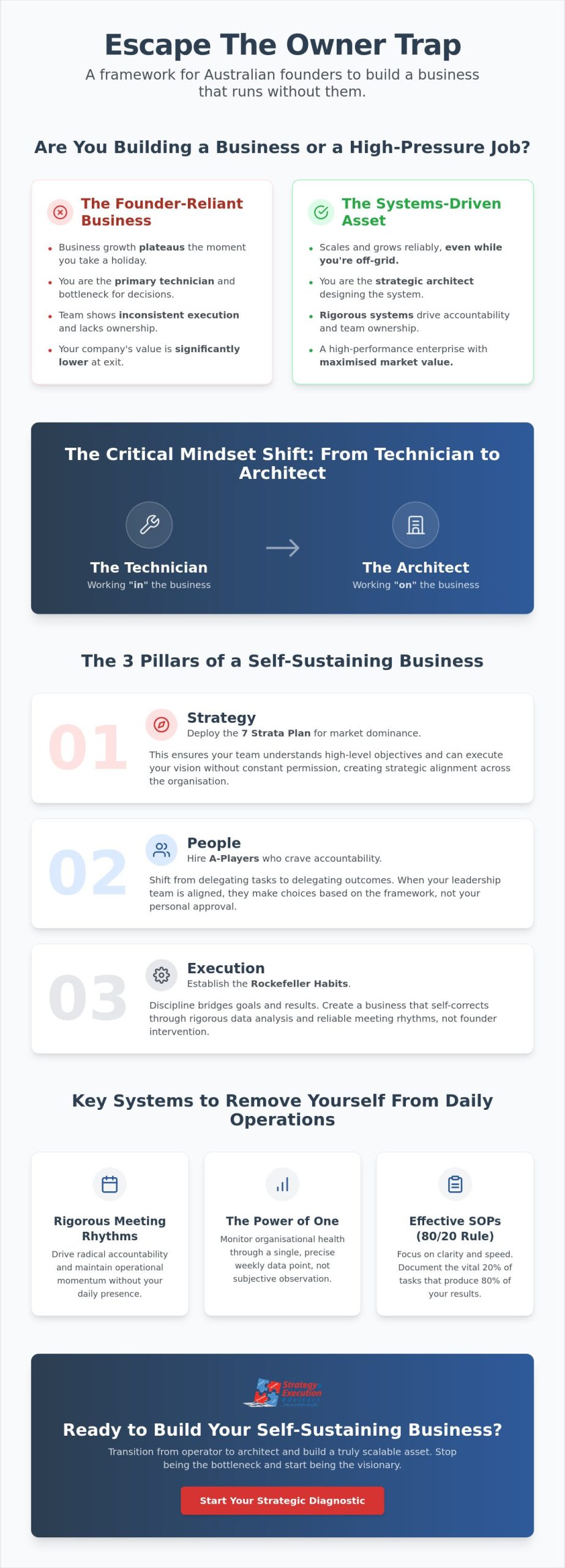
Efficiency isn’t found in a manual. It’s found in a framework. To build an organisation that can run without you, you must implement the Scaling Up methodology. This isn’t a collection of abstract theories. It’s a high-performance engine designed to drive momentum through three non-negotiable pillars.
- Strategy: Deploy the 7 Strata plan. This ensures your team understands your market dominance and can execute high-level objectives without asking for permission at every turn.
- People: Hire A-Players. These are individuals who don’t just follow instructions; they crave accountability and own the results of their specific departments.
- Execution: Discipline is the bridge between goals and results. Establish the Rockefeller Habits to create a business that self-corrects through data and rigorous rhythm.
If you are struggling to identify which pillar is currently failing in your organisation, reach out for a strategic diagnostic. Moving beyond your own personal input requires a level of structural integrity that most founders ignore until it’s too late.
Developing a High-Performance Leadership Team
Stop delegating tasks. Start delegating outcomes. If you are still telling senior leaders in Queensland or South Australia how to do their jobs, you are the bottleneck. Executive team alignment is the only way to remove yourself from the decision-making process. When your leaders are aligned, they make choices based on the strategic framework rather than your personal approval. This is the core of how to make your business run without you while maintaining elite standards.
Implementing Standard Operating Procedures (SOPs) that Actually Work
Most Brisbane businesses fail by over-complicating documentation. Stop writing 100-page manuals that nobody reads. Focus on the vital few. Document the 20% of tasks that produce 80% of your results. Creating standard operating procedures is about clarity and speed, not volume. If a process isn’t documented, it’s just a suggestion. Document it, enforce it, and then step back. Applying a rigorous business process improvement framework ensures that the systems you build eliminate redundant tasks and drive genuine operational velocity across your organisation.
Implementing the Exit: Moving from Operator to Architect
Execution is the final frontier of scalability. You have the strategy and the people. Now you need the discipline to step back. True freedom occurs when your physical presence is replaced by a rigorous communication architecture. To master how to make your business run without you, you must implement a system where information flows up and decisions are made without your intervention.
Start by identifying your critical KPIs. Use “The Power of One” to track how small changes in pricing, volume, or costs impact your cash flow. When you lead by data, you stop leading by “gut feel”. This allows your leadership team to manage the business through objective reality. Once the data is clear, transfer the strategic planning mantle. Your team should own the quarterly objectives. Your role is to coach the outcome, not dictate the process.
Finally, stress-test your system. Take a forced absence. Switch off your phone and go off-grid for a full fortnight. If the business stalls, you haven’t failed; you have simply identified the next structural weakness that requires systemisation. Fix the system, then leave again.
The Rockefeller Habits Meeting Rhythm
Ditch the ad-hoc “got a minute” culture. It kills productivity and keeps you trapped. Implementing a Rockefeller Habits weekly meeting agenda creates a predictable pulse for your organisation. These rhythms ensure that teams in Brisbane, Adelaide, or remote hubs remain aligned. Accountability becomes a habit rather than an occasional confrontation. When the meeting rhythm is solid, the business moves forward whether you are in the office or on the coast.
Your Scaling Up Implementation Plan
Transitioning from operator to architect requires a roadmap. The Scaling Up implementation plan provides a 90-day framework for this shift. Most leaders struggle with the discipline of stepping back. A strategic growth advisor acts as a catalyst here, holding you accountable to your new role as architect. Stop being the hero. Start being the strategist who builds an enterprise that thrives in your absence.
Transition from Operator to Architect
Building a business that scales requires more than just ambition. It requires a rigorous commitment to structural independence. You have seen how the “Owner Trap” creates a ceiling on your growth. You now understand that strategy, people, and execution are the only pillars that matter. Mastering how to make your business run without you is the difference between owning a job and owning a high-value asset.
Stop letting your organisation depend on your personal stamina. Transitioning from operator to architect is a disciplined process that demands expert guidance. We bring over 20 years of experience in the Australian mid-market to help you navigate this shift. As certified Scaling Up and Rockefeller Habits practitioners, we use proven E-Myth Mastery coaching protocols to install the systems your company needs to thrive.
Take the first step toward true scalability. Book a Scaling Up Strategy Session for your Brisbane or Adelaide business today. It’s time to build a company that works for you, instead of you working for it.
Frequently Asked Questions
How long does it typically take to make a business run without the owner?
A full transition typically requires 12 to 24 months of rigorous implementation. This timeline allows for the establishment of execution rhythms and the development of a leadership team capable of independent decision-making. The duration depends entirely on your starting point and your commitment to the Scaling Up framework. It is a structural overhaul, not a quick fix.
Will my customers stay if I am no longer the face of the business?
Customers stay for the value delivered, not the person delivering it. If your brand promise relies on your personal involvement, you have a scalability problem. Transitioning to a systems-dependent model ensures that quality remains consistent regardless of who is in the office. This shift actually increases customer trust by providing a more reliable and professional experience.
What is the first system I should build to start the process?
Establish your meeting rhythms immediately. This is the foundational system for anyone learning how to make your business run without you. Daily huddles and weekly tactical meetings create a pulse of accountability. Without this communication architecture, any other systems you build will eventually collapse due to a lack of oversight and alignment.
Do I need to hire an expensive CEO to take my place?
No. Many founders successfully step back by empowering a General Manager or a high-performance leadership team. Hiring an external CEO is often a premature move that fails if the underlying systems aren’t solid. Focus on building the framework first. A well-systemised business can often be led by internal A-Players who have grown with the firm.
Can a small business in Brisbane or Adelaide really afford to systemise?
You cannot afford the alternative. Inefficient businesses in Brisbane and Adelaide are currently facing rising costs and persistent inflation. Systemisation is a discipline that reduces waste and increases margins. It is not an expensive luxury; it is the essential groundwork required to protect your valuation and ensure your firm survives beyond your personal input. Family-owned enterprises in particular should consider working with a family business advisor Adelaide to navigate the unique dynamics that can otherwise derail systemisation efforts.
What happens to the business culture when the founder steps back?
The culture matures from founder-dependent to purpose-driven. When you step back, you give your team the space to take true ownership. This often leads to higher engagement and better performance as staff move from following orders to driving results. A healthy culture thrives on the systems and values you have installed, not your physical presence.
Need Help Turning Strategy Into Results?
Let’s talk about your goals and how we can help you move forward with clarity and confidence.
