

Your record-breaking sales quarter isn’t a victory if you can’t meet payroll on Friday. Growth is a hungry beast that devours liquidity long before it delivers profit. It’s a brutal reality that many high-growth companies face: the more you sell, the tighter things get. Implementing specific scaling up cash flow strategies is the only way to ensure your expansion doesn’t kill your business. You’ve likely felt that persistent anxiety when your bank balance doesn’t match the optimism of your P&L. It’s a frustrating gap that leaves leaders wondering why success feels so much like a struggle.
It’s time to stop treating liquidity as a byproduct of luck and start viewing it as a strategic discipline. You can transform your organisation into a self-funding model that doesn’t rely on external debt or the current 6.75% prime rate. This guide will show you how to master the CASh framework and aggressively shorten your cash conversion cycle. We’ll identify the specific levers you can pull to increase visibility and reclaim control over your capital. Learn how to fund your expansion with your own cash and finally align your bank balance with your ambitions.
Key Takeaways
- Stop confusing paper profit with actual liquidity and learn to calculate your Cash Conversion Cycle (CCC) to measure true scaling health.
- Apply the CASh framework to execute high-impact scaling up cash flow strategies that turn your operations into a self-funding growth engine.
- Eliminate the operational friction in your billing and delivery cycles that leaves your capital trapped in unnecessary work-in-progress.
- Commit to a rigorous executive cash rhythm to gain the visibility required to lead a high-growth organisation with absolute confidence.
The First Law of Entrepreneurial Gravity: Why Growth Consumes Cash
Growth isn’t free. It’s an investment that demands capital upfront. If you don’t implement rigorous scaling up cash flow strategies, your own success will eventually bankrupt you. This is the paradox of scaling. The faster you grow, the more cash you need to bridge the distance between paying for resources and receiving payment from customers. You can’t fund a rapid expansion on hope alone.
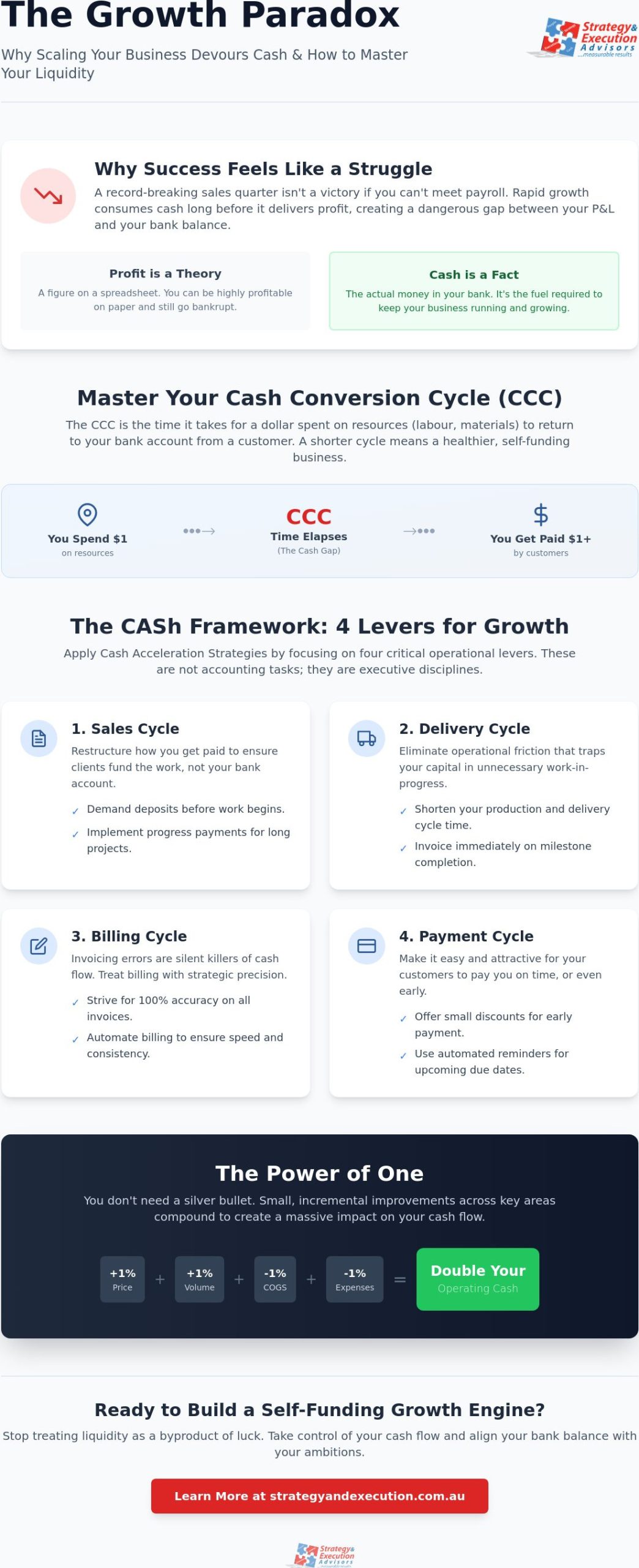
To survive this transition, you must master your Cash Conversion Cycle (CCC). This metric measures the time it takes for a dollar spent on labour or materials to return to your bank account. If your CCC is too long, growth becomes a liability rather than an asset. You’ll find yourself chasing sales just to cover the holes in your previous month’s liquidity.
To better understand this concept, watch this helpful video:
The Difference Between Profit and Liquidity
Profit is a theory; cash is a fact. You can have a glowing P&L while your business is literally starving for liquidity. Many Australian mid-market firms collapse despite being profitable because they run out of the fuel required to keep the engine running. The Cash Gap is the primary constraint on your rate of growth. If your cash gap is sixty days but your growth rate is doubling, you’ll quickly find yourself in a death spiral without external funding or disciplined management.
Cash as a Leadership Decision
Stop delegating cash flow to the back office. It’s an executive discipline, not an accounting task. Every department in your organisation impacts the cycle. Sales teams might offer loose payment terms to close a deal. Operations might hold excessive inventory to avoid stockouts. These are leadership choices that directly drain your bank account. Effective scaling up cash flow strategies require the entire executive team to align on liquidity as a core performance metric rather than a monthly report from the CFO.
The CASh Framework: Four Levers to Shorten Your Cash Conversion Cycle
The Cash Acceleration Strategies (CASh) framework is your primary weapon for maintaining liquidity during rapid expansion. Most leaders wait for the end of the month to see if they have money in the bank. This is a reactive posture that invites disaster. To lead effectively, you must master four distinct levers: Sales, Delivery, Billing, and Payment. These are not administrative tasks. They are the frontline of your scaling up cash flow strategies.
Small adjustments yield massive results through the “Power of One” concept. By improving seven key variables, such as price or volume, by just 1%, you can transform your bottom line and double your operating cash flow. It’s about cumulative discipline. Stop looking for a silver bullet. Start focusing on the incremental efficiencies that keep your business solvent.
Optimising Sales and Delivery Rhythms
Shorten your cycle time by restructuring how you get paid. If you’re waiting until a project is finished to invoice, you’re essentially acting as a bank for your clients. Demand deposits. Implement progress payments. These shifts ensure your customers fund the work-in-progress rather than your own reserves. This alignment should be a core part of your strategic planning process steps to ensure quarterly goals match your liquidity needs.
Billing and Payment: The Execution Gap
Invoicing errors are the silent killers of cash flow in Australian mid-market firms. A single mistake in Brisbane or Adelaide can push payment terms from 30 days to over 60. Stop treating billing as an administrative afterthought. It is a strategic execution point that requires absolute precision. You can also incentivise early payments through small discounts or automated reminders. If you need help refining these internal systems, consider how a tailored advisory session could tighten your operational cycle.
Implementing Cash Rhythms: From Theory to Executive Action
Execution is where most scaling businesses fail. You can’t manage liquidity through a rear-view mirror. You need a proactive “Cash Rhythm” that identifies bottlenecks before they become terminal crises. This isn’t a quarterly accounting review. It’s a relentless operational focus on the 90-day cycle. Integrating cash as a core pillar in your Scaling Up Implementation Plan ensures that every growth initiative is backed by the liquidity required to sustain it. Without this discipline, your expansion is just a house of cards.
The Cash-Focused Leadership Meeting
Your leadership team must own the numbers. Use a structured Rockefeller Habits Weekly Meeting Agenda to monitor cash health in real-time. Don’t let the CFO carry the burden alone. Assign specific levers of the CASh framework to individual executives. Your sales head should own the “Sales” lever. Your operations lead must own “Delivery” and work-in-progress. When everyone is accountable, liquidity becomes a shared priority rather than a financial footnote. This transparency forces the team to confront the cash impact of every operational decision.
Scaling Sustainably in the Australian Market
Local conditions demand specific attention. You must account for the impact of payroll tax and quarterly BAS cycles on your available capital. These aren’t surprises. They’re predictable events that require disciplined planning. Brisbane and Adelaide CEOs often face unique regional pressures that can mask “blind spots” in their cash cycle. Engaging professional advisors like KHT Accounting & Wealth or a battle-tested strategist helps you identify these gaps before they drain your reserves. It’s the difference between guessing your way through growth and executing a proven system with absolute clarity.
Cash flow is a habit. It is not a one-off project or a year-end cleanup. Effective scaling up cash flow strategies are built on daily discipline and weekly accountability. Review your metrics. Hold your team to account. Stop reacting to your bank balance and start dictating it. The health of your organisation depends on the transition from theory to deed.
Turn Your Growth into a Self-Funding Engine
Growth is a deliberate choice. It requires more than just sales momentum; it demands a rigorous commitment to liquidity. You’ve seen how the Cash Conversion Cycle can either fuel your expansion or starve it. By applying the CASh framework and establishing a weekly cash rhythm, you move from reactive survival to strategic command. These scaling up cash flow strategies are the difference between a business that scales and one that simply burns out.
Don’t let operational friction trap your capital. Our team of Certified Scaling Up Practitioners brings over 20 years of executive coaching experience to help you identify the blind spots in your cycle. We have delivered proven results for Australian mid-market firms by turning complex financial challenges into clear execution plans. Stop guessing where your cash is and start directing it toward your next milestone.
It’s time to master your liquidity. Master your cash flow with a Scaling Up Strategy Workshop and build the structural integrity your business deserves. You have the vision; now secure the fuel to reach it.
Frequently Asked Questions
What is the Cash Conversion Cycle (CCC) and why does it matter for scaling?
The Cash Conversion Cycle measures the precise number of days it takes for a dollar spent on labour or materials to return to your bank account as cash. It is the definitive metric for sustainable scaling because growth is a hungry consumer of capital. A shorter cycle allows you to fund expansion internally. A long cycle creates a liquidity gap that forces you into expensive debt or operational stagnation.
How can I improve my business cash flow without taking on more debt?
You improve liquidity by aggressively optimising the four levers of the CASh framework: Sales, Delivery, Billing, and Payment. Implementing effective scaling up cash flow strategies means reducing work-in-progress and demanding progress payments from your customers. Stop acting as a free bank for your clients. Eliminate invoicing errors and offer incentives for early settlement to pull cash forward without increasing your liabilities.
What are the 7 variables in the “Power of One” framework?
The “Power of One” focuses on seven strategic levers: Price, Volume, Cost of Goods Sold, Operating Expenses, Accounts Receivable, Inventory (or WIP), and Accounts Payable. Adjusting each of these variables by just 1% creates a compounding effect on your cash position. It shifts the focus from massive overhauls to disciplined, incremental improvements. This framework proves that small operational changes yield significant financial momentum when applied with consistency.
How often should a leadership team review cash flow strategies?
Your leadership team must review liquidity metrics at every weekly executive meeting. Monthly reviews are too slow to catch the pitfalls of rapid scaling. Use a structured rhythm to track your cash conversion progress and hold individual leaders accountable for their specific levers. This high-frequency oversight ensures that cash remains a strategic priority rather than an administrative afterthought that only the CFO handles.
Need Help Turning Strategy Into Results?
Let’s talk about your goals and how we can help you move forward with clarity and confidence.
