

What if your current strategic plan is actually a hallucination? Most Australian mid-market leaders suffer through the same cycle: an expensive offsite retreat followed by a total lack of execution. You know the frustration of a leadership team that nods in agreement but reverts to tactical chaos by Monday morning. To break this cycle, you must master the specific strategic planning process steps that bridge the gap between high-level vision and daily reality.
It’s time to stop treating strategy as an annual event and start treating it as a disciplined rhythm. Scaling in a 2026 landscape defined by new ACCC merger thresholds requires a more rigorous approach to your strategic planning process steps. This article provides the framework needed to transform abstract ideas into a high-growth execution engine. We will examine the essential strategic planning process steps for building a clear roadmap, establishing a disciplined execution rhythm, and ensuring every session delivers a measurable ROI.
Key Takeaways
- Stop guessing and conduct a brutal assessment of your market position using the SWT framework. Define your core ideology to act as the permanent guardrails for every executive decision.
- Use the 7 Strata of Strategy to escape the “sea of sameness” and build a unique competitive advantage. Differentiation is not optional; it is the foundation of mid-market survival.
- Master the strategic planning process steps needed to dismantle a five-year vision into 90-day priorities. If your goals aren’t broken down into immediate actions, they are merely wishes.
- Establish a disciplined communication rhythm to keep your leadership team aligned and focused. Strategy is 5% thinking and 95% execution; don’t let the operational whirlwind drown out your progress.
- Identify and remove the “Rocks” that obstruct your path to growth each quarter. Clear the path for your team by addressing the specific obstacles that prevent measurable success.
Phase 1: Assessing Strategic Position and Core Ideology
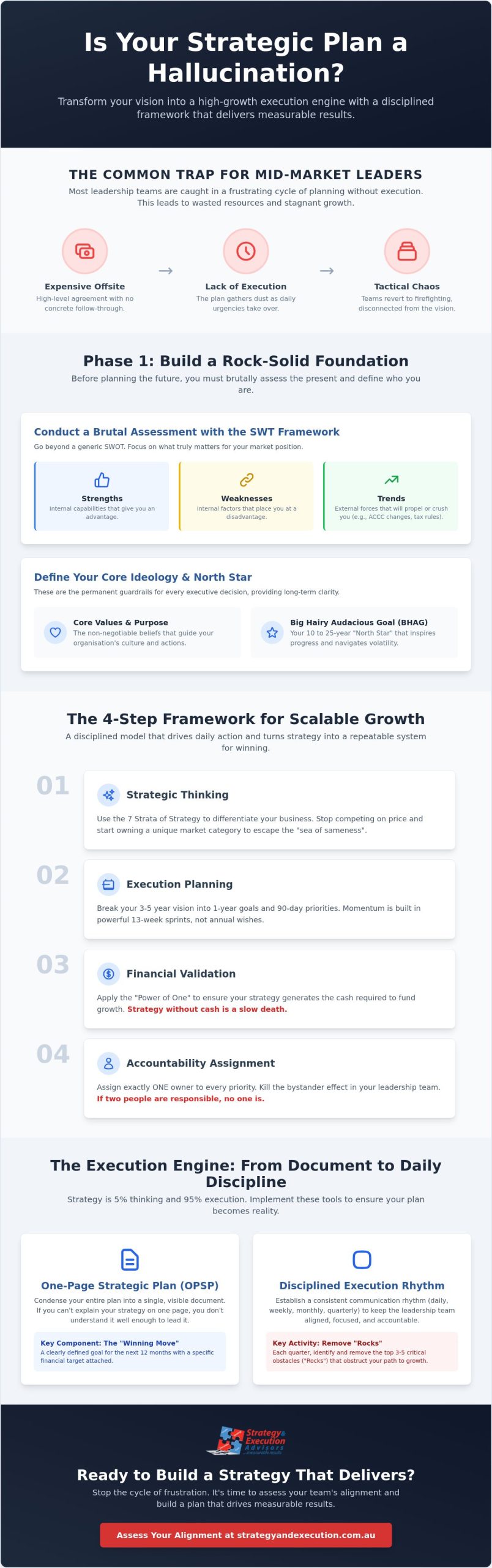
Stop relying on generic SWOT analyses. They produce vanilla results that lead to stagnant growth. A rigorous strategic planning process steps framework begins with a brutal assessment of your current state using the SWT (Strengths, Weaknesses, Trends) framework. While strengths and weaknesses look inward, trends are the external forces that will either propel you forward or crush your margins. You must look at the 2026 ACCC merger notification thresholds or the permanent tax loss carry-back rules as strategic variables, not just compliance items.
To better understand the foundations of this process, watch this helpful video:
You must define your Core Ideology. These are your Core Values and Purpose. They aren’t posters on a wall; they are the guardrails for every executive decision. If a potential acquisition or new product line doesn’t align with your purpose, kill it. Combine this with a BHAG (Big Hairy Audacious Goal) to set your 10 to 25 year North Star. This provides the long-term clarity needed to navigate short-term volatility. Effective strategic planning demands this level of structural integrity before you ever touch a spreadsheet.
Environmental Scanning in the Australian Market
Mid-market firms in Brisbane and Adelaide face unique pressures. You must evaluate local economic shifts and sector-specific competitor movements with clinical precision. Perform a “Start, Stop, Keep” analysis to identify activities that no longer serve your strategic intent. Discipline is often about what you decide to stop doing. If a legacy project is draining resources without contributing to your BHAG, cut it immediately.
Defining Your Brand Promise and Core Customer
The 4-Step Strategic Planning Framework for Scalable Growth
Execution is where most Australian mid-market firms bleed out. You don’t need a 50-page document that gathers dust. You need a strategic planning process steps model that drives daily action. This disciplined framework ensures your strategy is more than a list of intentions; it is a repeatable system for winning your market.
- Step 1: Strategic Thinking. Use the 7 Strata of Strategy to differentiate your business. Stop competing on price and start owning a unique category.
- Step 2: Execution Planning. Break your three to five year vision into one year goals and 90-day priorities. Momentum is built in 13-week sprints.
- Step 3: Financial Validation. Apply the “Power of One” to ensure your strategy generates the cash required to fund growth. Strategy without cash is a slow death. Understanding and implementing scaling up cash flow strategies is essential to ensuring your expansion doesn’t outpace your liquidity.
- Step 4: Accountability Assignment. Assign exactly one owner to every priority. If two people are responsible, no one is. Kill the bystander effect in your C-suite.
If your current leadership team lacks this level of clarity, it might be time to assess your alignment before the next quarter begins.
Translating Strategy into the One-Page Strategic Plan (OPSP)
Complexity is the enemy of execution. Condense your entire plan into a single, visible document that every employee can understand. Your OPSP should clearly define your “Winning Move” for the next 12 months. This move must have a specific financial target attached to it. If you can’t explain your strategy on one page, you don’t understand it well enough to lead it.
Establishing Critical Numbers and KPIs
Identify the one or two “Critical Numbers” that track the health of your entire organisation. These are leading indicators, not lagging results. Create a dashboard that provides real-time visibility into performance. Stop managing through the “rear-vision mirror” of monthly financial reports. You need to see the obstacles while you still have time to steer around them.
Phase 3: Beyond the Document: Implementing Execution Rhythms
Strategy is 5% thinking and 95% execution. Stop treating your strategic plan as a static document. You must establish a communication rhythm that breathes life into your vision every single day. Without this, your team will inevitably drown in the operational whirlwind. High-growth firms succeed because they prioritise the strategic planning process steps that occur long after the initial workshop ends.
Identify and remove the “Rocks” that stall your progress. These are the three to five critical obstacles preventing you from hitting your 90-day targets. Leaders often claim they are too busy for more meetings. This is a fallacy. Implementing a Rockefeller Habits weekly meeting agenda provides a massive ROI by reclaiming hours of lost productivity caused by misalignment. This structure is essential to a high-performance strategic planning process framework.
You must link individual performance to strategic outcomes. Use robust leadership team accountability systems to ensure every executive owns their results. If there is no consequence for missing a priority, your strategy is merely a suggestion. Accountability is the glue that holds your growth engine together. It transforms a list of goals into a series of non-negotiable outcomes.
The Power of Meeting Rhythms
Discipline starts with the calendar. Your execution strategy must include a structured meeting cadence to maintain momentum and clear the path for your team. This is not about talking; it is about moving.
- Daily Huddles: Spend 15 minutes to clear bottlenecks and align on the day’s must-wins. This prevents small issues from becoming major crises.
- Weekly Tactical: Dedicate 90 minutes to review KPIs and progress on quarterly priorities. This session is for collective problem-solving, not passive reporting.
Reviewing and Recasting: The Quarterly Pivot
Market conditions in the Australian mid-market shift rapidly. Schedule a full day every 90 days to review the previous quarter and set the next set of priorities. This allows for agility without losing sight of your long-term BHAG. A disciplined strategic planning process steps model enables you to pivot when the data demands it. This ensures your organisation remains relevant and profitable regardless of external economic pressures or regulatory changes.
Demand a Higher Standard of Execution
Strategic success is not a happy accident. It is the result of a rigorous, repeatable discipline. You now have the framework to move beyond abstract theory and into a state of structural integrity. By implementing these strategic planning process steps, you ensure your leadership team is aligned, your brand is differentiated, and your execution is relentless. The difference between a stagnant firm and a high-growth organisation lies in the rhythm of accountability and the clarity of a one-page plan.
The gap between your current performance and your true potential is simply the application of a proven system. With over 20 years of business growth expertise and as a Certified Scaling Up Practitioner, I provide the battle-tested frameworks Australian mid-market firms require to scale with confidence. Don’t allow the operational whirlwind to drown out your long-term vision for another quarter. It’s time to transition from thought to deed and secure your market position.
Book a Strategic Planning Workshop to align your team and accelerate growth. Your future growth depends on the discipline you establish today.
Frequently Asked Questions
How often should a mid-market Australian business update its strategic plan?
Mid-market firms must review their strategic plan every 90 days. While your 10 year BHAG remains constant, the Australian market moves too fast for annual-only reviews. A quarterly rhythm allows you to pivot based on real-world data, such as shifting ACCC regulations or economic headwinds. This frequency ensures your execution remains relevant and your team stays focused on immediate, high-impact priorities.
What is the difference between a business plan and a strategic planning process?
A business plan is a static document typically created for external stakeholders like banks or investors. In contrast, the strategic planning process steps focus on a dynamic, internal rhythm of execution. One describes what you intend to do; the other defines how you will actually do it. Mid-market firms need a living framework that drives daily decision-making rather than a dusty folder on a shelf.
Who should be involved in the strategic planning process steps?
Your senior leadership team must lead the initial phases to ensure high-level alignment and accountability. Involving too many people too early creates noise and dilutes the strategy. Once the core strategic planning process steps are defined, cascade these priorities to the rest of the organisation. This top-down clarity, often supported by executive coaching from Simon Lead LLC, ensures every employee understands their specific role in achieving the company’s long-term growth objectives.
How do we ensure the team actually follows the strategic plan?
You ensure follow-through by establishing a rigorous communication rhythm and assigning clear accountability. Every priority must have exactly one owner. If two people are responsible, no one is. Use daily huddles and weekly tactical meetings to track progress against KPIs. This visibility prevents the operational whirlwind from drowning out your strategic goals and forces a culture of performance over activity.
Need Help Turning Strategy Into Results?
Let’s talk about your goals and how we can help you move forward with clarity and confidence.
