

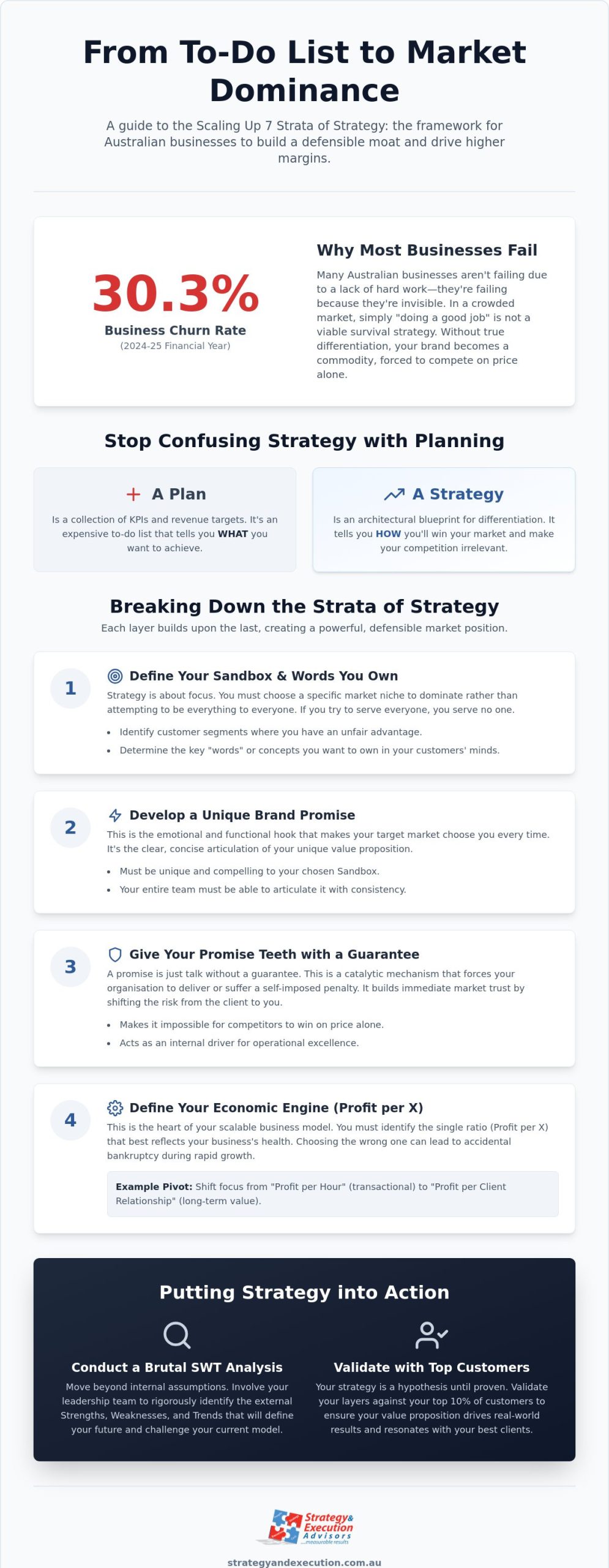
Most Australian businesses aren’t failing because they lack hard work; they’re failing because they’re invisible. With a business churn rate of 30.3 per cent in the 2024-25 financial year, simply “doing a good job” is no longer a viable survival strategy. If your brand feels like a commodity in a crowded market, your strategic plan is likely just a list of aspirations without a structural foundation. Implementing the scaling up 7 strata of strategy isn’t about adding more tasks to your plate. It’s about deciding exactly what you won’t do so you can dominate what you will.
You’ve likely felt the frustration of a plan that looks brilliant in the boardroom but crumbles when it hits the real world. It’s exhausting to lead a team that can’t articulate your unique value proposition with consistency. We’re going to fix that. This article provides the framework to master the seven layers of strategic differentiation, moving your business from a price-taker to a respected industry leader. You’ll learn how to build a defensible moat around your operations and align your team around a message that drives higher margins. We’ll move beyond abstract theory into the disciplined application of a system that works.
Key Takeaways
- Stop confusing operational efficiency with strategy. Learn to build a defensible moat that protects your margins from the trap of commoditisation.
- Discover how the scaling up 7 strata of strategy forces you to choose a specific “Sandbox” to dominate rather than attempting to be everything to everyone.
- Develop a Brand Promise that guarantees unique value and makes it impossible for your competitors to win on price alone.
- Move beyond internal assumptions by conducting a brutal SWT analysis with your leadership team to identify the external trends that will define your future.
- Learn the exact steps to validate your strategic layers against your top 10 per cent of customers to ensure your value proposition drives real-world results.
Beyond the Vision Statement: Why the 7 Strata of Strategy Matter
Many executives believe they have a strategy when they actually have an expensive to-do list. Doing things better than your competitors is merely operational effectiveness. It’s necessary, but it isn’t enough. Strategy is about doing things differently. The scaling up 7 strata of strategy framework acts as the architectural blueprint for this differentiation. It builds a defensible moat around your business, ensuring you aren’t forced into a race to the bottom on price. This is the essence of strategic management; it’s about making specific, difficult choices that your competitors won’t or can’t replicate.
To better understand this concept, watch this helpful video:
Without this framework, companies often suffer from “strategic drift.” As you grow, the original intent of the business becomes diluted by day-to-day fires. The 7 Strata bridge the gap between your high-level vision and the daily execution rhythms of your team. It grounds your abstract goals in a rigorous, multi-layered system that demands accountability. You don’t need more ideas. You need a system to filter out the wrong ones.
The Reality of the Australian Mid-Market
Scaling a business in competitive hubs like Brisbane or Adelaide presents unique challenges. The hunt for top-tier talent is brutal, and clients have more options than ever. In this environment, a “good enough” strategy leads to immediate stagnation. If you feel like you’ve hit a wall, you’re likely overcoming a business growth plateau that requires a fundamental shift in how you compete. You can’t out-work a bad strategy. Precision is your only path to sustainable growth.
Strategy vs. Planning: A Necessary Distinction
Look at your current plan. Is it a collection of KPIs and revenue targets, or does it explain how you will win? A plan tells you what you want to achieve; the 7 Strata tells you how you’ll make it happen. It forces you to define your sandbox and the unique value you guarantee. If you can’t articulate why you’re different in one sentence, you don’t have a strategy. You have a wish list. The scaling up 7 strata of strategy requires you to move beyond theory and into the hard work of defining your market dominance.
To gain the clarity needed to define this market dominance, you can visit Carter Strategies and explore their business strategy consulting and fractional CMO and CRO services for mid-size firms.
The Framework: Breaking Down the 7 Strata of Strategy
Most leaders treat the One-Page Strategic Plan as a fill-in-the-blanks exercise. It’s not. The scaling up 7 strata of strategy provides the rigour needed to ensure your plan actually produces results. This framework is a stack of decisions where each layer reinforces the next. If you fail to define the “Words You Own” in Layer 1, your “Brand Promise” in Layer 2 will be hollow. You can’t skip steps and expect to win.
Defining Your Sandbox and Brand Promise
Identify the specific customer segments in Queensland or South Australia where you possess an unfair advantage. Strategy is about focus. If you try to serve everyone, you serve no one. Your Brand Promise is the emotional and functional hook that makes your target market choose you every time. However, a promise is just talk without Layer 3: the Brand Promise Guarantee. This is a catalytic mechanism that forces your organisation to deliver or suffer a self-imposed penalty. It builds immediate market trust because the risk sits with you, not the client. It gives your promise teeth.
The Economic Engine and Profit per X
Your economic engine is the heart of building a scalable business model. You must identify your “Profit per X”, the single ratio that best reflects your business’s health. Choosing the wrong metric can lead to accidental bankruptcy during rapid growth. For example, a professional services firm might pivot from “Profit per Hour” to “Profit per Client Relationship” to incentivise long-term value over transactional billing. Understanding these foundations of scaling ensures your growth is profitable, not just fast.
If your current metrics aren’t driving the right behaviours, it’s time for an objective review of your strategic layers to ensure your team is pulling in the same direction.
Implementing the 7 Strata: A Roadmap for Australian Leaders
Execution is the graveyard of most strategic plans. To avoid this, you must move from theory to a disciplined scaling up 7 strata of strategy rollout. It begins with a brutal SWOT and SWT analysis. Don’t settle for surface-level observations. Identify the external trends that will disrupt your industry in the next three years and assess if your current strengths are actually relevant. This isn’t a feel-good exercise; it’s a diagnostic requirement for survival.
Once you’ve identified your sandbox, draft the first three strata. Test these immediately against your top 10 per cent of customers. If your Brand Promise doesn’t resonate with your most profitable clients, it isn’t a promise; it’s a hallucination. Use their feedback to refine your “Words You Own” before moving to the next layer. This iterative approach ensures your strategy is market-validated before you commit significant resources.
Integrate these findings into your One-Page Strategic Plan (OPSP). This ensures the strategy remains visible to every member of the leadership team. Finally, establish a quarterly review rhythm. Strategy is a living discipline, not a document that gathers dust on a shelf. Reviewing your progress every 90 days allows you to pivot before a minor market shift becomes a major catastrophe.
Common Pitfalls in Scaling Up Implementation
The most dangerous trap is “strategy by committee.” When you try to please everyone, you dilute your differentiation until it’s meaningless. Strong strategy requires the courage to say no to good opportunities so you can say yes to great ones. Don’t let your scaling up implementation plan fail because you’re afraid of internal conflict. Similarly, stop claiming you don’t have time for strategy. You don’t have time for the inefficiencies that result from a lack of it.
The Role of the Strategic Advisor
You cannot effectively coach your own team while you’re playing the game. An external advisor provides the “tough love” needed to challenge the status quo and eliminate internal bias. They force the difficult conversations that internal teams often avoid. Attending Strategy & Execution Advisors’ events is a high-impact way to achieve leadership alignment and gain outside perspective. For Brisbane-based leaders ready to translate these principles into action, a structured business strategy workshop Brisbane provides the facilitated environment needed to move from strategic drift to disciplined execution. If you’re ready to stop guessing and start dominating, contact Ted Bonel to start your Scaling Up journey today.
Move Beyond Theory to Market Dominance
Stop treating strategy as an annual retreat and start treating it as a competitive discipline. We’ve established that differentiation is your only protection against the churn of the Australian mid-market. By defining your sandbox and anchoring it with a Brand Promise Guarantee, you move from being a commodity player to a market leader with a defensible moat. Implementing the scaling up 7 strata of strategy requires a fundamental shift in leadership focus, moving away from mere operational efficiency toward genuine strategic distinction.
Execution requires more than just a plan; it demands an objective perspective to challenge internal biases. Ted Bonel is a Certified Scaling Up Practitioner with over 20 years of experience driving growth for Australian businesses. As a specialist in E-Myth and ExO methodologies, he provides the battle-tested guidance needed to turn complex frameworks into measurable results. Don’t let your growth plateau due to a lack of structural clarity.
It’s time to align your leadership team and engineer your path to industry leadership. Book a Strategy Alignment Session with Ted Bonel to begin the rigorous work of scaling your business with precision. Your market dominance is waiting; it’s time to build the structure that makes it inevitable.
Frequently Asked Questions
What are the 7 Strata of Strategy in the Scaling Up framework?
The framework consists of seven specific layers designed to build a structural competitive advantage. These layers include the Words You Own (your sandbox), your Brand Promise, the Brand Promise Guarantee, One-PH (One-Page Health), your Economic Engine (Profit per X), and your 10 to 25 year BHAG (Big Hairy Audacious Goal). Each layer provides the rigour needed to ensure your market position is defensible and your growth is profitable.
How do the 7 Strata differ from a traditional business plan?
Traditional business plans are often just lists of financial targets and tactical goals that fail to address competition. The scaling up 7 strata of strategy focuses on differentiation and market positioning. It forces you to define exactly how you will win against competitors rather than just stating what you want to achieve. It moves the conversation from what you sell to why your unique offering makes you the only logical choice for your target market.
How long does it take to implement the 7 Strata of Strategy?
Strategic alignment isn’t a quick fix or a weekend project. While you can draft the initial layers during a focused two-day executive retreat, fully testing and refining the framework typically takes two to three quarters. You must validate your Brand Promise against real customer feedback and ensure your economic engine is actually driving the right behaviours before the system is fully operational. Discipline is more important than speed during this phase.
Can a small business use the 7 Strata, or is it only for mid-market firms?
Small businesses should use this framework to avoid the trap of becoming an invisible commodity. While the complexity of the scaling up 7 strata of strategy is particularly vital for mid-market firms navigating rapid growth, the core principles of focus and differentiation apply to any organisation. If you intend to scale, building these foundations early prevents the strategic drift that often leads to stagnation or collapse as a business expands.
Need Help Turning Strategy Into Results?
Let’s talk about your goals and how we can help you move forward with clarity and confidence.
