

Your business isn’t stalled because of the 6.75 per cent prime rate or tightening credit standards. It’s stuck because your current operating system has reached its absolute limit. You have hit the invisible ceiling where individual grit no longer scales. This is the blunt reality of overcoming business growth plateau challenges in 2026. What got you to this turnover level will not get you to the next. You are currently the primary bottleneck in your own organisation. Every critical decision sits on your desk. Your team is constantly busy, yet strategic drift is pulling you away from your core objectives.
It is time to stop reacting and start architecting. You know your current growth strategies have plateaued, leaving you with tightening cash flow and increasing operational complexity. This guide provides the blueprint to implement the rigorous execution frameworks required to break through. We will examine how to dismantle the founder-dependent model and replace it with a system-dependent enterprise. You will discover how to align your executive team and install the accountability rhythms necessary for predictable, scalable revenue growth.
Key Takeaways
- Identify the structural failures that turn successful people-dependent businesses into stagnant, complex traps.
- Learn why overcoming business growth plateau challenges requires a shift from founder heroics to disciplined operational rhythms.
- Master the four critical decisions regarding People, Strategy, Execution, and Cash to restore momentum and align your executive team.
- Implement the Rockefeller Habits to synchronise your organisation and eliminate operational bottlenecks through high-frequency execution cadences.
- Recognise that sustained scaling is a result of rigorous discipline rather than mere inspiration or market luck.
The Growth Plateau Myth: Why “Working Harder” is a Strategy for Stagnation
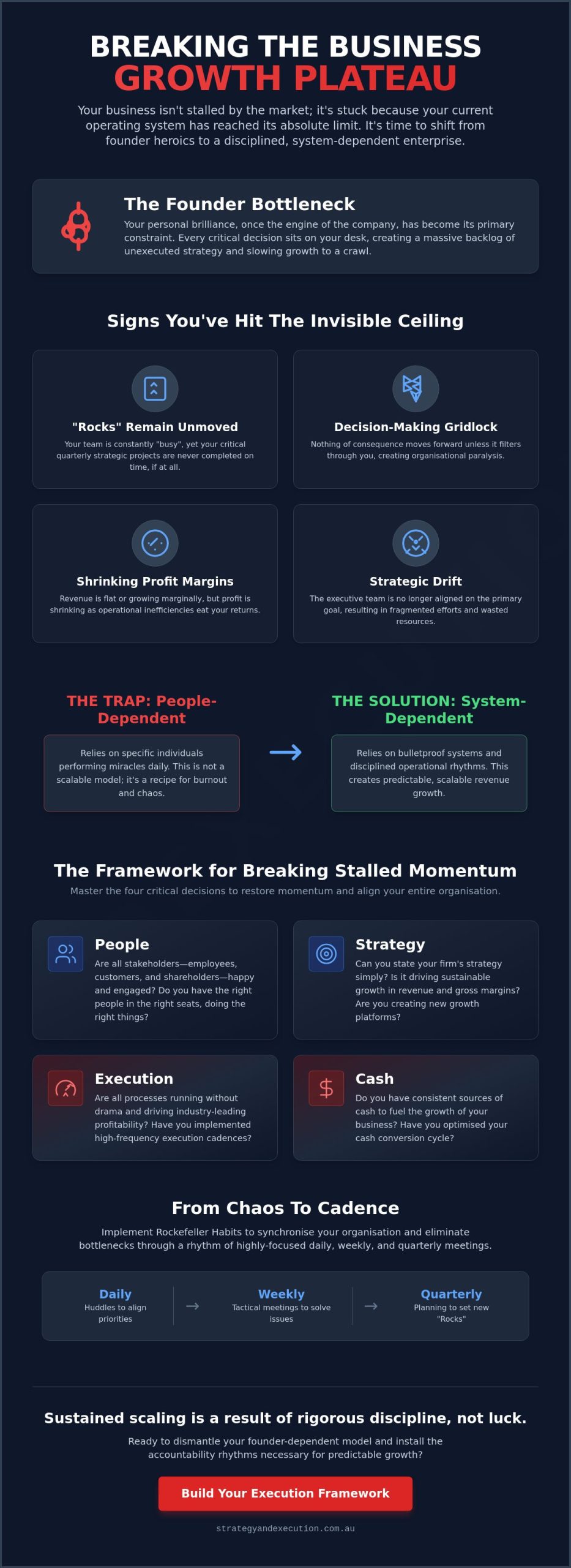
High-growth firms often hit a wall not because the market has shifted, but because their internal systems have failed. A business growth plateau occurs the exact moment your operational complexity outpaces your leadership capacity. It’s a structural failure. Most founders respond by redoubling their efforts, working longer hours, and demanding more from an already exhausted team. This is a mistake. Effort is not the solution when the underlying architecture is flawed. Your personal brilliance, once the engine of the company, has become its primary constraint.
This “Founder Bottleneck” creates a ceiling that no amount of individual grit can shatter. In cities like Brisbane and Adelaide, executive teams are feeling the emotional toll of this stagnation. They are busy, but they aren’t productive. They are running faster just to stay in the same place. This creates a culture of frustration where the initial passion for the business is replaced by a grinding sense of futility. To understand the mechanics of this stall, watch this analysis of the levers required for a breakthrough:
The “More Sales” Fallacy
The most dangerous instinct when facing a plateau is to “sell your way out of it”. It doesn’t work. Increasing volume on a broken process creates a black hole for your cash. In the Australian mid-market, we often see “Top-line Vanity” masking a total lack of “Bottom-line Sanity”. If your margins are thinning, more sales will only accelerate your collapse by stretching your inadequate systems to the breaking point. A plateau is a structural ceiling, not a market dip. Overcoming business growth plateau challenges requires you to stop chasing every lead and start building new growth platforms that can actually support a larger organisation without requiring your constant intervention.
Signs You Have Hit the Invisible Ceiling
Recognising the ceiling is the first step toward dismantling it. If you identify with the following symptoms, your business is currently outgrowing its architects:
- The “Rocks” remain unmoved: Your team is constantly “busy”, yet your critical Quarterly Rocks are never completed on time.
- The CEO bottleneck: Decision-making has slowed to a crawl. Nothing moves unless it filters through you, creating a massive backlog of unexecuted strategy.
- Profit erosion: Your revenue remains flat or shows marginal growth, but your profit margins are shrinking as operational inefficiencies eat your returns.
- Strategic drift: The executive team is no longer aligned on the “Big Hairy Audacious Goal”, resulting in fragmented efforts and wasted resources.
If these signs are present, your current operating system is obsolete. You don’t need more sales; you need a more robust framework for execution.
The Peter Principle for Organisations: When Systems Outgrow Their Architects
Most businesses don’t fail due to a lack of effort; they simply rise to their management team’s level of competency and then stall. This is the organisational Peter Principle. Your company has reached the limit of its current structure. Tactics that drove you to $5 million in turnover are the very obstacles preventing you from reaching $20 million. You’ve fallen into the “People-Dependent” trap. Instead of relying on bulletproof systems, you’re relying on specific individuals to perform miracles daily. This is not a scalable model; it’s a recipe for burnout.
In Queensland, we frequently see “Strategic Drift” take hold of established firms. This isn’t a lack of work ethic. It’s a lack of alignment. Your executive team is likely pulling in slightly different directions, creating internal friction that burns through cash and momentum. Overcoming business growth plateau hurdles requires a total redesign of your leadership architecture. If your team isn’t perfectly synchronised, your growth will remain stagnant. You need to move from being a collection of talented individuals to a unified execution machine.
The E-Myth Reality Check
You must distinguish between working in the business and working on it. Heroic effort is a liability, not an asset. If your business requires a hero to save the day every Tuesday, your systems have failed. Scalable growth requires a shift toward E-Myth Mastery, where the business becomes a systems-dependent entity. This transition is non-negotiable for those serious about breaking the invisible ceiling. Stop rewarding fire-fighting and start rewarding the creation of fire-prevention systems.
The Complexity Gap
As you scale, you hit “Valleys of Death” at specific headcount and revenue milestones. Complexity doesn’t grow linearly; it grows exponentially. When you move from five staff to fifty, the number of communication channels doesn’t just double, it explodes. This “Communication Chaos” is where most growth dies. You need a professional business architect to redesign your framework before the weight of your own success crushes your margins. If you’re ready to stop the drift and restore your momentum, it’s time to speak with a strategist about your structural alignment.
The 4 Critical Decisions: A Framework for Breaking Stalled Momentum
Breaking a stall requires more than just a new marketing plan. It requires a complete overhaul of your decision-making framework. Overcoming business growth plateau limitations is impossible without addressing the four pillars of scaling: People, Strategy, Execution, and Cash. These aren’t abstract concepts. They are the structural beams of a high-performance organisation. If one is weak, the entire building shakes. You must move beyond the “heroic effort” discussed previously and install a repeatable system for growth.
Mastering these four areas transforms a business from a chaotic collection of tasks into a streamlined execution machine. People decisions focus on getting the right talent in the right seats. Strategy ensures you aren’t just busy, but are actually building a competitive advantage. Execution turns that strategy into a daily habit through rigorous rhythms. Finally, Cash management ensures you have the oxygen required to fund your expansion. If you ignore any of these, your growth will remain accidental rather than intentional. Leaders who are serious about building a scalable business model understand that these four decisions must be addressed simultaneously, not sequentially.
Winning the Talent War in Brisbane and Adelaide
B-players are the silent killers of momentum. In a plateaued business, you cannot afford to carry underperformers who require constant supervision. You need a culture where accountability is built into the system, not forced by the CEO. For those ready to align their leadership, the Scaling Up Program Australia provides the exact roadmap for building a high-performance team. Stop settling for “good enough” and start demanding excellence from every member of your executive suite. Accountability is the only cure for the micromanagement trap.
Strategy as a Differentiator, Not a Document
Most Australian SMEs mistake a to-do list for a strategy. If your plan looks like every other competitor’s in your sector, it isn’t a strategy; it’s a commodity. True strategy involves the 7 Strata of Strategy, finding your unique “sandwich” in the market that competitors cannot replicate. This requires the discipline to focus on 10x growth opportunities rather than incremental gains. Strategy is fundamentally about the courage to say “no” to the wrong opportunities so you can say “yes” to the right ones. Without this clarity, your team will continue to drift, busy but ultimately unproductive.
Execution is the final frontier. You must transform your strategic goals into a “habit” through rigorous meeting rhythms. This isn’t about more meetings; it’s about better ones. By synchronising your team through daily, weekly, and quarterly cadences, you eliminate bottlenecks before they become crises. This discipline allows you to accelerate your cash conversion cycle, providing the capital needed to scale without relying on external debt.
From Chaos to Cadence: Implementing Execution Rhythms to Restore Momentum
Strategic drift occurs when your team lacks a pulse. To stop the drift, you must install the Rockefeller Habits. These are not optional suggestions; they are the operational heartbeat of every high-growth firm. If you are serious about overcoming business growth plateau hurdles, you must move from a culture of random activity to one of disciplined cadence. This starts with the Daily Huddle. It is a 15-minute stand-up designed to synchronise the team and clear immediate bottlenecks. If a problem takes longer than 60 seconds to explain, it moves to a separate breakout. Stop wasting time in unstructured chats and start managing by rhythm.
The 90-Minute Weekly Rhythm
The weekly meeting is where strategy meets reality. It is not a status update; it is a collective problem-solving session. You must structure the agenda for maximum impact and zero fluff. Decisions should be driven by hard data rather than subjective opinions or gut feelings. In many Australian boardrooms, too much time is spent debating anecdotes. Instead, use your weekly rhythm to interrogate the numbers. To ensure your leadership team stays on track, follow the Rockefeller Habits Weekly Meeting Agenda. This 90-minute rhythm ensures your “Rocks” stay prioritised and your team remains aligned on the quarterly objectives without getting bogged down in minutiae.
KPIs and Critical Numbers
Most Australian managers focus on lagging indicators like last month’s profit. This is like driving a car while only looking in the rearview mirror. You need leading indicators, the “Critical Numbers” that predict future success. Give every employee a single number they can own and influence. When everyone has a clear metric, accountability becomes automatic. You don’t need to micromanage when the scoreboard tells the story. Create a visible scoreboard that makes progress undeniable to the entire team. High-growth teams don’t wonder if they are winning; they see it on the board every day. If the number is red, the team self-corrects. If it’s green, momentum builds.
Execution is a muscle that requires consistent training. If your team is struggling to maintain pace or if your growth has flatlined, it is time to install these execution rhythms and reclaim your momentum.
Scaling Beyond the Plateau: Why Discipline Beats Inspiration Every Time
Growth is never a matter of luck. It is the calculated result of disciplined execution. Many leaders wait for a market shift or a lucky break to resume their climb. This is a strategy for failure. Overcoming business growth plateau hurdles requires you to stop relying on inspiration and start relying on a system. Inspiration is a spark; discipline is the engine. You must move from the abstract “Exponential Organisation” mindset into the daily reality of rigorous management. This is how you bridge the gap between your current stagnation and your true potential. High-growth firms don’t wait for the market to improve; they build the internal capacity to dominate it regardless of external conditions.
Brisbane and Adelaide leaders often find themselves trapped in the “thick of thin things”. They are busy with low-value tasks that should be automated, delegated, or eliminated. Reclaiming your time requires the courage to step out of the engine room and onto the bridge. You cannot steer the ship if you are shovelling coal. This transition is difficult to achieve alone. An external advisor provides the “tough love” and objective perspective necessary to identify the blind spots that are stalling your progress. You need a strategist who values measurable progress over abstract concepts.
The Role of a Certified Scaling Up Coach
Self-implementation is where most scaling efforts die. Internal politics and the “whirlwind” of daily operations usually choke out new initiatives before they can take root. A battle-tested strategist like Ted Bonel brings the discipline required to keep the Queensland executive team focused on what matters. You need someone who isn’t afraid to challenge your assumptions and hold your team accountable to their commitments. To begin this process, you need a clear Scaling Up Implementation Plan. This is the roadmap that moves you from theory to tangible results by installing the systems your business actually needs.
Your Next 90 Days
Your transformation begins with a single Quarterly Rock. This is the one priority that, if achieved, makes every other goal easier or unnecessary. Commit to the rhythm now. A $100 million business is built one disciplined quarter at a time. Stop accepting stagnation as a natural phase and start treating it as a structural problem to be solved. If you are ready to break the invisible ceiling and restore your momentum, it’s time to organise a Strategic Growth Advisory session. The choice to scale is yours; the discipline to execute is where we begin.
Architecting Your Future: Transition from Operator to Strategist
Stagnation is a choice, but so is scaling. You’ve seen that overcoming business growth plateau barriers requires a fundamental shift from people-dependency to systems-dependency. It is about moving from working in the business to architecting its future. By aligning your executive team and implementing the Rockefeller Habits, you replace operational chaos with a predictable, high-performance cadence. The invisible ceiling only exists as long as your current operating system remains unchanged.
You don’t have to navigate this structural shift alone. Ted Bonel is a Certified Scaling Up and Rockefeller Habits Practitioner with over 20 years of strategic leadership experience. He provides specialised ExO consulting designed to drive 10x growth for Australian mid-market firms. Stop letting strategic drift erode your margins and start building a business that runs independently of your daily intervention. Break through your growth ceiling—book a Scaling Up consultation with Ted Bonel today. It’s time to reclaim your time and lead your organisation to its next level of evolution.
Frequently Asked Questions
Is a business growth plateau a sign that my market is saturated?
A plateau is rarely a market saturation issue; it is almost always a structural constraint within your organisation. Unless you have captured 100 per cent of your total addressable market, the limit is internal. You’ve likely reached the maximum capacity of your current processes and leadership habits. Overcoming business growth plateau hurdles requires looking inward at your systems rather than blaming external market conditions or competitor activity.
How can I tell if I am the “bottleneck” in my own company?
You are the bottleneck if the business stops moving or decision-making stalls when you step away for a week. If your executive team waits for your approval on minor operational matters, you have a hero-dependent model. This lack of autonomy prevents scaling and creates a ceiling. You must transition from being the primary problem-solver to being the architect of systems that solve problems automatically without your intervention.
Can the Rockefeller Habits be implemented in a small team of under 10 people?
Yes, implementing these habits in a small team builds a high-performance culture before complexity explodes. Small teams benefit immensely from the clarity and alignment these rhythms provide. It’s much easier to install these systems early in your journey than to try and retrofit them once you have 50 employees and a collection of established bad habits that resist change.
How long does it typically take to break through a revenue plateau?
Breaking a plateau typically requires one to two full quarterly cycles of disciplined execution to see measurable results. While you might see immediate improvements in team communication and morale, structural revenue shifts take time to manifest in your accounts. You must commit to the rhythms and the data-driven decision-making process. Consistency is the only way to ensure the breakthrough is permanent.
What is the difference between a business coach and a Scaling Up advisor?
A business coach often focuses on individual mindset and general accountability; a Scaling Up advisor implements a specific, battle-tested framework for mid-market growth. Scaling Up advisors focus on the four critical decisions of People, Strategy, Execution, and Cash. They act as business architects who redesign your organisation’s operating system to handle increased complexity and drive predictable outcomes.
How much time do I need to commit to execution rhythms each week?
You should expect to commit approximately three hours per week to formal execution rhythms. This includes a 15-minute daily huddle to synchronise the team and a 90-minute weekly meeting to solve strategic issues. While this may seem like an additional burden, it actually saves hours of unstructured communication and redundant emails that typically clog a plateaued business.
What happens if my executive team is resistant to new management systems?
Resistance usually indicates that you have the wrong people in the right seats or a lack of alignment on the company’s vision. Scaling requires a team that values accountability and disciplined rhythms. If executives refuse to adopt proven systems, they are choosing stagnation over growth. You must address this resistance immediately or your scaling efforts will be sabotaged by internal friction.
Why do most Australian businesses fail to scale beyond 20 employees?
Most Australian firms stall at this stage because the founder’s personal span of control reaches its absolute limit. At 20 employees, informal communication breaks down and “Communication Chaos” takes over. Without a professional management system, the business becomes too complex for the founder to manage via heroics. Scaling beyond this point requires a shift from a people-dependent to a systems-dependent organisation built on a scalable business model. To ensure that system is built on a foundation of genuine competitive advantage, explore how the scaling up 7 strata of strategy can give your organisation the structural differentiation it needs to dominate your market.
Need Help Turning Strategy Into Results?
Let’s talk about your goals and how we can help you move forward with clarity and confidence.
