

Why does your executive team spend forty hours a week in meetings only to miss every major strategic milestone? You’re likely exhausted by high execution drama and the constant friction between departments that should be aligned. It’s frustrating to watch critical numbers get ignored while your people mistake frantic activity for actual progress. Stop tolerating a culture that values movement over results. By implementing the right leadership team performance metrics, you’ll transform your executive suite from a source of friction into a high-velocity execution engine. We’ll show you how to cut through the noise by measuring the four critical decisions that drive sustainable mid-market growth. This guide provides a clear scoreboard to help you prioritise outcomes and ensure your strategic goals are finally met with discipline and precision.
Key Takeaways
- Identify and eliminate “execution drama” by shifting your focus from vanity metrics to tangible outcomes that actually move the needle.
- Implement the 4 Decisions framework to establish robust leadership team performance metrics that ensure the right people are in the right seats.
- Define your “North Star” metric and align your entire organisation using the One-Page Strategic Plan (OPSP) as your ultimate scoreboard.
- Establish disciplined Rockefeller Habits meeting rhythms to ensure your strategic data is reviewed, prioritised, and acted upon every single day.
Beyond Vanity Metrics: Why Busy Leadership Teams Often Fail to Execute
Execution drama is the silent killer of growth. It is the friction, the repeated meetings about the same unresolved issues, and the departmental finger-pointing that occurs when leadership team performance metrics are absent or flawed. Most C-suites mistake frantic activity for progress. They report on busy schedules while their strategic goals remain stagnant. This drama is your primary negative metric; the higher the drama, the lower your execution capacity.
Traditional Key Performance Indicators (KPIs) often fail because they track individual department outputs in isolation. This masks deep-seated misalignments. If your leaders aren’t pulling in the same direction, those metrics are just vanity numbers. You must pivot to “Decision Velocity”. This indicator measures how quickly your team identifies a roadblock, decides on a fix, and implements it. True scalability requires you to prioritise outcomes over the sheer volume of activity.
Shifting Focus from Individual Output to Collective Alignment
Individual KPIs frequently incentivise departmental silos in Australian firms. When leaders only care about their own patch, the whole organisation suffers. You need a Function Accountability Chart (FACe) to clarify exactly who owns which result. This tool removes the “who’s doing what” confusion that plagues many boards. Alignment is the synchronisation of the entire team toward a single One-Page Strategic Plan (OPSP). You can learn more about these Scaling Up – Strategy Execution & Accountability Systems to ensure every leader is accountable to the same scoreboard. Without this shared focus, you don’t have a team; you have a group of individuals protecting their own interests.
The 4 Decisions Framework: A Scoreboard for High-Growth Teams
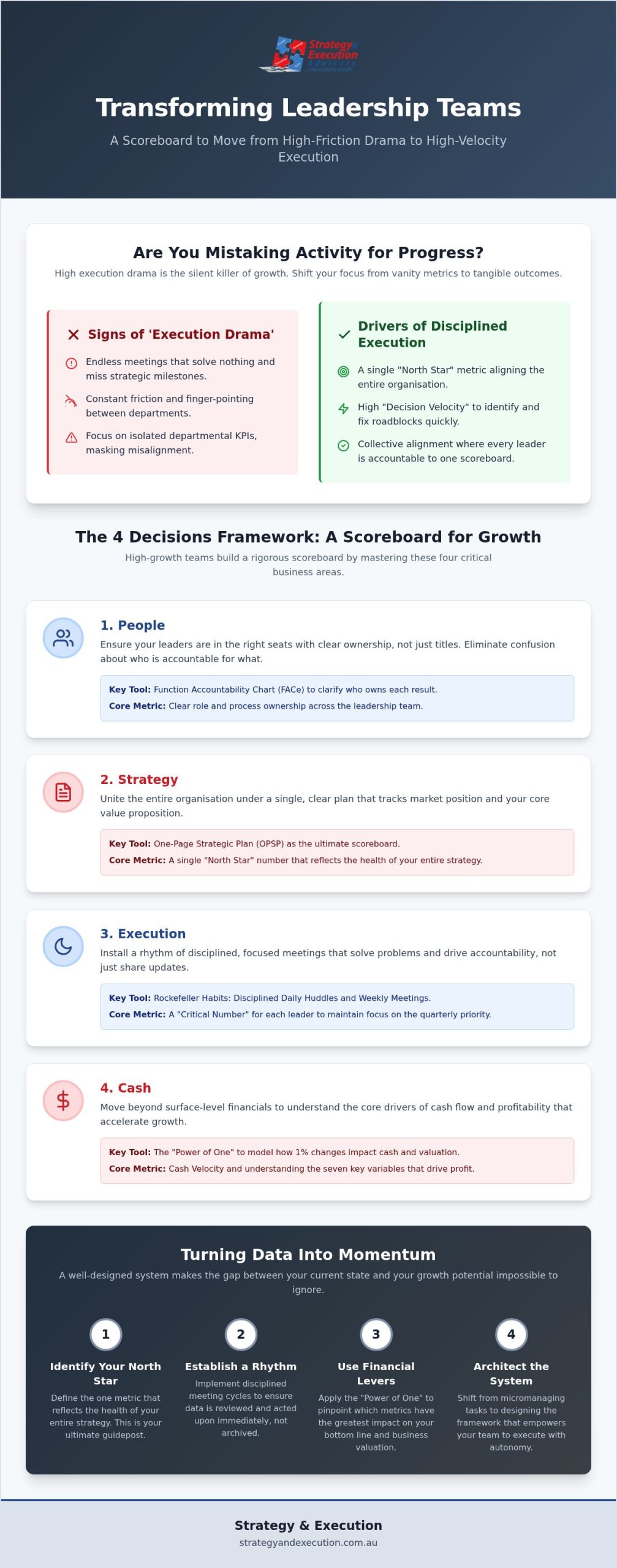
High-growth teams don’t settle for vague goals. They use the 4 Decisions framework to build a rigorous scoreboard. For People, use the Function Accountability Chart (FACe) to ensure your leaders are actually in the right seats. It’s about ownership, not just titles. Strategy metrics must track your Core Value Proposition and market share against the 7 Strata of Strategy. This isn’t theoretical; it’s about structural integrity. A longitudinal study on leadership and team effectiveness highlights that performance is driven by these specific, measurable behaviours rather than general management. If your leadership team performance metrics don’t include cash velocity, you’re flying blind. Use the “Power of One” to identify how 1% changes in price or volume impact your cash flow. These metrics force your team to understand the seven key variables that drive profit.
Execution Accountability and the Rhythm of Success
Execution is a habit, not an event. You must measure the effectiveness of your Daily Huddles and Weekly Meetings. Are they solving problems or just sharing updates? Every leader needs a “Critical Number” to prevent strategic drift and maintain focus on the quarterly priority. This number should be the heartbeat of your accountability system. Following a structured Rockefeller Habits Weekly Meeting Agenda ensures your data is reviewed with discipline and precision. Don’t let your meetings descend into aimless discussion. If your current rhythms feel like a waste of time, it’s time to realign your executive team to focus on tangible outcomes. This shift moves you from supervising activity to driving execution.
Building Your Scoreboard: Turning Data into Momentum
For Brisbane businesses, alignment starts with a single “North Star” metric. This isn’t a collection of departmental targets; it is the one number that reflects the health of your entire strategy. Once identified, you must establish a meeting rhythm that ensures data is reviewed and acted upon immediately. Don’t let your reports gather dust in an archive. Use these leadership team performance metrics to drive real-time adjustments. If the data doesn’t trigger an action, it is a vanity metric that you should discard.
The “Power of One” levers are your most potent tools for increasing business value. By focusing on the seven financial drivers, you identify which specific leadership team performance metrics will have the greatest impact on your final valuation. As a leader, your job is to be the architect of this system. Stop micromanaging individual tasks. Start designing the framework that allows your team to execute with autonomy. A well-designed system makes the gap between your current state and your growth potential visible and impossible to ignore.
Reducing Execution Drama in Queensland Leadership Teams
Implementing a Scaling Up Implementation Plan provides the roadmap Queensland CEOs need to move beyond operational chaos. High-visibility scoreboard design makes performance undeniable. When everyone can see the score, accountability becomes automatic. This shift allows you to transition from “People Management” to “System Management” using E-Myth principles. You aren’t just managing staff; you are refining a high-performance engine. This discipline reduces friction and ensures your strategic execution is both sustainable and profitable.
Stop Measuring Activity and Start Driving Execution
Stop tolerating execution drama and departmental silos. Your growth depends on your ability to measure what actually matters. We’ve explored how to move beyond busy-work by implementing the 4 Decisions framework and establishing a rigorous scoreboard. By focusing on your “North Star” and utilising the “Power of One” levers, you transform your executive team into a high-velocity execution engine. Effective leadership team performance metrics are the difference between a business that plateaus and one that achieves 10x growth. You don’t need more meetings; you need better rhythms and absolute accountability.
As a Brisbane-based Certified Scaling Up Practitioner, Ted Bonel uses the proven Rockefeller Habits framework to help leaders like you streamline operations and realise tangible results. It’s time to stop micromanaging tasks and start architecting a system that works. Contact Ted Bonel to build your high-performance leadership scoreboard today. You’ve got the vision; now build the discipline to execute it.
Frequently Asked Questions
What are the most important KPIs for a leadership team?
The most critical leadership team performance metrics focus on the 4 Decisions: People, Strategy, Execution, and Cash. You must track the percentage of “A Players” using the FACe tool and monitor your Core Value Proposition’s market impact. Additionally, measuring your Cash Conversion Cycle ensures your growth is sustainable. Don’t waste time on individual departmental output; prioritise metrics that reflect collective alignment and strategic velocity.
How do we measure “Execution Drama” in a growing business?
You measure execution drama by tracking the frequency of unresolved issues and the number of items that carry over between weekly meetings. If your team has more than five quarterly priorities, you’re likely creating friction. High drama manifests as departmental finger-pointing and repetitive discussions. Quantify this by measuring “Decision Velocity”, the time taken from identifying a bottleneck to implementing a permanent solution.
What is the “Power of One” in leadership performance?
The “Power of One” is a financial framework that measures how 1% changes in seven key levers, such as price, volume, and overheads, impact your cash flow and business valuation. It forces leaders to move beyond surface-level profit and loss statements. By focusing on these specific levers, you identify the exact leadership team performance metrics that will drive the most significant organisational change.
How often should a leadership team review their performance metrics?
Review your metrics according to the Rockefeller Habits meeting rhythms: daily, weekly, monthly, and quarterly. Daily huddles track immediate progress, while weekly meetings focus on the tactical review of your scoreboard. Monthly and quarterly sessions allow for deeper strategic pivots. Consistent review prevents strategic drift and ensures your team remains disciplined. If you only look at data monthly, you’re already too late.
Need Help Turning Strategy Into Results?
Let’s talk about your goals and how we can help you move forward with clarity and confidence.
