

Your weekly leadership meeting is likely the most expensive and least productive hour in your business calendar. Most executives tolerate circular status updates that offer zero strategic value while critical bottlenecks remain unaddressed for months. It’s a waste of talent and a drag on your momentum. You didn’t build a high-growth company to spend your Mondays rehashing the past.
By implementing a disciplined Rockefeller Habits weekly meeting agenda, you can shift your focus from reporting history to driving execution. This article provides a repeatable framework to ensure team accountability and total alignment on your 13-week Rock priorities. We’ll show you how to master the 90-minute rhythm that solves problems in real-time and keeps your team focused on the Critical Numbers that actually move the needle for your Australian business. It’s time to stop talking about work and start doing the work that scales.
Key Takeaways
- Shift status updates to your Daily Huddle to liberate your weekly session for high-impact strategic debate and bottleneck removal.
- Adopt a disciplined rockefeller habits weekly meeting agenda to ensure your leadership team remains aligned on 13-week Rock priorities and Critical Numbers.
- Protect your company’s Cash by treating meeting time as a premium investment, enforcing strict 90-minute boundaries to drive faster decision-making.
- Replace casual Australian “mateship” culture with a rigorous execution rhythm that prioritises collective accountability over comfortable status quo.
The Purpose of the Weekly Rhythm: Eliminating the Status Update Rot
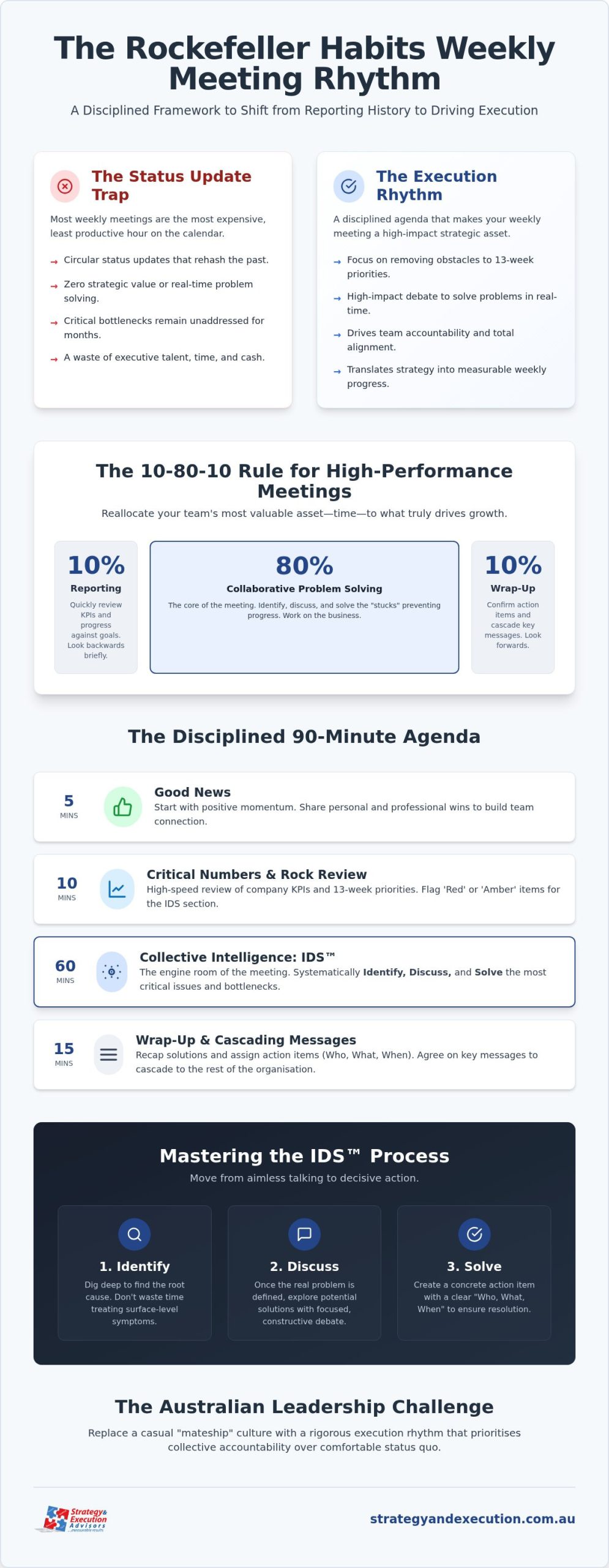
Most leadership teams treat their weekly meeting as a historical briefing. They go around the room, person by person, reciting what they did last week. This is a waste of expensive executive brainpower. Status updates belong in the Daily Huddle. The weekly meeting is the heartbeat of the Execution pillar within the Rockefeller Habits. Its purpose isn’t to report history. It’s to change the future by removing obstacles before they derail your quarterly goals.
When your team loses sight of their 13-week Rock priorities and Critical Numbers, execution drama inevitably follows. Execution drama is the friction caused by a lack of alignment and accountability. It manifests as missed deadlines, finger-pointing, and the same problems resurfacing every fortnight. A structured rockefeller habits weekly meeting agenda eliminates this noise by forcing the team to confront reality every seven days. By aligning this rhythm with your One-Page Strategic Plan, you ensure that every minute spent in the boardroom translates into measurable progress.
The 10-80-10 Rule for High-Performance Execution
Elite teams follow a strict 10-80-10 time allocation to maintain momentum. Spend only 10% of your 90 minutes on reporting against your KPIs. Dedicate 80% to collaborative problem solving and identifying “stucks” that prevent the team from hitting their targets. Use the final 10% for wrap-up, cascading messages, and feedback. This structure ensures you are working on the business, not just in it.
Audit your last session with brutal honesty. If you spent 90% of your time looking in the rear-vision mirror at past performance, you aren’t leading. You’re just observing. High-growth execution requires a forward-looking perspective that identifies bottlenecks before they impact your bottom line. Stop rehashing yesterday and start architecting tomorrow.
The 90-Minute Agenda: A Disciplined Framework for Tangible Results
Your leadership team’s time is your most expensive company asset. In a room of five senior executives, you are burning thousands of Australian Dollars every hour in salary costs alone. Respect the team Cash. Start on time. End on time. This disciplined 90-minute rockefeller habits weekly meeting agenda ensures every leader stays locked onto the goals defined in your One-Page Strategic Plan. Kick off with five minutes of “Good News” to build positive momentum. Transition immediately to a high-speed review of your Critical Numbers and quarterly Rocks. If a priority is “Red” or “Amber”, do not let the team drift into excuses. Flag it, record it, and move to the next item. This level of execution focus is central to our Scaling Up Program Australia.
Mastering the IDS Process: Identify, Discuss, Solve
Most executive meetings fail because they confuse “talking” with “solving”. The IDS process is designed to kill the waffle. Spend the bulk of your 90 minutes here. First, Identify the root cause. Do not waste time on surface-level symptoms. If a project is stalled, find out why. Is it a resource gap or a lack of clarity? Next, Discuss the issue only after the problem is accurately defined. Finally, Solve the issue by creating a specific action item with a clear Who, What, and When. The facilitator must be assertive. Cut off the storytellers. Force the team to reach a concrete resolution before moving to the next “stuck”.
This rigorous problem-solving discipline is the engine room of a successful Scaling Up Implementation Plan. It prevents small frictions from becoming catastrophic failures. If your sessions still feel like aimless chat, it’s time to align your leadership team with a proven execution system. Accountability isn’t a suggestion; it’s a requirement for growth.
Implementing the Rhythm in Your Australian Leadership Team
Australian business culture often prides itself on being laid-back. While this helps with team morale, it’s frequently the primary obstacle to high-growth execution. This “mateship” approach creates a culture where leaders avoid difficult conversations to keep the peace. You cannot scale a company on politeness. Implementing a rigid rockefeller habits weekly meeting agenda isn’t about micro-management. It’s about professionalising your performance. For Brisbane CEOs, the transition begins by reframing the meeting as a tool for team support rather than a platform for scrutiny. To see these rhythms in action, many local leaders attend our Strategy & Execution Advisors events to witness the power of a disciplined cadence.
Overcoming Mateship Drift in Brisbane Executive Teams
Breaking the cycle of informal, unproductive chat requires a fundamental shift from personality to data. When a Rock is off-track, the discussion must focus on the numbers, not the individual. Using an external advisor during the initial roll-out is the most effective way to ensure the discipline sticks. An advisor acts as the “rhythm police”, cutting off the waffle and ensuring the IDS process remains objective. This allows the CEO to step out of the facilitator role and engage as a strategic leader. Discipline is the only way to eliminate execution drama and create the operational freedom required to scale. Stop accepting excuses. Start demanding results.
Master the Rhythm of High-Growth Execution
Transitioning from a loose chat to a high-performance execution rhythm is the difference between stagnation and scale. Status updates belong in the Daily Huddle; your weekly session must focus on removing the bottlenecks that stall your momentum. By adopting a disciplined rockefeller habits weekly meeting agenda, you ensure your leadership team remains aligned on the Critical Numbers that drive results. Professionalising your cadence turns your boardroom from a talk-shop into an engine of progress.
Strategy & Execution provides the proven frameworks for People, Strategy, Execution, and Cash used by thousands of global leaders. Led by Ted Bonel, a certified Scaling Up practitioner with 20+ years of Australian business growth expertise, we help you eliminate execution drama and install lasting accountability. Ready to install a world-class execution rhythm? Contact our team in Brisbane today. Your team is ready for the clarity that comes with a professional cadence. Start your next 90-minute rhythm with purpose.
Frequently Asked Questions
How long should a weekly leadership meeting last for a mid-market firm?
Implementing a rockefeller habits weekly meeting agenda requires exactly 90 minutes of dedicated time. This duration allows for a brief review of metrics while leaving 60 minutes for intensive problem-solving. Shorter sessions don’t work because the team spends the entire time reporting rather than resolving. A rigid 90-minute boundary respects executive time and prevents the meeting from drifting into unproductive discussions.
What is the difference between a daily huddle and a weekly leadership meeting?
The daily huddle is a 15-minute tactical synchronisation for immediate coordination. The rockefeller habits weekly meeting agenda, however, is a 90-minute strategic rhythm focused on removing obstacles to your 13-week Rocks. While the huddle manages the “now”, the weekly meeting ensures the leadership team remains aligned on the broader execution plan and the Critical Numbers that define your quarterly success.
Who should facilitate the meeting if the CEO is too involved in the details?
If the CEO’s deeply embedded in the details, they should delegate facilitation to another senior leader or an external advisor. This allows the CEO to participate fully in the debate rather than managing the clock. The facilitator must be empowered to shut down waffling and force the team toward a concrete Who, What, and When resolution for every strategic hurdle.
How do we handle execution drama when a Critical Number is in the red?
Handle red Critical Numbers by immediately moving them into the IDS portion of your agenda. Do not search for a scapegoat; search for the root cause of the bottleneck. The objective is to determine what specific adjustment is needed to get the metric back on track. This data-driven approach replaces execution drama with a collective commitment to hitting your quarterly targets.
Need Help Turning Strategy Into Results?
Let’s talk about your goals and how we can help you move forward with clarity and confidence.
