

Your executive team’s inability to agree isn’t a personality clash. It’s a symptom of structural ambiguity and strategic drift. When high-performing individuals spend more time protecting their silos than hitting collective targets, your business loses its competitive edge. You’ve likely felt the frustration of circular meetings that lead nowhere while your quarterly plan gathers dust. Learning how to resolve conflict in the executive team requires moving past abstract theory and into disciplined execution. Recent 2026 reports indicate that 55% of employees witnessed workplace misconduct last year, a figure that often stems from fractured leadership and poor cultural alignment at the top. Addressing these systemic issues often requires an external perspective, such as that provided by Culture Of Belonging Global INC., to foster a more inclusive and effective leadership team.
You need a unified front to meet your positive duty obligations and drive aggressive growth. It’s time to stop managing egos and start managing outcomes. This guide shows you how to transform C-suite friction into strategic momentum using proven execution frameworks. We will examine a systematic approach to establish clear accountability across all functions and align your leaders around a single, non-negotiable goal. You’ll learn to eliminate wasted time and implement the rigorous structures required for faster execution of your quarterly objectives.
Key Takeaways
- Distinguish between destructive friction and productive dissent to identify the structural gaps causing leadership misalignment.
- Discover how to resolve conflict in the executive team by deploying a One Page Strategic Plan (OPSP) that forces every leader to row in the same direction.
- Utilise the Functional Accountability Chart (FAC) to define clear boundaries and permanently end the “turf wars” that stall execution.
- Implement disciplined communication rhythms, including Daily Huddles and Weekly Meetings, to surface and neutralise friction before it impacts the bottom line.
- Transform high-performing individuals from siloed protectionists into a unified force focused on the rapid execution of your quarterly plan.
Identifying the Root Cause: Why Australian Executive Teams Clash
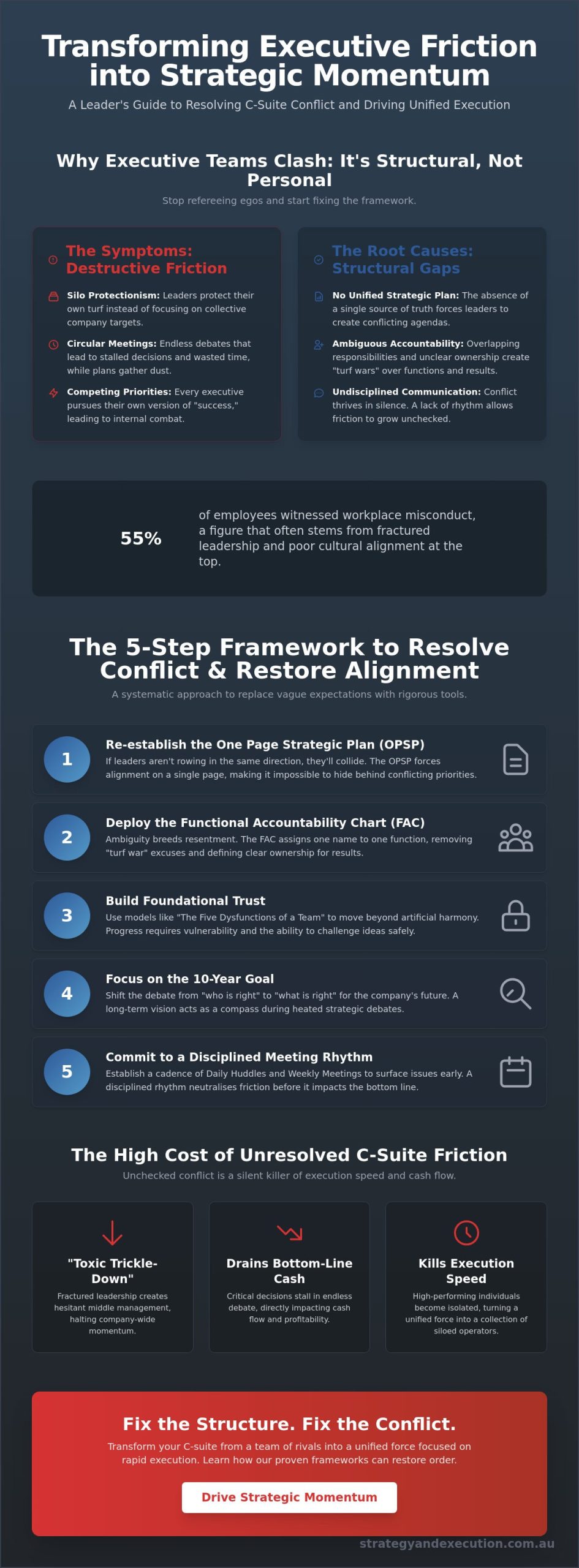
Your executives’ constant bickering isn’t a character flaw. It’s a leadership failure. Most leaders mistake executive conflict for a personality problem when it is almost always a structural breakdown. Destructive friction occurs when leaders fight for resources, status, or individual agendas. Productive dissent, conversely, is the engine of growth. It is the rigorous, healthy debate over strategy that leads to superior decisions. Knowing how to resolve conflict in the executive team requires you to stop refereeing egos and start fixing your framework.
The primary cause of C-suite combat is the absence of a single, unified Strategic Plan. Without one, every executive creates their own version of “success.” This leads to strategic drift, where competing priorities force talented leaders into unnecessary combat. When your Head of Sales and Head of Operations are at loggerheads, it’s usually because they’re working toward different definitions of victory.
To better understand this concept, watch this helpful video:
The High Cost of Unresolved C-Suite Friction
Unresolved friction is a silent killer of execution speed. It drains bottom-line cash flow as critical decisions stall in circular debates. This tension creates a “toxic trickle-down” effect. When the leadership team is fractured, middle management becomes hesitant, protecting their own silos rather than the company’s goals. In mid-market Queensland firms, this often results in high-performing individuals becoming isolated, which eventually halts momentum entirely.
Symptoms vs. Root Causes
Stop wasting time on conflict management styles or generic personality workshops. These initiatives treat symptoms while the disease remains. If you want a permanent cure, you must evaluate your Scaling Up implementation plan to ensure roles are clearly defined. Structural ambiguity creates personal animosity. Fix the structure, and the “personality clashes” often vanish.
The 5-Step Framework to Resolve Conflict and Restore Alignment
Stop looking for a silver bullet. You need a system. Understanding how to resolve conflict in the executive team starts with replacing vague expectations with rigorous tools. High-performance teams don’t avoid friction. They use it to sharpen their strategy. This requires a transition from emotional reactions to structural solutions that force clarity and accountability.
- Step 1: Re-establish the One Page Strategic Plan (OPSP). If your leaders aren’t rowing in the same direction, they’ll inevitably collide. The OPSP forces alignment on a single page, making it impossible to hide behind conflicting priorities.
- Step 2: Deploy the Functional Accountability Chart (FAC). Ambiguity is the breeding ground for resentment. The FAC assigns one name to one function, removing “turf war” excuses and defining clear boundaries.
- Step 3: Build foundational trust. Use the “Five Dysfunctions of a Team” model to move beyond artificial harmony. Real progress requires the ability to be vulnerable and challenge ideas without fear of retribution.
- Step 4: Focus on the 10-year goal. Shift the debate from “who is right” to “what is right for the company’s future.” High-level goals act as a compass during heated debates.
- Step 5: Commit to a Meeting Rhythm. Establish a cadence that surfaces issues early. Conflict thrives in silence; a disciplined rhythm kills it.
Depersonalising Conflict with the FAC
Clearly defining “who owns what” eliminates 80% of executive arguments. When Sales, Ops, and Finance have overlapping responsibilities, conflict is inevitable. The FAC provides the surgical precision needed to separate roles. This isn’t about job descriptions. It’s about result ownership. If you’re struggling with overlapping mandates, you might need to speak with a strategist to reset your organisational design and restore order.
Building Strategic Trust in Adelaide and Brisbane Boards
Vulnerability-based trust is the prerequisite for healthy debate. Without it, your board meetings become a series of polite lies or aggressive posturing. Leaders in Brisbane and Adelaide must lead by example. Acknowledge your weaknesses first. This creates a safe environment for others to do the same. This approach aligns with Harvard’s guide to managing team conflict, which emphasises identifying disruptive patterns before they escalate. For a structured approach to this cultural shift, consider the Scaling Up Program Australia to facilitate team alignment sessions that drive measurable results. Adelaide-based organisations dealing with persistent execution gaps may also benefit from engaging a leadership accountability coach Adelaide to install the rigorous accountability systems that bridge the gap between strategic intent and measurable outcomes.
Sustaining Harmony: Rhythms That Prevent Future Conflict
Conflict doesn’t disappear; it evolves. If you lack a disciplined communication rhythm, you’re merely waiting for the next explosion. Leaders who master how to resolve conflict in the executive team recognise that harmony is a byproduct of structure, not personality. You must force issues to the surface through a relentless cadence of huddles and planning sessions. Silence is where resentment grows. Structure is where it dies.
Daily Huddles using a structured daily huddle format Brisbane executives rely on provide a ten-minute pulse check to clear immediate roadblocks. Weekly Meetings allow for tactical alignment. Quarterly Planning sessions act as a strategic reset, ensuring the team remains focused on the 10-year goal rather than short-term ego wins. These rhythms prevent the strategic drift that leads to siloed protectionism. Adopting proven conflict resolution strategies for leaders involves creating an environment where healthy conflict is expected. Groupthink is a death sentence for innovation. You need productive dissent to stress-test your decisions and ensure the best ideas win.
The Rockefeller Habits Meeting Rhythm
Implementing a Rockefeller Habits weekly meeting agenda provides a 90-minute sanctuary for high-growth teams. This isn’t just another talk-fest. It’s a rigorous process to identify “stuck” items. When a specific priority remains stalled for three weeks, it’s rarely a resource issue. It’s a conflict issue. These “stucks” highlight underlying friction that requires immediate resolution before it poisons the broader culture. Use this rhythm to flush out disagreements and commit to a single path forward.
Executive Coaching and Facilitation
Sometimes, the internal deadlock is too tight to break alone. High-ego C-suite environments in Brisbane or Adelaide often benefit from a neutral third party. An external facilitator doesn’t take sides. They enforce the framework. They hold the mirror up to the team’s dysfunctions and demand accountability. Bringing in strategic advisory isn’t a sign of weakness. It’s an investment in your organisation’s structural integrity. A seasoned leadership accountability coach Adelaide teams trust can navigate the politics and return the focus to measurable progress and tangible outcomes.
Drive Strategic Alignment and Accelerate Growth
Executive conflict is a structural failure, not a personality clash. To fix it, you must implement the One Page Strategic Plan and Functional Accountability Chart to remove ambiguity. Sustaining this alignment requires a relentless communication rhythm that forces issues to the surface before they derail your quarterly plan. Mastering how to resolve conflict in the executive team is the only way to transition from a group of high-performing individuals into a unified leadership force.
You don’t have to navigate this transition alone. With over 20 years of experience in Australian mid-market growth, our team of Certified Scaling Up Practitioners uses the proven Rockefeller Habits framework to restore order and accountability. Stop letting C-suite friction stall your progress. It’s time to Book a Strategic Alignment Workshop for your Executive Team and turn your leadership team into your greatest competitive advantage.
Your business deserves a leadership team that executes with precision. Start today.
Frequently Asked Questions
Is all conflict in the executive team bad for business?
No. Productive dissent is the engine of high performance strategy. You want your leaders to challenge ideas, stress test assumptions, and debate the mechanics of execution. The problem arises when dissent turns into destructive friction, where egos and silo protection override the company’s collective goals. Learning how to resolve conflict in the executive team means distinguishing between healthy debate and the structural drift that poisons progress.
How do I tell an executive their behaviour is damaging the team culture?
Deliver the feedback with blunt honesty and link it directly to organisational performance. Avoid vague emotional descriptions. Instead, point to specific instances where their actions caused strategic drift or stalled a quarterly priority. Challenge them to align with the agreed leadership rhythms. If they value the company’s momentum, they’ll adjust. If they don’t, you have a deeper alignment issue that requires immediate intervention.
Can a toxic but high-performing executive be integrated back into the team?
Only if they commit to the rigour of your accountability systems. A high performer who destroys culture is actually a net negative for the business’s long term value. Integration requires them to abandon siloed protectionism and embrace the Functional Accountability Chart. If they cannot operate within these structural boundaries, their individual results don’t justify the cost of the friction they create. You must prioritise the structural integrity of the team over any single ego.
What is the best way to handle a deadlock between the CFO and the COO?
Refer immediately to the One Page Strategic Plan and the 10-year goal. Most deadlocks between Finance and Operations occur because of overlapping responsibilities or conflicting KPIs. Use the FAC to determine who has the final decision making authority for the specific outcome in question. When roles are clear, the argument stops being about who is right and becomes a logical discussion about what best serves the company’s execution speed.
Need Help Turning Strategy Into Results?
Let’s talk about your goals and how we can help you move forward with clarity and confidence.
