

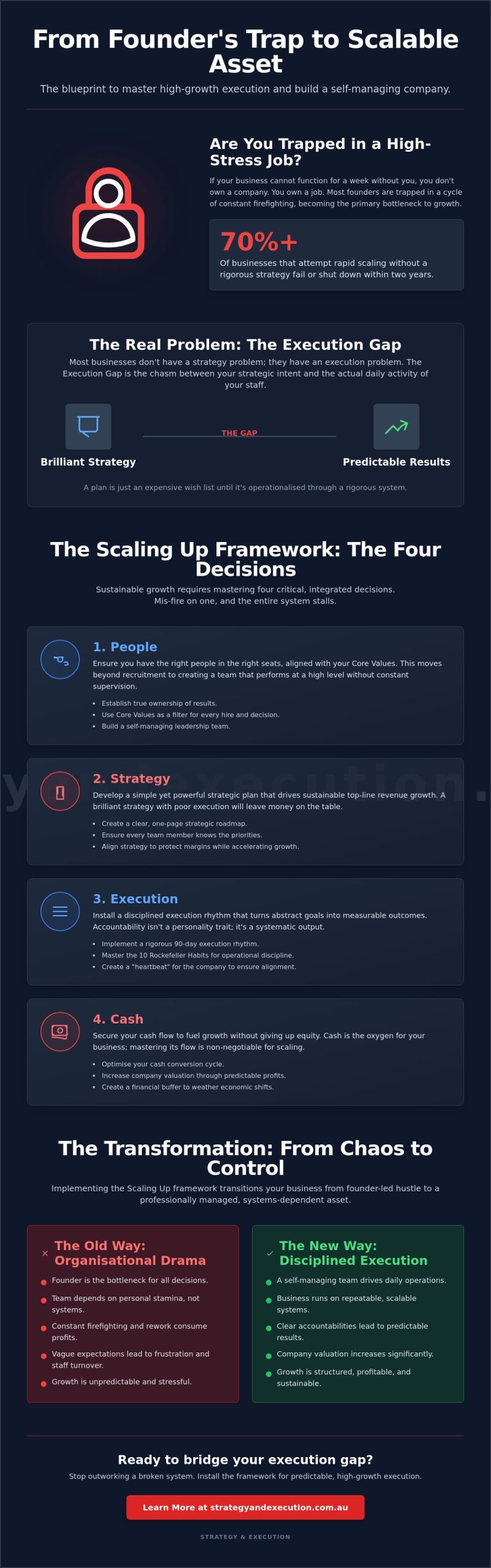
If your business cannot function for a week without your direct intervention, you do not own a company; you own a high-stress job. Over 70% of businesses that attempt rapid scaling without a rigorous strategy struggle or shut down within two years. Most Brisbane founders find themselves trapped in a cycle of constant firefighting and executive inconsistency, where strategic plans gather dust and the team remains dependent on the owner’s every move. This chaos is not an inevitable part of growth. It is a symptom of a weak Scaling Up – Strategy Execution & Accountability Systems framework. Accountability is not a personality trait you hire for; it is a systematic output of a disciplined execution rhythm.
Forget cookie-cutter consulting. Every business has unique bottlenecks that require bespoke Scaling Up – Strategy Execution & Accountability Systems. We work with founders in Brisbane and Adelaide to build owner-independent organisations. This requires a “tough love” coaching style. We don’t settle for excuses or “busy-ness”. We ensure the Rockefeller Habits actually stick. If you want a coach who will simply nod and agree with you, look elsewhere. We are here to challenge your assumptions and enforce the discipline required for elite, predictable performance. To understand how professional support can be structured for your firm, you can discover more about Retainer-based growth consulting and strategic execution fees to evaluate your options.
You likely recognise that your current pace is unsustainable if you want to reach the next tier of turnover. This article provides the blueprint to master the frameworks required to eliminate organisational drama and drive predictable, high-growth execution. We will examine how to transition from founder-dependency to a self-managing team using a clear one-page roadmap that increases company valuation and secures your cash flow.
Key Takeaways
- Identify and close the execution gap between your strategic intent and daily operations to stop the cycle of constant firefighting.
- Master the alignment of the Four Decisions—People, Strategy, Execution, and Cash—to ensure your business is structurally sound for rapid growth.
- Utilise the Function Accountability Chart (FACe) to move beyond “following orders” and establish true ownership of results within your leadership team.
- Implement Scaling Up – Strategy Execution & Accountability Systems through a rigorous 90-day rhythm and the 10 Rockefeller Habits.
- Transition to a systems-dependent business model that increases company valuation while reducing the organisation’s reliance on the founder.
Why Strategy Fails: Closing the Execution Gap in Your Organisation
Most Brisbane business owners believe they have a strategy problem. They don’t. They have an execution problem. The Execution Gap is the chasm between your high-level strategic intent and the actual daily activity of your staff. You can have the most sophisticated Strategic planning document in Queensland, but if your team doesn’t know what to prioritise by 9:00 AM on Monday, that plan is worthless. Strategy is just an expensive wish list until it is operationalised through a rigorous system.
Scaling a business exposes every hidden crack in your foundation. As you grow, you will hit three specific barriers: leadership, infrastructure, and marketing. Most leaders try to solve these by demanding “more effort” from their team. This is a mistake. You cannot outwork a broken system. Pushing harder only accelerates the rate of failure and leads to total executive burnout. Instead, you need a proven operating system for growth. The Scaling Up – Strategy Execution & Accountability Systems framework provides the structural integrity required to move from a founder-led hustle to a professionally managed organisation.
The High Cost of Organisational Drama
Organisational drama is the primary tax on your profits. In Australian SMEs, miscommunication and rework consume a staggering amount of productive time. When expectations are vague, staff default to guesswork. This lack of clarity breeds frustration and eventually drives your best talent out the door. You likely find yourself caught in the “founder’s trap,” where every decision—no matter how minor—must pass through your desk. You have become the ultimate bottleneck. This isn’t leadership; it’s a lack of scalable systems. Without a clear accountability framework, your business remains dependent on your personal stamina rather than a repeatable process.
From Vision to Results: The Need for a Framework
Hope is not a management strategy. Many Australian leaders rely on a “she’ll be right” attitude toward execution, expecting results to materialise through sheer willpower. This approach fails as soon as you move beyond a handful of employees. High-growth execution requires a disciplined rhythm. It requires a move toward Scaling Up – Strategy Execution & Accountability Systems that turn abstract goals into measurable outcomes. A framework creates a heartbeat for the company. It ensures every person in the building is aligned with the core vision and, more importantly, knows exactly what they are accountable for delivering this quarter. Discipline is the only way to bridge the gap between where you are and where you intend to be.
The Four Decisions: A Framework for Sustainable Scalability
Scaling a business is not a matter of luck. It is the result of four specific, high-stakes decisions: People, Strategy, Execution, and Cash. If you misfire on any one of these, you create friction that halts momentum and drains your reserves. Australian mid-market firms often struggle because they treat these pillars as separate departments. They aren’t. They are an integrated system. To navigate common scaling challenges, you must address all four simultaneously. If you have great people but a weak strategy, you will work hard for low margins. If you have a brilliant strategy but poor execution, you will leave money on the table.
Implementing Scaling Up – Strategy Execution & Accountability Systems requires a holistic view of your operations. You cannot simply “fix” marketing and expect the business to double. You need to align your entire executive team around these four decisions. For those ready to move beyond theory, the Scaling Up Program Australia provides a structured path to mastering these fundamentals. By mastering Scaling Up – Strategy Execution & Accountability Systems, you protect your margins while accelerating your growth.
People and Strategy: The Foundation of Growth
Growth starts with your team. You must ensure you have the right people in the right seats, performing at a high level without constant supervision. This is not about recruitment; it is about alignment. Your Core Values are not just posters on the wall. They are the filter for every hire, fire, and promotion within your company. Once the people are right, you need a strategy that actually works. A differentiated strategy creates a sustainable competitive advantage. It ensures you aren’t just a commodity competing on price in a crowded Brisbane market. It forces you to define what you do better than anyone else.
Execution and Cash: The Engines of Momentum
Strategy is useless without the discipline to execute it. You must convert your long-term vision into three to five clear priorities for the current quarter. If everything is a priority, nothing is. This focus drives the “rhythm” of the business. However, execution requires fuel. Growth sucks cash. You must monitor your Cash Conversion Cycle to ensure you aren’t growing yourself into bankruptcy. The Cash Conversion Cycle is the ultimate metric of your execution efficiency. If you want to see how these systems apply to your specific industry, you can speak with a growth advisor to audit your current framework.
Accountability Systems: Turning Strategic Intent into Tangible Results
Accountability is frequently the most misunderstood concept in Australian boardrooms. Most managers view it as a mechanism for blame after a failure. This is a reactive, low-performance mindset. True accountability is the proactive ownership of results before the work begins. It is the refusal to hide behind excuses or “busy-ness”. When you implement Scaling Up – Strategy Execution & Accountability Systems, you are not just installing a checklist; you are shifting the psychological contract between the business and its employees. We move away from “following orders” toward a culture where every individual is the CEO of their specific outcomes.
Subjectivity kills growth. You cannot manage a high-growth firm based on how the team “feels” things are going. You need a scoreboard that provides real-time visibility. A robust Scaling Up – Strategy Execution & Accountability Systems approach ensures that “Critical Numbers” are not executive secrets but daily focal points for the entire workforce. This replaces boardroom opinions with objective facts, allowing for rapid course correction before a small issue becomes a financial disaster.
The Function Accountability Chart (FACe)
The Function Accountability Chart (FACe) is the diagnostic tool used to strip away ambiguity. Traditional organisational charts focus on reporting lines, but the FACe focuses on results. It distinguishes between a role—what you do—and a function—what you are accountable for delivering. The “Rule of One” is non-negotiable: every function must have exactly one person accountable. If two people share a KPI, no one owns it. Confusion is the enemy of scale. Use the FACe tool to identify where your current structure is leaking profit through duplicated efforts or neglected responsibilities.
Metrics and KPIs: Measuring What Matters
To drive momentum, you must distinguish between leading and lagging indicators. Lagging indicators, like monthly profit or total sales, tell you what happened in the past. They are a post-mortem. Leading indicators, such as the number of qualified sales appointments booked this week, predict your future results. High-performing teams establish a “rhythm of data” that makes performance visible to everyone. When you have a clear scoreboard, peer accountability naturally emerges. The team stops waiting for the founder to call out poor performance and begins holding each other to the agreed standard. This shift from top-down policing to peer-driven discipline is what separates stagnant SMEs from scalable enterprises.
Implementing the Rockefeller Habits: Your 90-Day Execution Rhythm
Strategy execution is not a one-time event. It is a recurring discipline. To maintain growth in the 2026 economic environment, where 85% of fast-growth companies now depend on scalable digital infrastructure, you must move beyond ad-hoc management. The 10 Rockefeller Habits serve as your non-negotiable checklist for operational excellence. These habits don’t just organise your workflow; they create a predictable heartbeat for the entire organisation. When you implement Scaling Up – Strategy Execution & Accountability Systems, you replace the chaos of “management by accident” with a structured 90-day execution rhythm that ensures your strategic priorities are actually met.
The One-Page Strategic Plan (OPSP) is the primary tool for maintaining this alignment. It distils your complex vision into a single, accessible document that every staff member can understand. If your strategy cannot fit on one page, it is too complicated to execute. By stripping away the fluff, you ensure that every person in your Brisbane office knows exactly what the company is trying to achieve and how their specific role contributes to that success. This level of clarity is the only way to eliminate the organisational drama that stalls mid-market firms.
The Daily and Weekly Rhythm
Stop allowing “got a minute” interruptions to hijack your executive team’s productivity. The 15-minute daily huddle is the corrective measure for this common pitfall. It provides a dedicated forum to synchronise daily activities and identify immediate roadblocks before they escalate. Your weekly meeting should then focus on reviewing “Rock” progress and solving “Stucks”. These sessions are not for status updates that could have been an email. They are high-energy environments designed for collective problem-solving. If your meetings feel like a drain on your time, you aren’t running them correctly. You are likely missing the rigorous structure required for high-growth execution.
Quarterly and Annual Planning
Every 90 days, your leadership team must step away from the daily grind to re-evaluate the market and your internal performance. The 90-day cycle is the optimal timeframe for human focus because it is long enough to achieve a significant goal but short enough to maintain a sense of constant urgency. During these sessions, you must set a specific “Theme” for the quarter. This theme creates a rallying point for the team and provides a reason to celebrate wins. In a volatile market, this rhythm allows you to pivot your strategy based on real-world feedback without losing your execution momentum. If you are ready to install this rhythm in your business, you can book a strategy execution audit to identify your current gaps.
Scaling Up in Brisbane and Adelaide: The Strategy & Execution Advantage
Most consulting firms offer generic, high-level advice that fails the moment it hits the reality of daily operations. We don’t. Ted Bonel and the Strategy & Execution team bring over 20 years of battle-tested experience, having coached over 250 Australian business leaders across more than 20 industries. We do not teach the Scaling Up framework in isolation. Instead, we integrate it with E-Myth Mastery for system dependency and Exponential Organisations (ExO) for rapid technological leverage. This multi-framework approach ensures your business isn’t just growing; it’s becoming a systems-dependent asset that thrives without founder intervention.
Local expertise matters. While generic online programs offer theory, our Brisbane and Adelaide presence allows for face-to-face alignment with your executive team. We understand the specific economic landscape of 2026, where digital infrastructure is the primary driver for 85% of fast-growth firms. By implementing Scaling Up – Strategy Execution & Accountability Systems with a local strategist, you ensure your execution rhythm is tailored to your specific market conditions and organisational culture.
A Tailored Approach for Australian Mid-Market Firms
Forget cookie-cutter consulting. Every business has unique bottlenecks that require bespoke Scaling Up – Strategy Execution & Accountability Systems. We work with founders in Brisbane and Adelaide to build owner-independent organisations. This requires a “tough love” coaching style. We don’t settle for excuses or “busy-ness”. We ensure the Rockefeller Habits actually stick. If you want a coach who will simply nod and agree with you, look elsewhere. We are here to challenge your assumptions and enforce the discipline required for elite, predictable performance.
Next Steps: From Theory to Execution
Transformation begins with a Scalability Audit. This diagnostic identifies the specific friction points in your People, Strategy, Execution, and Cash decisions. From there, your executive team will enter a high-impact workshop. These are not passive seminars. They are intensive working days where you build your One-Page Strategic Plan and establish your non-negotiable 90-day rhythm. To see the impact of these sessions firsthand, visit Our Events for upcoming Scaling Up workshops in your area.
Stop guessing and start executing. Your business has the potential to scale, but it currently lacks the structural integrity to do so without drama. Master the systems required to hit your KPIs predictably and increase your company valuation. Book a discovery call today to evaluate your execution systems and begin the transition to a self-managing, high-growth company.
Secure Your Growth with Disciplined Execution
Growth is a choice, but scaling is a discipline. You cannot expect different results by applying more of the same effort to a broken system. To move beyond the founder’s trap, you must bridge the execution gap with a rigorous rhythm of accountability. This article has detailed how to align your team through the Four Decisions and the 10 Rockefeller Habits to ensure your strategic intent translates into tangible cash flow. By implementing Scaling Up – Strategy Execution & Accountability Systems, you replace organisational drama with a predictable, high-performance culture that increases your company’s valuation.
The transition from a high-stress job to a scalable enterprise requires an elite architect. Our team of Certified Scaling Up Practitioners brings over 20 years of executive coaching experience to mid-market leaders in Brisbane and Adelaide. We don’t just offer theory; we provide the battle-tested frameworks required to build owner-independent businesses. It’s time to stop firefighting and start leading with clarity. Master Your Execution—Explore Our Scaling Up Programmes and take the first step toward a self-managing organisation today. Your future growth depends on the systems you build now.
Frequently Asked Questions
What is the difference between Scaling Up and other management systems?
Scaling Up is a comprehensive performance platform specifically designed for mid-market companies aiming for exponential growth. Unlike entry-level frameworks that focus primarily on basic operations, Scaling Up offers deeper strategic tools and a rigorous focus on cash flow management. It is the preferred choice for leaders who have outgrown simplistic systems and require a more sophisticated approach to navigate complex market challenges.
How long does it take to see results from the Scaling Up framework?
Operational clarity is usually immediate, but tangible shifts in performance typically take one full 90-day cycle to settle. You will notice a significant reduction in organisational drama within the first quarter of implementation. Sustained financial results and total cultural alignment usually manifest within 12 to 18 months of disciplined adherence to the execution rhythm.
Can Scaling Up work for a small business with under 10 employees?
Yes. Implementing these habits early prevents the “founder’s trap” from becoming a terminal bottleneck as the company expands. While the framework is built for teams of 10 to 250, smaller organisations use it to build a systems-dependent foundation. This ensures that future growth doesn’t lead to operational chaos as you add more staff to the payroll.
What are the 10 Rockefeller Habits?
The Rockefeller Habits are a diagnostic checklist used to ensure operational excellence across the organisation. They include executive team alignment, clear quarterly goals, and a rigorous meeting rhythm. These habits ensure that every person in the company is focused on the same high-impact priorities. Without these habits, strategy remains a theoretical exercise rather than a daily reality.
How much time does the Scaling Up meeting rhythm actually take?
The rhythm consumes approximately 2% to 3% of your team’s total working hours. This is a strategic investment that pays for itself by eliminating hours of wasted time spent on rework and miscommunication. It replaces the “got a minute” culture with structured, high-energy synchronisation that drives faster decision-making across the entire Brisbane or Adelaide office.
Do we need a coach to implement Scaling Up or can we do it ourselves?
You can read the books and attempt it alone, but internal bias often prevents the “tough love” required to make habits stick. A coach acts as an external architect who identifies your blind spots and holds your executive team to a higher standard. Professional guidance ensures that Scaling Up – Strategy Execution & Accountability Systems are installed correctly the first time.
How does Scaling Up improve company valuation for an exit?
Buyers pay a premium for businesses that are not dependent on the founder’s daily presence or personal stamina. Scaling Up builds a systems-dependent asset with predictable, high-growth execution and healthy cash reserves. By demonstrating a track record of hitting KPIs through a repeatable framework, you significantly de-risk the acquisition for any potential buyer.
What is the One-Page Strategic Plan (OPSP)?
The OPSP is a single-page document that distils your entire business strategy into actionable, measurable components. It removes the complexity of traditional 50-page plans that no one reads or follows. By using the OPSP within your Scaling Up – Strategy Execution & Accountability Systems, you ensure every employee understands the company’s vision and their specific role in achieving it.
Need Help Turning Strategy Into Results?
Let’s talk about your goals and how we can help you move forward with clarity and confidence.
