

Most Australian strategic plans are nothing more than expensive wallpaper. You spend thousands on a retreat, set ambitious targets, and return to an office where the same old silos and cash flow constraints kill your momentum. With the RBA cash rate sitting at 4.35 per cent and inflation at 4.2 per cent, your business cannot survive a stagnant scaling up implementation plan. If your goals are consistently missed, you don’t have a vision problem; you have an execution crisis.
You likely feel that the transition from thought to deed is where most leaders fail. It is a common frustration that we will correct by moving you from abstract theory to disciplined application. This guide provides the rigorous framework needed to move from strategic theory to disciplined execution and 10x your business valuation. We will preview the step-by-step roadmap to align your executive team, increase profitability, and build a business that runs efficiently without your constant intervention. It is time to stop dreaming and start scaling.
Key Takeaways
- Stop paying the “Drama Tax” and learn to navigate the “Valley of Death” where rapid growth threatens to outpace your current management capacity.
- Master the Four Critical Decisions to ensure your executive team is aligned and your strategy creates a genuine, sustainable competitive advantage in the Australian market.
- Execute a rigorous 90-day scaling up implementation plan to embed the Rockefeller Habits and establish a rhythmic discipline that drives accountability.
- Replace chaotic communication with high-impact meeting rhythms that clear roadblocks and ensure every team member is focused on the daily win.
- Discover how professional advisory provides the external objectivity and discipline required to accelerate growth and maximise your total business valuation.
The Reality of Scaling: Why Most Implementation Plans Stall
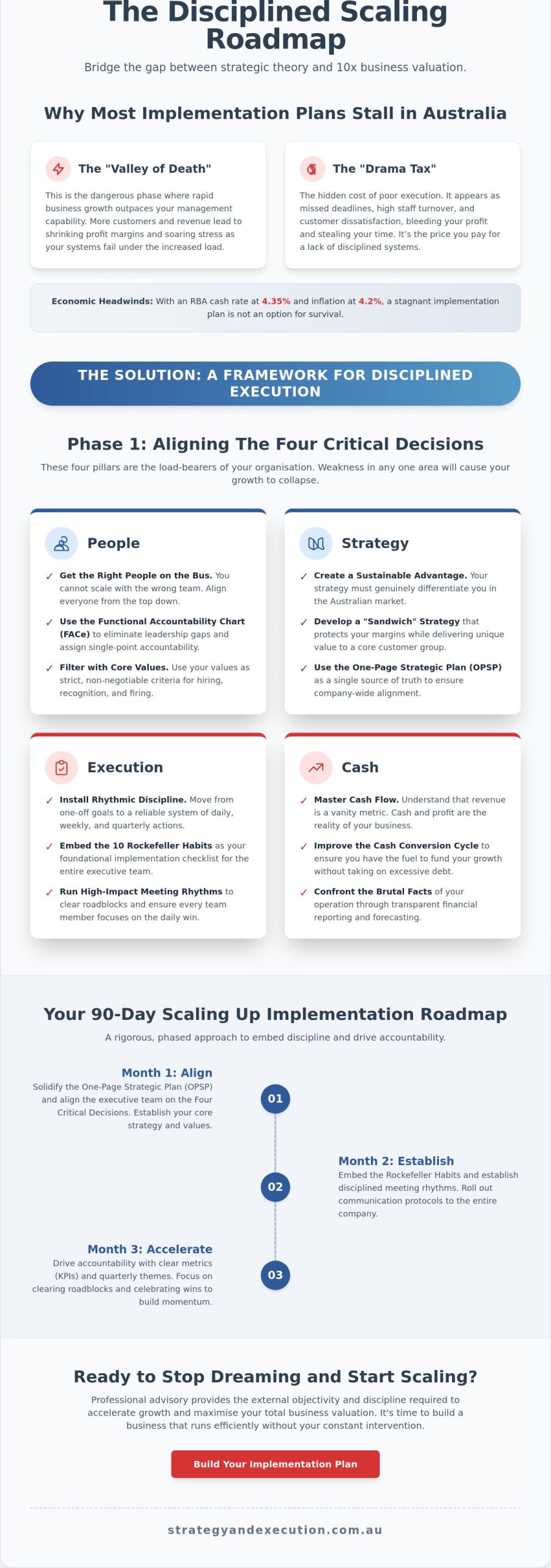
Growth is a double-edged sword. For many Australian leaders, the excitement of expansion quickly gives way to the “Valley of Death.” This is the precarious stage where your business growth outpaces your management capability. You have more customers, more staff, and more revenue, yet your profit margins are shrinking and your stress levels are soaring. This happens because your existing systems cannot handle the increased load. Scaling is not merely about getting bigger; it is about the property of a system to handle a growing amount of work without breaking under the pressure.
If your executive team spends more time putting out fires than driving strategy, you are paying a “Drama Tax.” This tax is the hidden cost of poor execution. It manifests as missed deadlines, high staff turnover, and customer dissatisfaction. It bleeds your profit and steals your time. Most leaders try to solve this with a static strategic plan. They write a document, file it away, and wonder why nothing changes. A successful scaling up implementation plan is different. It is a dynamic roadmap that focuses on rhythmic discipline rather than one-off goals. You can learn more about building these systems at Strategy and Execution.
Stop using the excuse that you are “too busy” to implement these systems. Being busy is often a symptom of a lack of priority. If you don’t have time to fix your business, you don’t have a business; you have a high-pressure job that owns you. Disciplined priority is the only way out of the chaos.
The Gap Between Vision and Execution
Ideas are easy. Delivery is difficult. Industry data suggests that a vast majority of strategic initiatives fail due to poor execution rather than poor intent. In the Australian mid-market, this often leads to “Strategic Drift.” This occurs when a firm’s strategy gradually moves away from its original intent because the daily grind takes over. You need more than a vision; you need a battle-tested framework. The Scaling Up methodology provides the structural integrity required to bridge this gap. It turns abstract goals into concrete actions that your team can actually deliver.
The Rockefeller Habits as Your Foundation
The 10 Rockefeller Habits serve as your implementation checklist. Think of this as a “Checklist Manifesto” for your executive team. These habits are not optional extras; they are the fundamental building blocks of a systems-dependent business. When you apply these habits through a structured scaling up implementation plan, you shift the weight of the business from your shoulders to a reliable system. The goal is simple. You want a business that thrives independently of the owner’s constant intervention. This is how you build real value and achieve sustainable momentum.
Phase 1: Aligning the Four Critical Decisions
Scaling a business is not a matter of working harder; it is a matter of deciding better. To move beyond the chaos of the “Valley of Death,” you must align four critical areas: People, Strategy, Execution, and Cash. If any of these pillars are weak, your scaling up implementation plan will collapse under its own weight. These decisions are the structural load-bearers of your organisation. When they are aligned, growth feels like a deliberate choice rather than a frantic accident. When they are neglected, you face executive burnout and stagnant valuations.
Most leaders focus on revenue. This is a mistake. Revenue is a vanity metric; cash and profit are the reality. You need a framework that forces you to confront the brutal facts of your operation. This phase is about stripping away the “drama” and replacing it with measurable, high-standard systems. It requires a level of discipline that many executive teams find uncomfortable. That discomfort is the price of progress.
People and Strategy: The Long-Term Drivers
You cannot scale with the wrong team. Period. Use the Functional Accountability Chart (FACe) to map your organisation. This tool identifies leadership gaps by assigning one person to be accountable for each specific function. If one person is doing too much, or if a seat is empty, your execution will suffer. Your Core Values must then act as a filter. They are not marketing slogans; they are the criteria for hiring and firing. If a high performer violates your values, you must remove them to protect the culture.
Strategy is about creating a sustainable competitive advantage. You need a “Sandwich” strategy that protects your margins while delivering unique value. Document this in the One-Page Strategic Plan (OPSP). This single source of truth ensures every staff member understands where the company is going and how they contribute to the win. If you find your team is still misaligned, you may need to request a strategic alignment session to reset your trajectory.
Execution and Cash: The Immediate Accelerators
Execution is where strategy meets the real world. You must establish the “Top 5” priorities for the company and ensure every individual has their own matching set. If everything is a priority, nothing is. This focus drives profit through disciplined habits and radical accountability. You must stop guessing and start measuring. Building robust leadership team accountability systems is what separates high-growth firms from those that plateau under the weight of their own ambition.
Cash is the oxygen that fuels exponential growth. Use the “Power of One” to identify the seven levers that impact your cash flow, such as price, volume, and operating expenses. Small, one per cent changes in these areas can have a massive impact on your bottom line. You must also master your Cash Conversion Cycle (CCC). In its simplest terms, the Cash Conversion Cycle is the number of days it takes for every dollar you spend on labour and supplies to travel through your business and return to your bank account as profit. Shorten this cycle to fund your growth without external debt.
Phase 2: Establishing Your Execution Rhythms
Strategy without execution is a hallucination. Most Australian leadership teams fail because they lack a consistent heartbeat. They rely on ad-hoc emails and “quick chats” that disrupt focus and breed confusion. A robust scaling up implementation plan replaces this chaos with a rigorous meeting cadence. These rhythms don’t waste time; they create it. By front-loading communication, you eliminate the need for constant interruptions and ensure every team member is moving in the same direction.
Start with the Daily Huddle. This is a non-negotiable 15-minute stand-up. It is not a discussion forum. It is a reporting pulse. Each person shares what is up, their daily win, and where they are stuck. If a roadblock needs solving, take it offline. The goal is alignment, not analysis. Follow this with a Monthly Management Meeting to review the numbers and apply “The Power of One” levers. Finally, use a Quarterly Theme to create a “sprint” mentality. Focus the entire organisation on a single goal for 90 days. This gamifies execution and prevents initiative fatigue.
The 90-Minute Weekly Rhythm
The weekly meeting is the heartbeat of your scaling up implementation plan. It is 90 minutes of “Level 10” tactical problem solving. Don’t let it devolve into a status update. Spend the first 25 per cent of the time reviewing good news, KPIs, and Rock updates. Spend the remaining 75 per cent on IDS: Identify, Discuss, and Solve. You must attack the issues, not the people. For a detailed breakdown of how to run this session, follow the Rockefeller Habits Weekly Meeting Agenda. This structure ensures you solve problems once rather than discussing them forever.
Quarterly and Annual Planning Sessions
Execution requires perspective. You cannot get this perspective while sitting in your own boardroom. Take your team off-site for quarterly and annual planning. A critical rule: the CEO should not facilitate their own session. You cannot be a player and the referee at the same time. You have blind spots. An external facilitator ensures the “tough love” conversations actually happen.
During these sessions, review your “Start, Stop, Keep” list. This exercise refines your OPSP by identifying what is working and what is merely clutter. Set your “Critical Number” for the next 13 weeks. This is the one metric that, if achieved, will have the greatest impact on the business. It provides the clarity your team needs to ignore the noise and focus on the signal.
A 90-Day Scaling Up Implementation Roadmap
Execution is a habit, and habits take time to form. In the Australian mid-market, particularly within the competitive hubs of Brisbane and Adelaide, leaders often mistake motion for progress. A structured scaling up implementation plan provides the timeline required to shift from reactive management to proactive leadership. This 90-day roadmap is designed to move your executive team through the initial friction of change into a state of rhythmic execution. You cannot rush this process. If you skip the foundational alignment, the entire structure will eventually buckle under the weight of your growth.
Most academic guides for scaling are far too vague for a tactical business environment. They offer theory but lack the “boots on the ground” reality of managing a growing firm. This roadmap is different. It is a battle-tested schedule that demands accountability at every stage. If you are ready to audit your current leadership alignment, book a Scaling Up diagnostic session to identify your specific roadblocks before you begin the rollout.
Month 1: The Internal Audit and Alignment
Your first 30 days are about brutal honesty. Start by conducting a Scaling Up Assessment to identify which of the Four Decisions is currently your weakest link. You must address “People” issues immediately. Toxic high-performers are a cancer in your culture; if they don’t align with your Core Values, they must go. Use the FACe tool to ensure every key function has one, and only one, accountable leader. Verify that your leadership team is 100 per cent committed to this discipline. Without total buy-in at the top, the plan is dead on arrival.
Month 2: Documenting the Strategy
Once you have the right people, you must document the path. Spend this month filling out the first draft of your One-Page Strategic Plan (OPSP). Identify your Big Hairy Audacious Goal (BHAG) for the next 10 to 25 years. This provides the long-term “North Star” for your organisation. From there, work backwards to establish your “Rocks” or priorities for the current 13-week quarter. You aren’t just setting goals; you are defining the specific actions required to reach them. This creates a single source of truth that eliminates departmental silos. To ensure your documentation reflects a truly rigorous approach, review the strategic planning process steps that bridge the gap between high-level vision and daily operational reality.
Month 3: Rollout and Accountability
Month three is when you take the plan to the front line. Communicate the vision and the OPSP to the entire organisation to ensure buy-in. People don’t resist change; they resist being changed. By involving them in the “why,” you reduce friction. Set up a visual dashboard to track your KPIs and progress. Transparency drives performance. Expect resistance during this phase. Some staff will struggle with the new level of accountability. Hold the line. Refine your meeting rhythms and ensure the Daily Huddle is functioning as a reporting pulse rather than a chat session. By day 90, these habits should be the new normal.
Accelerating Growth with Professional Advisory
Execution is a lonely discipline. Most Australian CEOs attempt to drive a scaling up implementation plan while simultaneously managing day-to-day operations. This is a recipe for implementation fatigue. Without external objectivity, your executive team will naturally drift back toward comfortable, low-impact activities. A professional advisor provides the “tough love” and structural integrity required to keep the momentum high. The ROI of an elite coach isn’t just found in faster growth; it’s found in the discipline of avoiding expensive strategic mistakes.
Transitioning from “working in the business” to “architecting the business” requires a mental shift that few leaders achieve alone. You must stop being the primary engine of your company and start being its lead designer. This is the difference between owning a job and owning an asset. An architect builds systems that produce results. An operator produces results through sheer force of will. One is scalable; the other is a bottleneck. If your business plateaus the moment you step away, it is time to learn how to make your business run without you by installing the leadership systems and execution rhythms that replace your personal stamina with reliable, repeatable processes. Professional advisory forces you to build the systems that allow the business to thrive independently of your presence. For Brisbane-based owners trapped in the technician’s role, working with an e-myth coach Brisbane provides the structured framework needed to install the processes that replace your personal stamina with reliable, repeatable systems.
Mid-market firms in Brisbane and Adelaide face unique challenges that generic global advice cannot solve. These markets reward operational efficiency and punish management bloat. Local leaders need an advisor who understands the specific industrial and commercial pressures of the Australian landscape. Whether you are navigating the mining services sector in Queensland or the manufacturing shifts in South Australia, your scaling up implementation plan must be grounded in local reality. Generic directories won’t provide the nuance required to navigate local award rates or regional supply chain constraints. For Adelaide-based leaders specifically, understanding why execution trumps strategy in the current South Australian market is essential to converting your plan into measurable results.
The Strategy & Execution Advantage
Strategy & Execution is not a generic consultancy. We are elite business architects. Led by Ted Bonel, who brings over 20 years of experience in the Australian mid-market, we specialise in transforming chaotic growth into rhythmic profit. Our approach is unique because we integrate E-Myth Mastery with the Scaling Up framework. This ensures your business is not just growing, but is systems-dependent and scalable. This dual-framework approach identifies the “Drama Tax” you are currently paying and eliminates it through rigorous process. To see how this framework applies to your specific goals, review our Scaling Up Program Australia.
Your Next Steps to Scale
Thought without deed is a waste of potential. You have the roadmap; now you need the discipline to execute it. Don’t let another quarter pass with goals that are set but never met. It’s time to align your team, secure your cash flow, and 10x your valuation. Move beyond theory and start the practical application today. Book a consultation with our scaling experts and take command of your organisation’s future. The path to a systems-dependent business starts with a single, decisive action.
Commit to Disciplined Execution
Scaling is a choice. You can continue to tolerate strategic drift and executive misalignment, or you can commit to a rigorous scaling up implementation plan that turns your vision into a measurable asset. Success requires more than a 90-day roadmap; it demands a fundamental shift in your leadership heartbeat. You must move from being an operator who puts out fires to an architect who designs systems.
We have covered how to align the four critical decisions and establish the execution rhythms that drive accountability. Now, the burden of action lies with you. Strategy & Execution brings over 20 years of business growth experience and specialised E-Myth Mastery coaching to the table. As a Certified Scaling Up Practitioner, we don’t just offer advice; we provide the external discipline required to 10x your valuation.
Architect your growth: Contact Strategy & Execution today. It’s time to stop tolerating mediocrity. Take command of your organisation’s trajectory and build the systems-dependent business you deserve.
Frequently Asked Questions
How long does a full Scaling Up implementation plan take to see results?
You will see cultural alignment and improved communication within the first 90 days. Significant financial results and valuation increases typically require 12 to 24 months of consistent application. The framework relies on the compound effect of disciplined habits. While the initial “rhythm” provides immediate clarity, true scaling is a long-term commitment to operational excellence.
Can we implement Scaling Up without an external coach?
Yes, you can self-implement using available resources, but the success rate is lower. Internal attempts often stall because the CEO cannot facilitate their own sessions objectively. You have blind spots that only an external advisor can identify. A coach provides the “tough love” necessary to address toxic behaviours and ensures the leadership team remains accountable to the process.
What is the most common mistake when starting a scaling up implementation plan?
The most frequent failure is a lack of consistency in the meeting rhythms. Leaders often abandon daily huddles or weekly meetings when the office gets “busy.” This is a mistake. If you treat the framework as an optional extra rather than your core operating system, your scaling up implementation plan will fail. Discipline is the only way to eliminate the “Drama Tax.”
How do the Rockefeller Habits differ from other management systems like EOS?
Scaling Up is a more robust and sophisticated framework designed for mid-market firms with higher levels of complexity. While EOS is an effective starting point for smaller businesses, Scaling Up provides deeper tools for strategy and cash flow management. It is built for leaders who want to move beyond basic organisation into exponential growth and significant business valuation.
Is Scaling Up suitable for small businesses or just mid-market firms?
The framework is primarily designed for mid-market companies with 10 to 250 employees. However, any high-growth business can benefit from these habits. Starting early prevents the chaos that usually occurs when growth outpaces management capability. If you intend to scale, building a systems-dependent foundation now will save you from the “Valley of Death” later.
What software tools are recommended for tracking a Scaling Up implementation?
Purpose-built platforms like Align, Metronome, or Rhythm Systems are highly recommended for tracking your OPSP and KPIs. These tools provide a visual dashboard that ensures every team member stays focused on their “Rocks.” Avoid using complex spreadsheets that are difficult to update. Transparency drives performance, so choose a tool that makes your data accessible and easy to interpret.
How much time does the leadership team need to commit to the implementation?
The executive team must commit to a 90-minute weekly meeting and a full-day quarterly planning session. The daily huddle requires only 15 minutes. While this sounds like an additional burden, it actually replaces the hours wasted on ad-hoc emails and reactive fire-fighting. You are trading low-value “busy work” for high-value “architectural work” that builds long-term equity.
Need Help Turning Strategy Into Results?
Let’s talk about your goals and how we can help you move forward with clarity and confidence.
