

If your business cannot function for a month without your direct involvement, you don’t own an asset; you own a high-pressure job. Most Australian mid-market leaders mistake rising turnover for increased worth, yet they remain trapped in the “owner’s trap” where every minor decision requires their signature. You likely feel that execution drama and team misalignment are just unavoidable costs of doing business. They aren’t. These inefficiencies are actively eroding your exit price. To secure a premium multiple, you must shift your focus toward aggressive business valuation growth strategies that prioritise structural integrity over personal heroics.
Stop reacting to daily fires. Start engineering an enterprise that operates independently of your presence. This article reveals the proven execution frameworks used by Australia’s fastest-growing firms to eliminate owner-dependency and drive predictable cash flow. You’ll discover how to transition from a people-dependent hustle to a systems-dependent machine, providing a clear roadmap to a 10x valuation. We will break down the specific financial levers and the discipline required to turn your operational chaos into a streamlined, bankable asset.
Key Takeaways
- Recognise that enterprise value is driven by your multiple; if you’re the primary bottleneck, you’re actively devaluing your asset.
- Master the Rockefeller Habits to replace operational drama with a 90-minute weekly rhythm that ensures rigorous execution discipline.
- Align your leadership team through a One-Page Strategic Plan to eliminate strategic drift and focus on high-impact growth.
- Implement effective business valuation growth strategies by building a systems-dependent machine that operates independently of the owner.
- Map your value streams and enforce process accountability to de-risk the enterprise and command a premium price from prospective buyers.
The Core Drivers of Enterprise Value: Moving Beyond Simple Turnover
Most CEOs fixate on turnover. It’s a vanity metric. True business valuation isn’t an accounting exercise; it’s a measure of your company’s independence from you. In the Australian mid-market, your Enterprise Value (EV) is determined by the multiple applied to your EBITDA. If your business relies on your personal brilliance to function, your multiple will stay depressed. You’ve built a job, not an asset. You must stop chasing turnover and start chasing “Valuable Revenue” that is recurring, high-margin, and scalable.
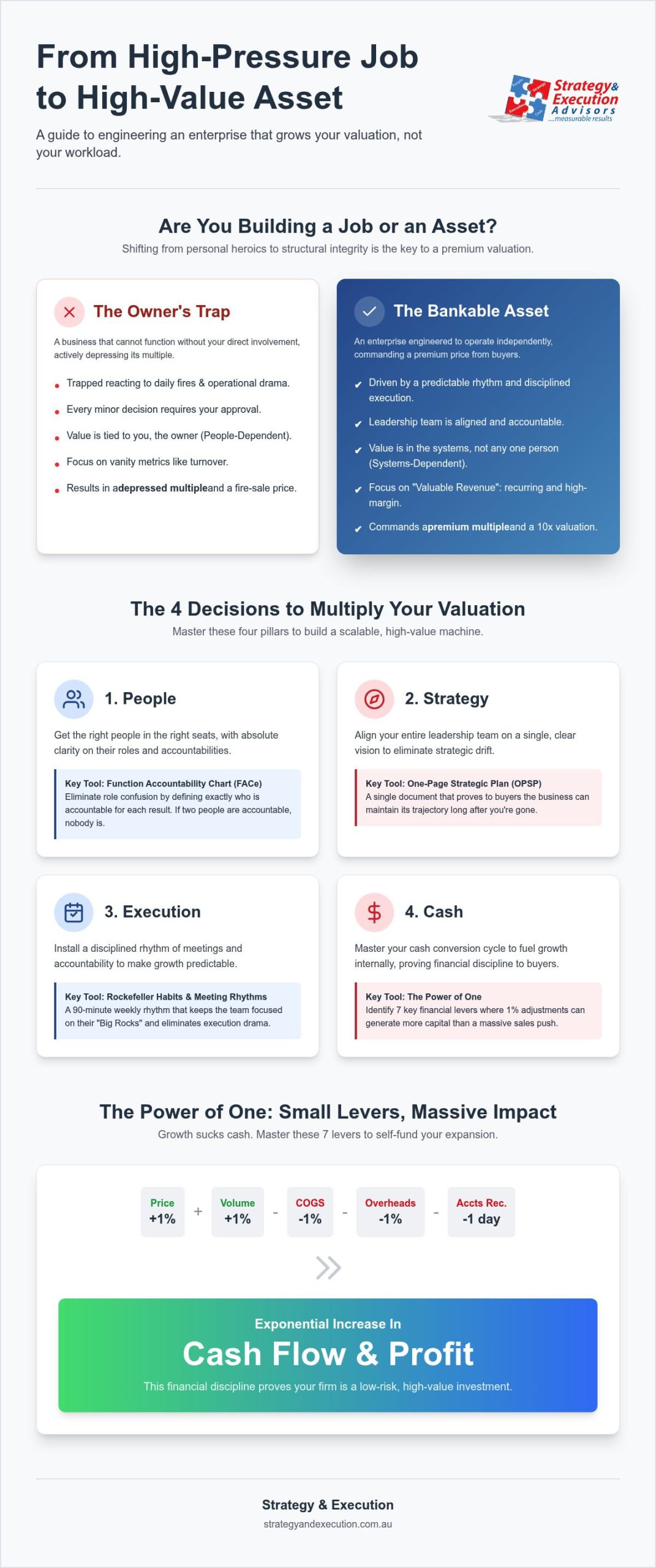
You must escape the “Owner’s Trap.” Being the smartest person in the room is a liability, not an achievement. By acting as the primary decision-maker for every operational hurdle, you create a bottleneck that scares away sophisticated buyers. They don’t want to buy your talent; they want to buy your machine. Effective business valuation growth strategies focus on building that machine through the Four Decisions framework: People, Strategy, Execution, and Cash. These four pillars dictate whether you command a premium multiple or a fire-sale price.
The Difference Between Profit and Scalable Value
Profit is what you keep today; scalable value is what a buyer pays for tomorrow. A firm generating $5 million in profit with high “execution drama” is often worth less than a $2 million profit firm with airtight systems. Buyers look for consistency. If your revenue requires constant manual intervention to deliver, it isn’t scalable. It’s just expensive noise. Eliminating execution drama is the fastest way to de-risk the business and justify a higher valuation in the eyes of an investor.
The Cash Decision: Using the ‘Power of One’ to Fuel Growth
Growth sucks cash. If you don’t manage your Cash-to-Cash Conversion Cycle, you’ll go broke while growing. We use the “Power of One” to identify seven financial levers, such as price, volume, and accounts receivable, that move the needle on cash flow. Small, 1% adjustments across these levers can generate more internal capital than a massive sales push. This financial discipline is a cornerstone of business valuation growth strategies. It makes your firm far more attractive to external capital and increases your market multiple by proving you have mastered the art of self-funded expansion.
Scaling Up Your Valuation: Execution Strategies That Multiply Multiples
Execution is where most Australian firms fail. They have a vision, but they lack the discipline to deliver it without the founder’s constant input. To secure a premium multiple, your business valuation growth strategies must move beyond high-level theory and into the rigour of daily operations. You need a system that makes growth predictable and leadership intervention optional. For many service-based businesses, this means implementing a growth engine like toolsntactics.com to ensure revenue generation is systematic rather than personality-driven. Buyers don’t pay for your hard work; they pay for the reliability of your results.
Implementing the Rockefeller Habits is the secret to a high-value exit. It starts with the One-Page Strategic Plan (OPSP). This single document aligns your entire leadership team to a shared vision, effectively eliminating strategic drift. When sophisticated buyers look to Calculate Business Valuation, they pay a premium for firms that demonstrate this level of internal alignment and clarity. It proves the business can maintain its trajectory long after you’ve handed over the keys.
Meeting Rhythms and Accountability Systems
Meeting rhythms are the heartbeat of a systems-dependent enterprise. Daily, weekly, and quarterly huddles reduce the need for owner intervention by surfacing issues early. A structured Rockefeller Habits Weekly Meeting Agenda keeps your team focused on their “Big Rocks” without you having to micromanage. This 90-minute weekly rhythm creates the accountability needed to sustain momentum and eliminate the execution drama that devalues so many mid-market companies.
The People Decision: Getting the Right People in the Right Seats
Your leadership team is your most valuable asset, yet role confusion often hampers productivity. We use the Function Accountability Chart (FACe) to define exactly who is responsible for what. If two people are accountable for a single result, nobody is. Clearing this hurdle is essential for scaling. If you’re ready to optimise your executive team, start by ensuring everyone knows their specific contribution to the bottom line.
Finally, you must build a “Strategic Flywheel.” By applying the 7 Strata of Strategy, you differentiate your brand so effectively that you stop competing on price alone. This momentum makes growth feel inevitable rather than forced, significantly increasing the attractiveness of your firm to potential acquirers.
De-risking for a Premium Exit: Systemisation and Succession Planning
Owner-dependency is the ultimate valuation killer. If you are the single point of failure in your organisation, your business is a liability to a buyer. Sophisticated business valuation growth strategies must centre on de-risking the enterprise by removing you from the critical path. E-Myth Mastery isn’t just a management theory; it’s the rigorous process of transforming a “job” you own into a systems-dependent machine that produces predictable results. If the business can’t breathe without you, it isn’t an asset. It’s a cage.
Buyers pay for certainty. They want to see that your value streams are mapped and that process accountability is embedded in your culture. Consistency in delivery creates a premium multiple because it reduces the perceived risk of the transition. This requires a fundamental shift from managing people to managing systems. Engaging a Business Exit Strategy Consultant in Brisbane allows you to identify these valuation gaps early. You should prepare for an exit years before you intend to step away to ensure the business is always market-ready.
Building a Systems-Dependent Business Model
Documentation is only valuable if it’s functional. Most firms fail by creating bloated manuals that gather dust. You need Standard Operating Procedures (SOPs) that your team actually uses to maintain quality and speed. This is the foundation of scale. Review our guide on how to make your business run without you to ensure your operations remain robust and attractive to prospective acquirers.
Succession Planning for Brisbane Family Firms
Family business transitions in Queensland present unique emotional and structural challenges that can erode value if handled poorly. Succession planning is a strategic growth lever, not just an exit plan. It ensures the legacy of the firm while maximising its eventual sale price. Whether you are based locally or seeking a Succession Planning Advisor Adelaide, the objective remains the same: build an enterprise that outlasts its founder and commands the respect of the market.
Secure Your Legacy Through Strategic Discipline
Building a high-value firm requires more than just increasing your top-line revenue. You must shift from being the engine of the business to the architect of its systems. By focusing on the Four Decisions framework and eliminating the “Owner’s Trap,” you transform your company from a job into a bankable asset. These business valuation growth strategies are not optional for those seeking a premium exit; they are the baseline for any leader who wants to command a premium multiple in a competitive market.
Integrating professional exit planning for business owners into your long-term strategy ensures that you are not just building a profitable company, but a transferable asset that can thrive under new leadership.
Execution drama is a choice. You can continue to tolerate misalignment and stagnant margins, or you can apply the same rigorous systems used by over 40,000 global leaders to scale with certainty. As Certified Scaling Up practitioners, we provide the no-nonsense, “tough love” advisory needed to bridge the gap between your current operations and your ultimate enterprise value. Stop working in the business and start building an organisation that outlasts your involvement.
Ready to eliminate owner-dependency and multiply your multiple? Book a Strategy Execution Workshop in Brisbane to begin your transition toward a systems-dependent enterprise today. It’s time to turn your vision into a disciplined, scalable reality.
Frequently Asked Questions
How do I determine the current valuation of my business in Brisbane?
Valuation is primarily determined by applying a market multiple to your EBITDA. While asset-based assessments exist, mid-market buyers focus on your ability to generate future cash flow without owner intervention. You need a professional appraisal that weighs your financial performance against local industry benchmarks and the structural integrity of your operations. Don’t rely on “rule of thumb” guesses; they often ignore the execution drama that devalues your firm.
What are the most effective growth strategies for increasing business value quickly?
The most effective business valuation growth strategies involve de-risking the enterprise by eliminating owner-dependency. You must secure recurring revenue streams and document Standard Operating Procedures that the team actually follows. Buyers pay a premium for businesses that operate as a turnkey machine rather than a personal hustle. Improving your execution discipline through structured meeting rhythms often yields the fastest results in perceived value.
Can the Scaling Up framework work for any industry in Australia?
Scaling Up is industry-agnostic because it addresses the universal pillars of People, Strategy, Execution, and Cash. Whether you run a manufacturing plant in Pinkenba or a professional services firm in the Sydney CBD, the requirement for leadership alignment and operational rigour remains the same. The framework provides the structural backbone necessary for any firm to move from chaotic growth to predictable, systems-dependent scale.
How long does it take to see a significant increase in enterprise value after implementing these strategies?
You will likely see immediate improvements in cash flow and team alignment within the first 90 days. However, driving a significant expansion in your market multiple typically requires 12 to 24 months of consistent execution. This timeframe allows you to prove the sustainability of your systems. It demonstrates to prospective buyers that the business can thrive independently of your day-to-day involvement.
Need Help Turning Strategy Into Results?
Let’s talk about your goals and how we can help you move forward with clarity and confidence.
