

Stop pretending your exhaustion is a badge of honour. If your business requires your constant intervention to function, you haven’t built an asset; you’ve built a cage. With only 75% of Australian businesses surviving past their first year, the stakes for long-term viability are high. Building a scalable business model isn’t about working harder. It’s about implementing the structural disciplines that allow your organisation to grow without a proportional increase in costs or owner-dependency.
You likely recognise the frustration of a team that lacks accountability and a schedule dominated by fire-fighting rather than strategy. It’s time to move beyond theory and embrace a results-oriented framework. This guide provides the exact execution systems required to decouple your growth from your personal hours. You’ll learn how to shift from hero-led chaos to a predictable, systems-dependent operation. We’ll break down the four critical decisions every leader must master to ensure their business runs on discipline, not just hope.
Key Takeaways
- Identify the “Owner’s Trap” to determine if your current operation is a genuine asset or a personal cage that stalls the moment you step away.
- Discover why building a scalable business model requires a simultaneous focus on the Four Critical Decisions: People, Strategy, Execution, and Cash.
- Utilise the Scaling Up framework to align your executive team and remove the structural bottlenecks that are currently hindering your momentum.
- Adopt the Rockefeller Habits to establish the disciplined communication rhythms and accountability systems necessary for exponential revenue growth.
- Shift from a culture of individual heroics to a system-dependent organisation that delivers predictable results without your constant intervention.
The Foundation: Moving from Owner-Dependent to System-Dependent
Scalability is not a vague ambition; it’s a rigid structural requirement. What is scalability? In a commercial context, it’s your firm’s capacity to handle a surge in workload without buckling or requiring a linear increase in overheads. If your revenue doubles but your stress and costs triple, you’ve failed at building a scalable business model. You’ve merely built a bigger problem.
Test your current structure with the four-week holiday rule. If your absence causes the operation to stall, you’re caught in the ‘Owner’s Trap’. You’re the engine, not the architect. True scale requires a shift where systems run the business and people run the systems. You must stop being the primary source of momentum and start being the designer of it.
To better understand how this transition looks in practice, watch this helpful video:
The E-Myth Mastery: Why Systems are Non-Negotiable
Most leaders spend their days working “in” the business, performing technical tasks they should have delegated years ago. Success requires working “on” the business. Building a scalable business model demands that you stop being the technician and start being the strategist. Adopt a “Franchise Prototype” mindset. Design every department as if you intended to replicate it 1,000 times across Australia. This level of precision eliminates ambiguity and forces accountability. Start today by documenting three Standard Operating Procedures (SOPs) for your most frequent high-impact tasks. If it isn’t documented, it doesn’t exist.
Identifying and Breaking Through Growth Plateaus
Growth is rarely a smooth upward curve. You’ll hit invisible ceilings at specific headcount or revenue milestones where old habits become liabilities. Recognising these plateaus is the first step toward Overcoming the Business Growth Plateau. When your current processes no longer deliver results, you don’t need more effort; you need Business Transformation. Stop trying to “power through” structural flaws. Re-engineer the model to suit the new scale and ensure your organisation remains agile as it expands.
The Scaling Up Framework: Mastering the Four Critical Decisions
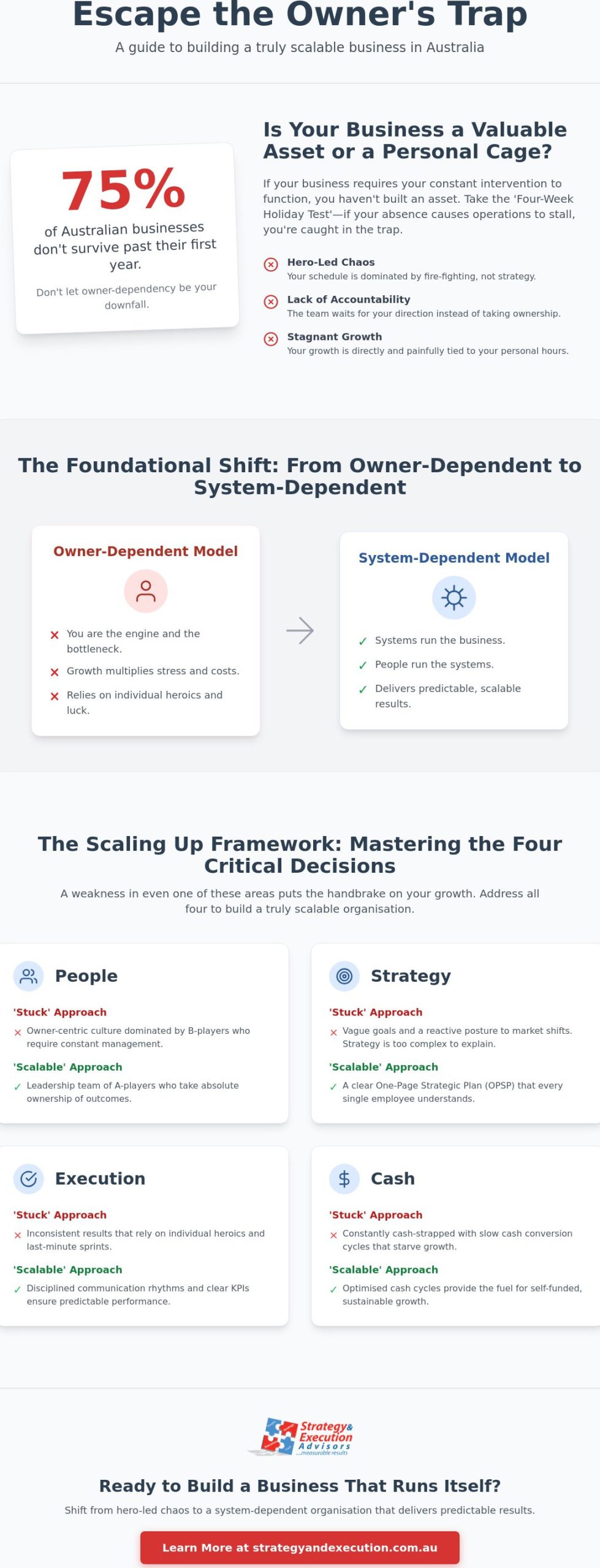
Automation is useless if your underlying foundation is cracked. True scalability requires more than just software; it requires a proven framework for scaling your business. For Australian mid-market leaders, the Verne Harnish ‘Scaling Up’ framework serves as the definitive blueprint. It forces you to confront four critical decisions: People, Strategy, Execution, and Cash. If you have a weakness in even one of these areas, you’ve effectively pulled the handbrake on your growth. A business with a brilliant strategy but poor execution is simply a hallucination.
| Decision | The ‘Stuck’ Approach | The ‘Scalable’ Approach |
|---|---|---|
| People | Owner-centric; dominated by B-players. | Led by A-players; high accountability. |
| Strategy | Vague goals; reactive to market shifts. | Clear One-Page Strategic Plan (OPSP). |
| Execution | Relies on individual heroics; inconsistent. | Disciplined rhythms; clear KPIs. |
| Cash | Cash-strapped; slow conversion cycles. | Optimised cycles; self-funded growth. |
People and Strategy: The ‘Who’ and the ‘What’
Examine your leadership table with brutal honesty. You cannot achieve 10x growth with a team that struggles to manage your current volume. Building a scalable business model starts with A-players who take absolute ownership of outcomes. Your strategy must then be distilled into a One-Page Strategic Plan (OPSP) that every employee understands. Identify your core competency and protect it fiercely. If your team cannot articulate your competitive advantage in 30 seconds, your strategy is too complex. Complexity is the enemy of scale. Structuring that competitive advantage across every layer of your business is precisely what the scaling up 7 strata of strategy framework is designed to achieve.
Execution and Cash: The ‘How’ and the ‘Fuel’
Execution is where most Australian businesses fail. Implement the ‘Power of One’ to identify the 1% changes in pricing, volume, or costs that create massive shifts in net profit. Discipline in execution creates the freedom to lead. Remember that scaling consumes cash; it is the fuel for your growth engine. You must optimise your Cash Conversion Cycle (CCC) to ensure you aren’t growing yourself into insolvency. For leaders ready to apply these disciplines with rigour, the Scaling Up Program Australia offers a systematic path forward. If your current growth feels like a constant uphill battle, it’s time to speak with a strategist about your execution framework.
Implementation: Establishing Rhythms for Exponential Growth
Strategy is only as good as its execution. Building a scalable business model requires a shift from accidental growth to a disciplined, rhythmic operation. The Rockefeller Habits provide the 10 essential disciplines necessary to ensure your strategy doesn’t just sit on a shelf. These habits create a framework for accountability that most Australian mid-market firms lack. Without a structured communication rhythm, your organisation will naturally descend into silos and fire-fighting.
Scaling requires you to move beyond linear thinking. Adopting ‘Exponential Organisation’ (ExO) principles allows you to leverage external assets and data to grow without the traditional burden of heavy overheads. Simultaneously, you must master ‘The Power of One’. This involves adjusting seven key financial levers, such as price, volume, and accounts receivable, to dramatically increase your cash flow and business valuation. Small, disciplined adjustments in these areas often yield more significant results than a massive increase in sales effort.
The 90-Minute Weekly Meeting Rhythm
Alignment is the primary driver of organisational speed. If your leadership team isn’t meeting regularly to solve obstacles, you aren’t moving fast enough. Implementing a structured Rockefeller Habits Weekly Meeting Agenda ensures your team remains focused on quarterly priorities rather than daily distractions. This 90-minute session is designed to identify “stuck” issues and resolve them before they become crises. It replaces the culture of endless, aimless emails with a culture of decisive action.
Your 2026 Scalability Roadmap
Your transition to a scalable model follows a proven sequence. First, audit your leadership team to ensure you have A-players in every key seat. Second, define your Big Hairy Audacious Goal (BHAG) to provide a 10-year north star for every decision. Third, master the daily huddle to maintain operational momentum and clear bottlenecks in real time. For executive teams in Queensland looking to translate strategy into operational results, a business strategy workshop Brisbane provides the structured environment to build a one-page roadmap and install the execution rhythms that actually stick. Discipline is the bridge between goals and accomplishment, and for many, michelboutinstudio provides the executive coaching necessary to navigate this journey toward strategic freedom by 2026.
Theory alone won’t transform your results. Attend our upcoming events in Brisbane or Adelaide for hands-on training with seasoned strategists. If you’re ready to stop being the bottleneck and start building a self-sustaining asset, contact Strategy & Execution today to begin your implementation plan.
Transition from Operational Heroics to Strategic Growth
Stagnation is a choice. You can continue to act as the bottleneck in your organisation, or you can commit to the structural discipline required for building a scalable business model. Real growth doesn’t happen by accident; it’s the result of rigorous systems and the Four Critical Decisions. To explore how to move beyond traditional extractive models, you can discover Jannine Barron and her regenerative business strategies. You’ve seen how owner-dependency limits your potential. Now, you must implement the rhythms that ensure your team remains aligned and accountable without your constant intervention.
Theory is a start, but execution is the finish line. At Strategy & Execution, we bring over 20 years of experience in the Australian mid-market to help you bridge that gap. As certified Scaling Up and Rockefeller Habits practitioners, we’ve delivered proven results for leadership teams across Brisbane and Adelaide. We don’t offer quick fixes; we provide the architectural blueprint for an organisation that runs on systems, not heroics. Stop fire-fighting and start leading with intent.
Start building your scalable execution plan today with Strategy & Execution. Your future asset depends on the decisions you make today. Let’s get to work.
Frequently Asked Questions
What is the difference between business growth and business scaling?
Growth is a linear increase where revenue and expenses rise in tandem. Scaling is the capacity to increase revenue at a significantly faster rate than your operating costs. In a growth model, you might require a new staff member for every $200,000 in revenue. In a scalable model, your existing systems and technology absorb the extra volume without a corresponding headcount surge.
How do I know if my current business model is actually scalable?
Your model is scalable if your gross margins improve as your volume increases. If every new client requires a bespoke solution that relies on your personal expertise, you’re trapped in a professional services bottleneck. Building a scalable business model requires productising your service so that delivery remains consistent and profitable regardless of which team member is performing the task.
Do I need a massive capital injection to scale my Australian business?
External capital isn’t always the answer. Many Australian firms grow themselves into insolvency by ignoring their internal cash conversion cycle. By focusing on the “Power of One” and tightening your accounts receivable and inventory management, you can often fund your own expansion internally. Sustainable scale is built on operational efficiency rather than a constant reliance on high-interest debt or equity dilution.
What are the first steps to implementing Scaling Up in a mid-market company?
Start by aligning your executive team around the Four Critical Decisions: People, Strategy, Execution, and Cash. Your first practical step is to document your One-Page Strategic Plan (OPSP) to ensure every leader is moving in the same direction. From there, establish a daily huddle to create a fast-paced communication rhythm that identifies and resolves bottlenecks before they stall your organisational momentum.
Need Help Turning Strategy Into Results?
Let’s talk about your goals and how we can help you move forward with clarity and confidence.
